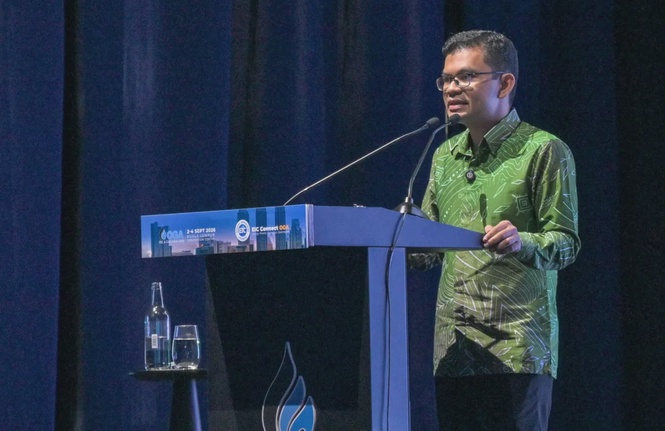
KUALA LUMPUR: Malaysia can leverage its existing oil and gas expertise, infrastructure and resources to position itself as a provider of low-carbon solutions across Asean and Japan.
Economy Minister Akmal Nasrullah Mohd Nasir said Malaysia should build on its existing strengths rather than develop new industries from scratch, particularly as the energy transition creates opportunities for oil, gas and energy services and equipment (OGSE) companies.
“Since Malaysia has this kind of advantage, the leverage that we have is not going to just position Malaysia in this Asean region, but also up to Japan,” he said during a fireside chat at Oil & Gas Asia 2026 here today.
Akmal Nasrullah said Malaysia already had the foundation to venture into carbon capture and storage (CCS), including existing facilities, wells and engineering expertise developed over decades in the oil and gas industry.
“When we ventured into CCS, it was not just a dream or concept that we were trying to prove could work. We have the right ingredients, capabilities and expertise to make it work.”
The challenge was to optimise those capabilities and turn them into solutions that could be applied in other markets. Akmal Nasrullah said. “We can actually look at our existing strength and how to manipulate it for the benefit of the industry and actually to unlock more potential for OGSE.”
Malaysian players, he said, had an advantage through their practical, hands-on experience in the oil and gas industry, but needed to combine that knowledge with expertise from other fields.
Digitalisation, in particular, could help companies develop higher-value solutions by bringing together field expertise and digital capabilities.
“People working on the ground need greater exposure to digital expertise. The OGSE companies that can successfully combine their technical capabilities with digital solutions will be better positioned to move ahead of the competition,” Akmal Nasrullah said.
Combining different areas of expertise could enable Malaysian companies to become full-solution providers for the energy industry.
“It is about bringing together different strengths and expertise across disciplines to create a more comprehensive capability, enabling companies to become full-solution providers even in a complex sector such as oil and gas.”
Akmal Nasrullah that CCS remained costly and technically challenging, but said Malaysia needed to begin developing the capability while exploring regional cooperation.
He cited Malaysia’s experience in cross-border energy cooperation, including the Malaysia-Thailand Joint Development Area, as an example of how regional collaboration could unlock resources and opportunities. He also pointed to Malaysia’s cooperation with Vietnam and Petroliam Nasional Bhd (Petronas) activities in Turkmenistan as evidence that Malaysian companies could pursue opportunities beyond the domestic market.
“The way I look at it with Malaysia’s experience and Malaysia’s talents, we are actually something valuable to the world,” he said.
Akmal Nasrullah said the energy transition should be viewed as an opportunity to restructure Malaysia’s economy towards higher-value activities.
“When we talk about energy, particularly the energy transition, I see it as more than just an energy issue. From a broader macroeconomic perspective, it presents an opportunity for us to look beyond the energy sector and use the transition as a catalyst to restructure and strengthen our economy.”
Malaysia’s experience in using gas to develop downstream industries demonstrated how an energy resource could generate wider economic spillovers, the minister said, citing Kerteh as an example of industrial development built around the country’s energy strengths.
The next step, was to translate those energy and industrial capabilities into technology, innovation and proprietary solutions while creating better opportunities for highly skilled Malaysian talent.
Ultimately, Akmal Nasrullah said, Malaysia needed to turn its finite oil and gas resources into capabilities that could endure after those resources were depleted.
Malaysia’s long-term legacy should not rest solely on Petronas, but also on local OGSE companies establishing themselves as globally recognised solution providers.
“Our legacy should be to show that, despite being a relatively small country blessed with oil and gas resources, Malaysia can build world-class capabilities. The pride of the nation should not rest solely on Petronas, but also on our OGSE players, who can take Malaysian solutions beyond our borders and be recognised among the leading players globally,” Akmal Nasrullah said.