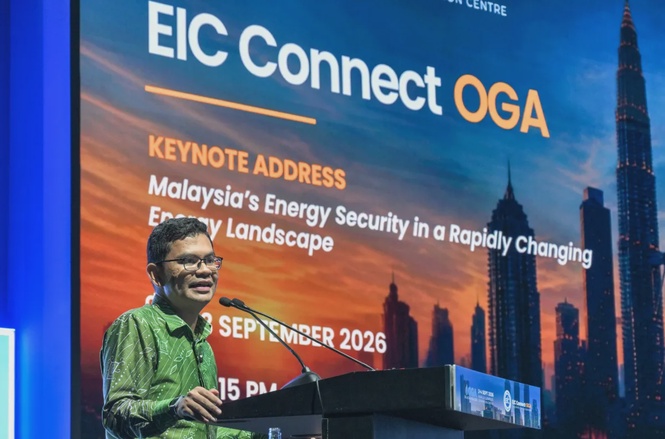
KUALA LUMPUR: Malaysia’s oil, gas and energy services and equipment (OGSE) companies must move beyond the domestic market and turn decades of industry experience into exportable solutions.
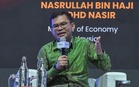
Economy Minister Akmal Nasrullah Mohd Nasir said local OGSE players should develop technology and proprietary solutions that can be commercialised internationally.
“My wish is actually for the industry to remain not just at the ability to operate, to provide technical solutions, or to really resolve the issues on the ground, but it’s more like how can we move and provide technical solutions beyond the borders,” Akmal Nasrullah said during a fireside chat at Oil & Gas Asia 2026 today.
He said Malaysia had accumulated significant hands-on expertise through five decades of developing its oil and gas industry, but the next challenge was to convert that knowledge into higher-value products and services.
“When we talk about the technologies nowadays, definitely the advantage of ourselves, we are very hands-on. I think the players are really involved in the industry and try to resolve the operational issues. And the next challenge is how to transform that knowledge to become part of our solution that can be sold all over the world.”
Akmal Nasrullah said this would require OGSE companies to embrace digitalisation and combine their existing technical capabilities with expertise from other fields.
“People working on the ground need greater exposure to digital expertise. The OGSE companies that can successfully combine their technical capabilities with digital solutions will be better positioned to move ahead of the competition.”
Combining different areas of expertise could enable Malaysian companies to become full solution providers for the energy industry, he said. “It is about bringing together different strengths and expertise across disciplines to create a more comprehensive capability, enabling companies to become full-solution providers even in a complex sector such as oil and gas.”
Akmal Nasrullah said the opportunity for OGSE companies extended beyond conventional oil and gas activities as Malaysia was undergoing its energy transition.
He said the transition should not be viewed solely as an effort to change the country’s energy mix, but as an opportunity to restructure the economy and create higher-value industries.
“When we talk about energy, particularly the energy transition, I see it as more than just an energy issue. From a broader macroeconomic perspective, it presents an opportunity for us to look beyond the energy sector and use the transition as a catalyst to restructure and strengthen our economy.”
He said Malaysia had previously leveraged its natural gas resources to build an industrial ecosystem, with Petronas and local industrial players helping turn the resource into an engine of economic growth.
“Over the past 50 years, the industry has evolved from leveraging our natural resource base to building stronger capabilities, industries and supporting ecosystems around it. This evolution has created opportunities for our OGSE players to grow, adapt and remain relevant within the energy sector.”
However, Akmal Nasrullah said, the industry could not remain complacent with the ecosystem built around Malaysia’s existing resources and infrastructure.
“We cannot just remain complacent with the resource that we have, the infrastructure that we have been building,” he said. “The next resilience is really about putting our position in this more complex economy, how to be part of the higher value chain.”
Under this approach, he said, the energy transition could create opportunities in areas including carbon capture and storage (CCS), while Malaysia’s existing oil and gas capabilities could provide a foundation for the industry.
“When we decided to venture into CCS, it was not simply a dream or concept that we were trying to sell. We have the capabilities, expertise and resources needed to make CCS commercially viable and turn it into a reality.”
The Economy minister said Malaysia already had facilities, wells and expertise that could potentially be repurposed for CCS.
“In terms of facilities, including existing wells that can be repurposed for CCS, we already have the infrastructure in place. As for the expertise required to support the process, much of it involves applying our existing capabilities in a different way.”
Akmal Nasrullah acknowledged that CCS remained costly and technically challenging, but said Malaysia should begin pioneering the technology while exploring regional cooperation. “CCS remains costly and technically challenging, but we need to start pioneering the technology, developing the necessary capabilities and exploring its potential as part of the energy transition.”
Malaysia’s existing strengths could ultimately allow local companies to become solution providers beyond the domestic market and potentially serve customers across the region.
“The capabilities we have can position Malaysia not only within Asean, but also as a strategic partner to markets such as Japan. By developing into a solutions provider, we can open the door for Malaysia to play a more instrumental role in advancing the low-carbon transition across the region,” Akmal Nasrullah said.
He added that bringing more gas into Peninsular Malaysia would create further opportunities for the industry, particularly in infrastructure and skills.
“As we require more gas from overseas, RGTP will become an important part of our pipeline. This will also create opportunities for the development of new infrastructure and capabilities, as well as demand for different skill sets across the industry.”
Gas, Akmal Nasrullah said, would continue to play a role during Malaysia’s energy transition, with the country needing to maintain reliable baseload supply while diversifying its energy sources and pursuing lower-carbon solutions.
“When we look at the opportunities in gas, remaining competitive is critical, particularly given the increasing complexity of the global energy landscape. That means ensuring reliability and being precise and competitive in the solutions and value we offer.”
For the OGSE industry, however, Akmal Nasrullah said, the challenge was ultimately one of scale and appetite to compete beyond Malaysia.
“Among our OGSEs, are they up for a game to go abroad?” he said. “The issue is how to scale us up then.”
Petroliam Nasional Bhd (Petronas) would continue to provide an important domestic ecosystem for local players, but companies needed to be willing to leave their comfort zone, Akmal Nasrullah said.
“I am not suggesting that we move away from Petronas. We definitely need to remain part of that ecosystem, but we also need to ask whether our OGSE companies are ready and willing to take their capabilities beyond Malaysia and compete in international markets.”
Malaysian OGSE players, Akmal Nasrullah said, had already demonstrated that their capabilities could meet international standards.
“I am betting that what we do here is up to the international standard,” he said. “The issue is how to scale us up then.”
Akmal Nasrullah said the transition towards higher-value activities was also important for retaining Malaysian talent and creating better-paying jobs.
The country needed to move beyond simply having resou
rces and infrastructure towards building technology, innovation and proprietary capabilities.
“For the past 50 years, we have been blessed with resources, and we also really rely on industrialisation,” he said.
“But moving forward, I think the values are actually beyond having that strength.”
“The value of so-called prosperity lies in, for example, the technology, the innovation that we need to embark on, and definitely in terms of having that propriety.”
Ultimately, Akmal Nasrullah said, Malaysia needed to turn its finite oil and gas resources into capabilities that could endure after those resources were depleted.
“When we talk about the natural gas, it’s going to be obsolete. I mean, depleted, It’s something how do you transform or translate this resource into something more enduring.”
He said Malaysia’s future success should not rest solely on Petronas, but also on whether its OGSE companies could establish themselves as globally recognised solution providers.
“I believe the legacy we should leave is to prove that, although Malaysia is a relatively small country blessed with oil and gas resources, we can build capabilities that bring pride to the nation.
“That pride should not rest solely on Petronas, but also on our OGSE companies, which can develop solutions that go beyond our borders and earn recognition among the world’s leading players,” Akmal Nasrullah said.