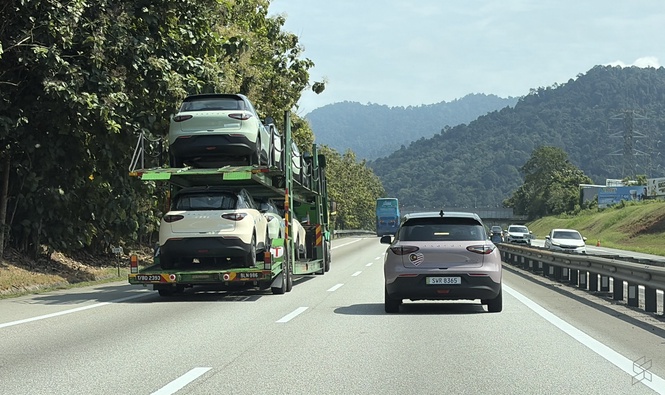
Malaysia recorded 4,592 new electric vehicle (EV) registrations in October 2026, marking a significant slowdown after a strong performance earlier this year.
According to the latest vehicle registration data from the Road Transport Department (JPJ), EV registrations fell 23.8% month-on-month from 6,029 units in September. This makes October the second-lowest month for EV registrations in 2026, after February, which recorded 3,635 units.
Despite the sharp monthly decline, EV registrations were still 5.7% higher year-on-year compared to October 2025, when 4,345 units were registered.
Meanwhile, Proton continues to dominate Malaysia’s EV market, capturing 61.3% of total EV registrations in October, largely driven by the Proton e.MAS 5.
Interestingly, petrol hybrid registrations also exceeded EV registrations in October, with 5,023 units compared to 4,592 fully electric vehicles.
EV registrations account for 6.12% of TIV in October 2026
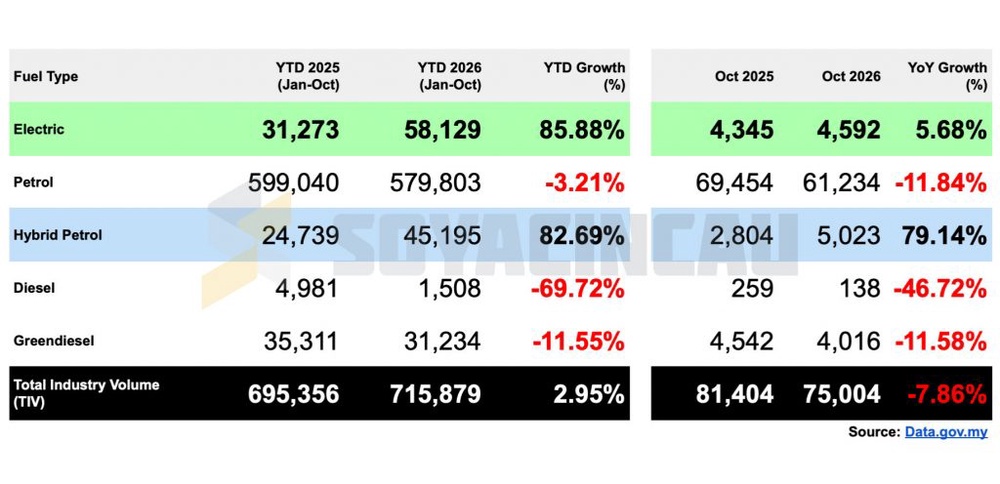
A total of 75,004 vehicles were registered in Malaysia in October 2026, representing a 7.9% decline compared to 81,404 units in October 2025.
EVs accounted for 6.12% of total industry volume (TIV), down from 8.12% in September. This is significantly lower than the record 11.43% EV market share achieved in August 2026.
However, overall vehicle registrations actually increased slightly by 1.0% month-on-month, from 74,259 units in September to 75,004 units in October.
Despite the overall TIV decline year-on-year, EV registrations still managed to grow by 5.7%. In contrast, petrol-powered vehicles recorded 61,234 registrations in October, down 11.8% year-on-year. Diesel registrations also declined, with conventional diesel falling 46.7% to 138 units, while green diesel registrations dropped 11.6% to 4,016 units.
Interestingly, petrol hybrid registrations exceeded EV registrations in October, with 5,023 units compared to 4,592 EVs. Hybrid registrations jumped 79.1% year-on-year from 2,804 units in October 2025, significantly outperforming EV growth.
Among the leading petrol hybrid models registered in October were the Toyota Yaris Cross at #1 with 720 units, followed by the Proton e.MAS 7 PHEV at #2 with 710 units, Toyota Corolla Cross at #3 with 644 units and Toyota Vios at #4 with 596 units.
For the first ten months of 2026, EV registrations still exceed petrol hybrids with 58,129 units versus 45,195 units.
Malaysia’s Top 30 EVs in October 2026
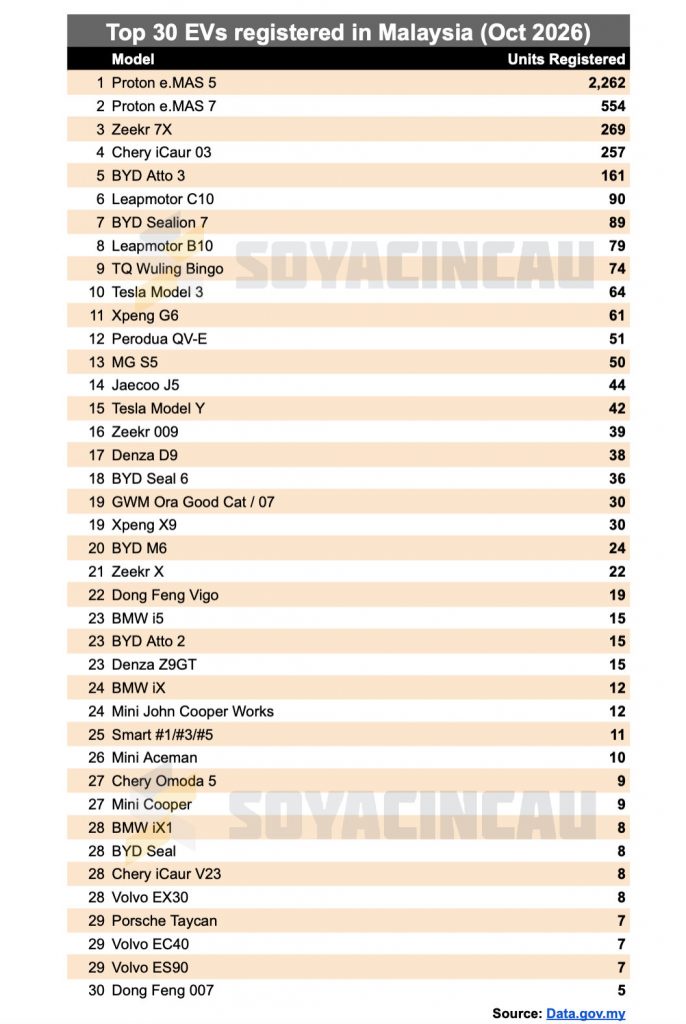
The Proton e.MAS 5 remained Malaysia’s most registered EV in October 2026, recording 2,262 units. Although this represents a 9.2% decline from September’s 2,490 units, the affordable electric hatchback still accounted for 49.3% of all EV registrations during the month.
The Proton e.MAS 7 EV came in second with 554 registrations, followed by the Zeekr 7X with 269 units. The Chery iCaur 03 took fourth place with 257 registrations, ahead of the BYD Atto 3 with 161 units.
Tesla and BYD were among the brands that experienced a significant slowdown in October. Tesla’s Model 3 recorded just 64 units, down from 325 in September, while the Model Y fell from 378 to 42 units.
Combined, Tesla registered only 106 vehicles in October, compared to 703 units in September, representing an 84.9% month-on-month decline.
BYD also saw its registrations fall from 615 units in September to 333 units in October, a decline of 45.9%. Its best-performing model was the Atto 3 with 161 units, followed by the Sealion 7 with 89 units.
The weaker performance of both brands could be linked to stock availability and shipment timing.
Interestingly, the Perodua QV-E managed to register more units than the Tesla Model Y in October. Perodua recorded 51 QV-E registrations, placing it 12th, while the Tesla Model Y managed just 42 units in 15th place.
However, the QV-E’s October registrations were down 40.7% from 86 units in September.
Malaysia’s Top 30 EVs for January to October 2026
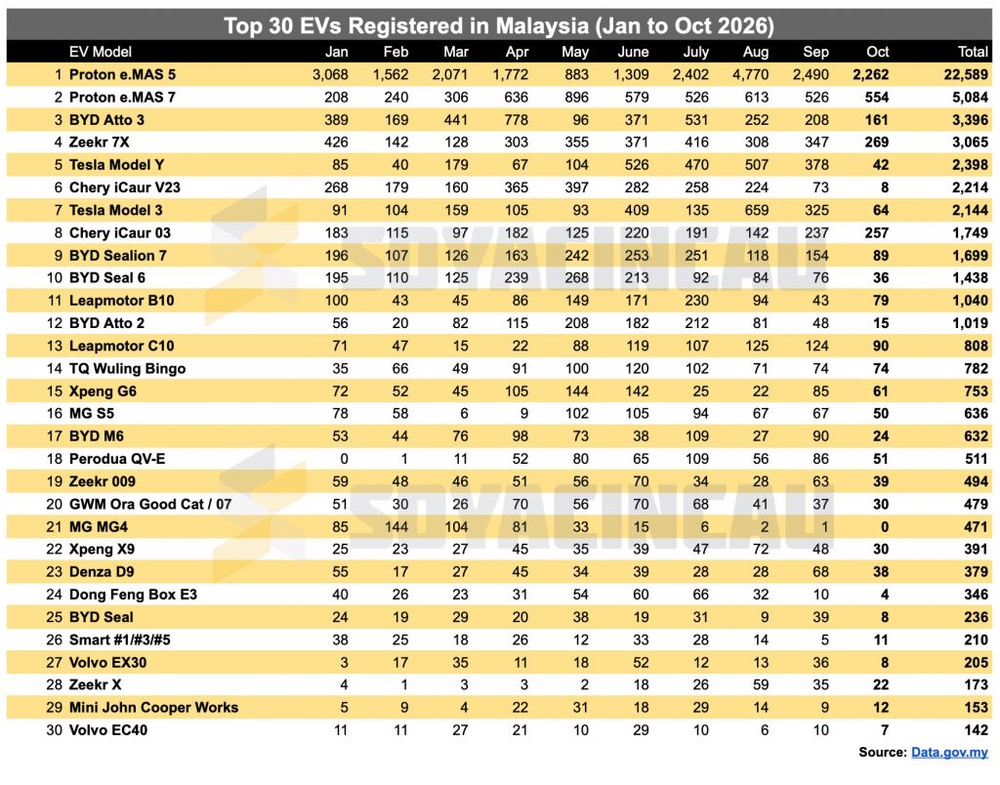
Despite October’s weaker performance, Malaysia recorded 58,129 EV registrations between January and October 2026, representing an 85.9% increase compared to 31,273 units during the same period last year.
This has already surpassed the full-year 2025 EV registration total of 44,813 units by 29.7%, setting a new annual record with two months remaining in 2026.
EVs accounted for 8.12% of total vehicle registrations between January and October 2026, compared to approximately 4.5% during the same period in 2025. Meanwhile, total industry volume stood at 715,879 units, up 3.0% year-on-year.
Looking at cumulative EV model registrations, the Proton e.MAS 5 still dominates in first place with 22,589 units. That’s more than four times the registrations of the second-place Proton e.MAS 7, which recorded 5,084 units.
The BYD Atto 3 ranks third with 3,396 registrations, followed by the Zeekr 7X with 3,065 units.
Despite its weak October performance, the Tesla Model Y remains fifth with 2,398 registrations, followed by the Chery iCaur V23 with 2,214 units and the Tesla Model 3 with 2,144 units.
The Chery iCaur 03 has also overtaken the BYD Sealion 7 in the cumulative rankings, with 1,749 registrations compared to 1,699 units.
Top 20 EV brands for January to October 2026
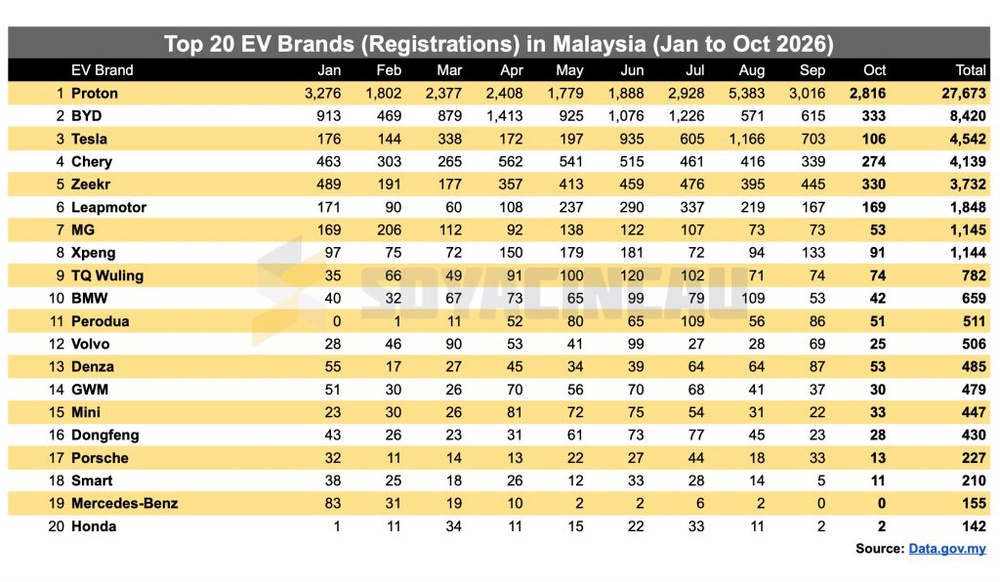
Proton e.MAS remains Malaysia’s leading EV brand with 27,673 registrations between January and October 2026, representing 47.6% of the EV market.
BYD follows in second place with 8,420 units, while Tesla takes third place with 4,542 units.
Chery, including its iCaur models, ranks fourth with 4,139 registrations, followed by Zeekr with 3,732 units.
Leapmotor takes sixth place with 1,848 registrations, followed by MG with 1,145 units and Xpeng following very closely behind with 1,144 units.
TQ Wuling ranks ninth with 782 registrations, while BMW completes the top ten with 659 units.
Can Malaysia sustain EV growth without additional incentives?
Although October recorded a sharp decline in EV registrations compared to previous months, Malaysia’s EV market continues to show strong year-on-year growth, with registrations up 85.9% in the first ten months of 2026.
What’s interesting is that this growth has been achieved without additional EV-centric incentives which ended in 2025. Meanwhile, the government has increased the subsidised RON95 petrol quota under BUDI95 to 300 litres per month, providing continued support for petrol vehicle users. During the recent tabling of Budget 2027, there were no notable EV-centric incentives announced to help accelerate transition from petrol and diesel to electric vehicles.
At the same time, Malaysia’s revised CBU EV import requirements have made it more challenging for brands to introduce competitively priced fully imported electric models.
One positive development is BYD’s recent confirmation that it will partner with Inokom in Kulim for local assembly. This provides some hope that the Chinese EV giant can continue offering more affordable electric models in Malaysia once CKD production begins. However, their locally produced models could be limited to the minimum price of RM100,000.
With two months remaining in 2026, the question is whether EV registrations can regain momentum towards the end of the year, especially as brands adjust their product strategies and prepare for a market that focuses on locally assembled EVs.