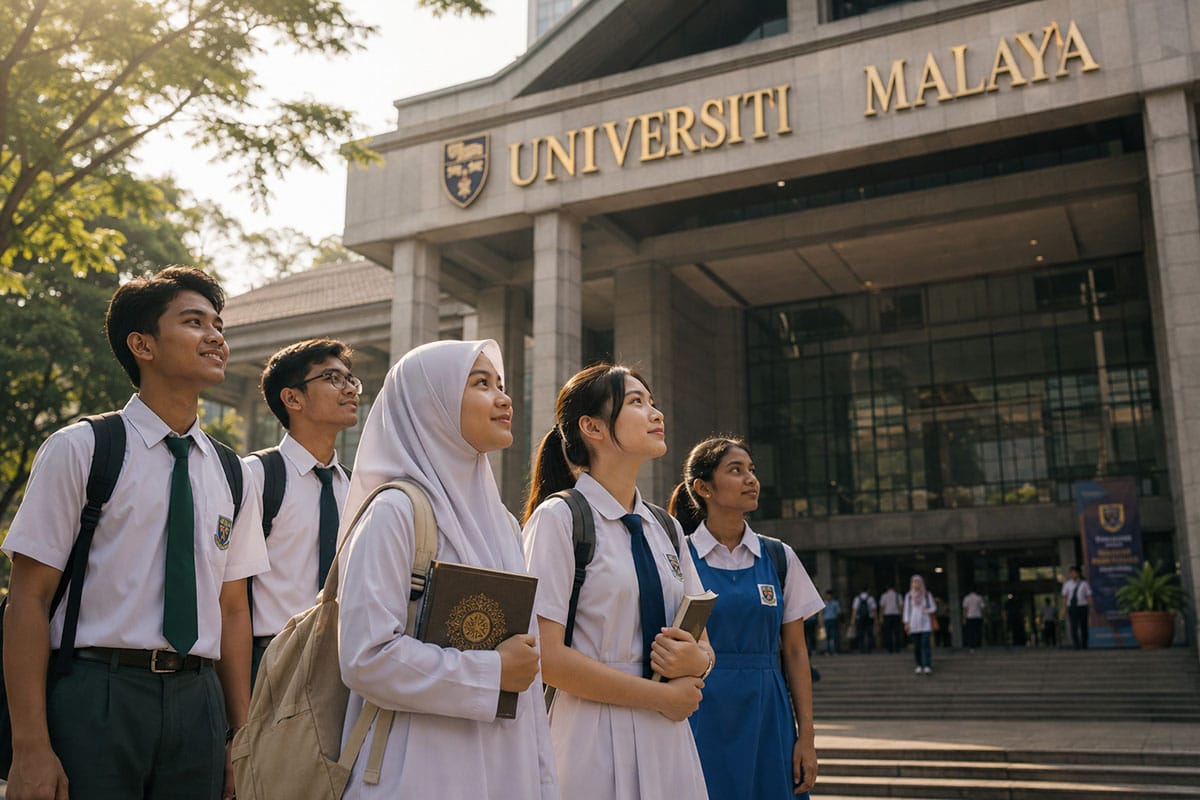
Malaysia's education system has just made a significant policy shift. Quietly, without the fanfare you might expect for a decision that has been decades in the making, the Cabinet approved new admission pathways into public universities for students from outside the national education stream, tahfiz graduates, Chinese independent school students with the Unified Examination Certificate, and those from private schools.
This is big. And it is complicated. And depending on which side of the political spectrum you sit on, it is either a long overdue act of inclusion or a dangerous dilution of meritocracy.
But I want to make a different argument altogether. Because the debate everyone is having is not quite the debate we should be having.
What Was Actually Decided
Let me be clear about what this policy actually says, because the social media version has been considerably more dramatic than the reality.
The Ministry of Higher Education announced two distinct pathways. The first pathway is for students from these non-mainstream streams who also have a full SPM certificate. They can apply through the existing UPUOnline system, competing on merit alongside every other SPM student. Nothing special. No shortcuts. Same queue.
The second pathway is the new one. For students without a full SPM but who have passed the SPM papers for Bahasa Melayu and History, a limited selection of specific programmes becomes accessible. For tahfiz graduates, those programmes are Dakwah, Al-Quran and As-Sunnah studies, Tahfiz Education, and Islamic Studies. For UEC graduates from Chinese independent schools, the programmes are Chinese Language Studies, Chinese Language and Linguistics, Chinese Studies, and Chinese Language with Education.
Three public universities are currently identified for these new pathways: University Malaya, Universiti Putra Malaysia, and Universiti Pendidikan Sultan Idris. Applications open on June 30. Students admitted through these pathways are eligible for government education subsidies and financial aid.
PM Anwar confirmed this morning that the policy is still being fine-tuned, emphasising that the Bahasa Melayu and History requirement is non-negotiable, and that access begins with selected courses before potentially expanding further.
What This Is Not
Before the outrage machine runs too hot, a few things worth noting.
This is not a back door. As The Rakyat Post pointed out, UEC graduates who want to enter programmes like medicine, engineering, or law still need to compete based on SPM results. Those critical programmes are not part of this new pathway. The programmes available are narrow and field-specific, Chinese language programmes for UEC students, Islamic studies programmes for tahfiz graduates. Nobody is getting a shortcut into medicine or engineering through this route.
This is also not new. Similar limited pathways have existed in various forms since 2012. What has changed is the formalisation and expansion of the framework, and the explicit Cabinet-level endorsement.
And this is not a full recognition of UEC. The Higher Education Director-General was explicit about this: the new pathway is not a recognition of the UEC syllabus. It is simply an additional route in. The UEC itself remains unrecognised as an equivalent to SPM for the purposes of general university admission.
Chinese independent school associations have called it half-hearted. They are not entirely wrong. But half a door open is still more than a closed door, which is where things stood for a long time.
The Question Nobody Is Asking
Here is where I want to step back from the political argument and say something that might be slightly uncomfortable.
The condition set for the new pathway. Pass Bahasa Melayu and History at SPM level makes political sense. It signals national belonging. It says you may come from outside the mainstream system, but you must demonstrate a baseline of national language proficiency and civic knowledge before entering a publicly funded institution.
I understand the logic. I even think it is defensible as a policy position.
But is it the right test for university readiness in 2026?
I have two young boys who are not yet at SPM age. When I think about what will actually matter for their futures, what will open doors for them in the workforce, what will allow them to compete not just locally but regionally and globally, it is not History. It is English.
English is the language of academic research. It is the language of technology, of international business, of medicine, engineering, law, and virtually every other professional field that Malaysian graduates will eventually enter. A student who cannot function in English will struggle in university regardless of their BM grade, because the textbooks, the journals, the case studies, and increasingly the lectures themselves are in English.
Malaysia's English proficiency has been a persistent concern for employers and educators alike. Graduate unemployment in Malaysia consistently shows that weak communication skills, particularly in English, are among the top reasons fresh graduates struggle to find work. This is not a new observation. It has been made repeatedly for decades, by the same universities that are now being asked to admit students from diverse educational backgrounds.
If the gatekeeping condition for non-mainstream students entering public universities is designed to ensure they are ready for university-level study, a credit in English would arguably do that job more effectively than a pass in History.
I am not saying remove the Bahasa Melayu requirement. National language proficiency in a public institution is a reasonable expectation. But adding English as a mandatory condition rather than an optional one would send a clearer signal about what Malaysian universities actually need their students to be capable of when they arrive.
The Bigger Picture Worth Celebrating
Setting aside my English argument for a moment, this policy direction is fundamentally the right one.
Malaysia has always had a diverse educational landscape. Tahfiz schools produce graduates with remarkable memory, discipline, and religious depth. Chinese independent schools produce graduates with strong academic foundations, particularly in mathematics and sciences, that have been internationally validated. Private school graduates come with a variety of strengths depending on their curriculum.
Telling all of these students that the doors of public universities are simply not available to them, regardless of their abilities, is a waste of human potential that Malaysia can ill afford, particularly given the tech talent shortage and the broader economic challenges we have been discussing all week.
The new pathways are narrow. The programmes available are limited. The policy is still being fine-tuned, as the PM himself acknowledged this morning. But the direction of travel, more inclusivity within a framework of clear conditions, is correct.
The debate should now shift from whether to open the doors to how to open them more effectively. And in that debate, I would argue that English proficiency deserves a seat at the table alongside Bahasa Melayu and History.
My Take
I believe in an education system that is genuinely inclusive without abandoning standards. These two things are not mutually exclusive, despite what both extremes of this debate will tell you.
A tahfiz graduate who has memorised the Quran and passed BM and History deserves a pathway to study Islamic education at a public university. A UEC graduate from a Chinese independent school who scored brilliantly in mathematics and science and passed BM and History deserves a pathway to contribute to Malaysian academia and industry.
But if we are serious about preparing all of these students for the reality of a Malaysian university and a Malaysian job market, we should be honest about what that reality actually demands of them.
It demands English. And the sooner our education policies say that out loud rather than dancing around it, the better off all Malaysian students from every stream will be.
Kamarul Azwan (k.azwan@gmail.com) is a content creator under the Newswav Creator programme, where you get to express yourself, be a citizen journalist, and at the same time monetize your content & reach millions of users on Newswav. Log in to creator.newswav.com and become a Newswav Creator now!
The User Content (as defined on Newswav Terms of Use) above including the views expressed and media (pictures, videos, citations etc) were submitted & posted by the author. Newswav is solely an aggregation platform that hosts the User Content. If you have any questions about the content, copyright or other issues of the work, please contact creator@newswav.com.