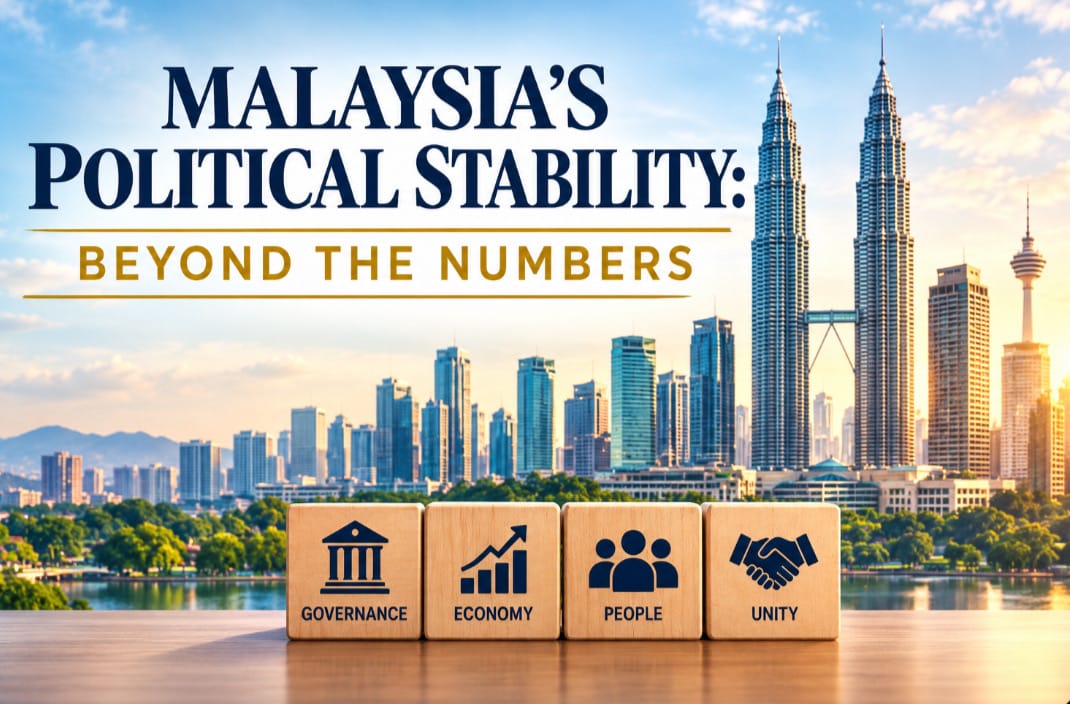
Malaysia’s Budget 2027: Can Political Stability Improve Ordinary Lives?
A government can remain in power and still struggle to convince ordinary Malaysians that their lives are improving. That is why Budget 2027 deserves to be examined beyond its headline allocation and political implications.
Tabled by Prime Minister Anwar Ibrahim on 9 October, the RM459.84 billion Budget raises a fundamental question: can political stability translate into tangible improvements in people’s lives?
Since the November 2022 general election produced a hung Parliament, Anwar’s unity government has brought together parties with competing political interests. Its survival has provided continuity, but longevity alone does not demonstrate public satisfaction or effective governance.
The Budget allocates RM83 billion for development expenditure, while more than RM80 billion is earmarked for subsidies, assistance and incentives. Combined allocations for Sumbangan Tunai Rahmah (STR) and Sumbangan Asas Rahmah (SARA) rise to RM16 billion.¹ These measures offer immediate relief, but their success depends on whether assistance reaches those who need it most and keeps pace with living costs.
The proposed minimum-wage increase from RM1,700 to RM2,000, effective June 2027, is another important measure. The government has also proposed a minimum starting salary of RM2,500 for semi-skilled workers and graduates, alongside expanded personal income tax relief.² These initiatives could improve household finances, although higher wages must be accompanied by stronger productivity, better employment opportunities and more affordable housing.
However, economists have questioned whether the Budget does enough to address persistently low wages, gaps in assistance and high operating expenditure.³ Such concerns deserve attention. Cash transfers can cushion financial pressures, but they cannot substitute for sustainable income growth, quality jobs and more efficient public spending.
Fiscal discipline presents another challenge. The government targets a fiscal deficit of 3.3% of gross domestic product in 2027, down from an estimated 3.6% in 2026.⁴ Achieving this reduction while maintaining assistance and financing development will require disciplined expenditure, stronger revenue collection and transparent oversight.
Governance reform is equally important. Anwar has announced plans for legislation to strengthen oversight of government-owned companies and statutory bodies, aiming to prevent a recurrence of scandals involving public assets.⁵ The proposal is welcome, but its credibility will depend on enforcement, accountability and institutional independence.
Political stability should enable difficult reforms, not insulate policymakers from criticism. Parliamentary scrutiny, an effective opposition and transparent implementation remain essential to democratic accountability.
Ultimately, Budget 2027 should be judged by measurable outcomes rather than its size or the number of initiatives announced. Rising household purchasing power, better employment prospects, improved public services and stronger institutions would provide more convincing evidence of progress than political longevity alone.
As Malaysia approaches its next general election, the central question remains: can political stability deliver inclusive growth and restore public trust? The answer will determine whether this period becomes a foundation for lasting democratic progress or merely an interval between political contests.
Footnotes and sources
- Free Malaysia Today, “2027 budget: the key highlights”, 9 October 2026.
- Bernama, “Budget 2027: A National Covenant For A Better Life For The People”, 9 October 2026.
- Free Malaysia Today, “It’s an election budget, say economists”, 9 October 2026.
- Reuters, “Malaysia to lift minimum wages, expand tax relief in $112.5 billion 2027 spending boost”, 9 October 2026.
- Free Malaysia Today, “Putrajaya plans law to tighten oversight of govt-owned firms”, 9 October 2026.Email : salleh35@gmail.com
Healthy LifeSTYLE (salleh35@gmail.com) is a content creator under the Newswav Creator programme, where you get to express yourself, be a citizen journalist, and at the same time monetize your content & reach millions of users on Newswav. Log in to creator.newswav.com and become a Newswav Creator now!
The User Content (as defined on Newswav Terms of Use) above including the views expressed and media (pictures, videos, citations etc) were submitted & posted by the author. Newswav is solely an aggregation platform that hosts the User Content. If you have any questions about the content, copyright or other issues of the work, please contact creator@newswav.com.