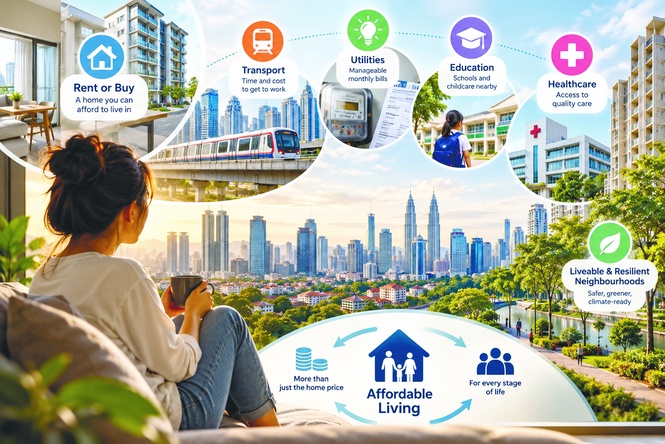
FOR many Malaysians, affordability is no longer just about buying a home. It is about whether the home they can access, rented or owned, is one they can realistically afford to live in.
This distinction matters as Budget 2027 takes shape. The Finance Ministry’s Pre-Budget Statement places homeownership and rental affordability alongside public transport, urban liveability, and wider household cost pressures, from transport to healthcare, education, and childcare.
For the property sector, this shows why affordability needs to be measured differently. Where a home is located, how people get to work, how much they spend on transport and utilities, and whether they can access essential services all affect whether a home is truly affordable over time.
Recognising rental affordability as part of Malaysia’s housing agenda
Rental is an increasingly important part of how Malaysians navigate the housing market.
Recent PropertyGuru platform data shows rental searches outpacing sale searches, with rental properties also shortlisted more frequently than sale properties. This points to rental as a significant part of the property search journey, not simply a temporary step before ownership.
For many households, renting provides flexibility. This includes younger workers, those building financial capacity, people relocating for employment, and households prioritising proximity to workplaces or public transport.
However, rental affordability is not just about finding the lowest monthly rent. A young worker who rents further from the city may save on rent but spend more time and money commuting. A family may find a cheaper home, but still struggle if schools, childcare, public transport, or healthcare are far away.
PropertyGuru’s H1’26 Consumer Sentiment Study adds to this picture. Among renters surveyed, 81% said rents were too high; 51% had moved further from the city because of housing costs, and 89% paid less than RM1,500 a month.
The National Housing Policy 2026–2035 also reflects this broader housing landscape, with rental affordability, secure tenancy, housing quality, and liveable neighbourhoods among its areas of focus.
Budget 2027 is an opportunity to continue recognising rental as a core part of Malaysia’s housing ecosystem. This includes improving access to suitable, trusted and affordable rental supply, while giving responsible landlords and agents clearer pathways to bring that supply into the market.
This is also the gap we are looking to support through Pay Per Post, our new flexible listing option for trusted agents and property owners. By making it easier to bring individual listings onto PropertyGuru and iProperty Malaysia, we hope to help more suitable rental supply reach renters where they are already searching, while keeping trust and listing quality central to the experience.
Looking beyond housing price to the true cost of living
A lower rent or mortgage does not always mean a home is more affordable. If that home comes with a longer commute, higher transport costs, higher energy bills, or limited access to essential amenities, the total burden on the household may still be significant.
This is why affordability should also consider the recurring costs of living in a home. Energy efficiency, public transport access, connectivity, climate resilience, and proximity to everyday services are not just lifestyle preferences. They influence what households spend every month, and how practical a home is to live in.
PropertyGuru’s H1’26 Consumer Sentiment Study found that 86% of respondents considered sustainable features important when buying or renting a home, while 78% took climate risks such as flooding and landslides into account when purchasing property. Infra-structure and amenities were also prioritised by 30% of respondents.
For Budget 2027, this means housing affordability should be viewed alongside the wider cost of living in a particular location. A more practical measure of affordability would take into account not only rent or purchase price, but also transport, utilities, connectivity, and access to essential services.
Using demand-led data to guide housing and infrastructure planning
Housing needs differ by location, household type, income level, and stage of life. Planning works best when it reflects how people are actually searching, moving, and making trade-offs.
For policymakers and industry players, this means looking beyond headline supply numbers to understand local demand, rental and ownership intent, price accessibility, existing housing stock, and connectivity.
Public datasets remain essential, but they can be strengthened by complementary demand signals from the private sector including how consumers search, shortlist, and enquire. Used responsibly and in aggregate, these signals can help identify mismatches earlier so that homes, infrastructure, and services are better aligned with community needs.
Budget 2027 provides an opportunity to embed this demand-led approach more strongly in housing planning.
Towards affordable living
The housing market is not made up of one type of household or one housing pathway. Malaysians move between renting and ownership at different stages of life, depending on income, household needs, employment, and location.
This is why housing affordability should be treated as a question of affordable living. An affordable home is also about whether a household can manage the cost of living there. Rent or mortgage, transport, utilities, maintenance, and access to everyday needs all play a part.
As Malaysia shapes Budget 2027, bringing homeownership, rental, connectivity, infrastructure, and liveability into the same conversation would move housing policy closer to how Malaysians actually live, move, and make decisions today.
This article is attributedto PropertyGuru Malaysia & iProperty Malaysia managing director Vic Sithasanan.