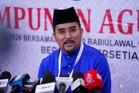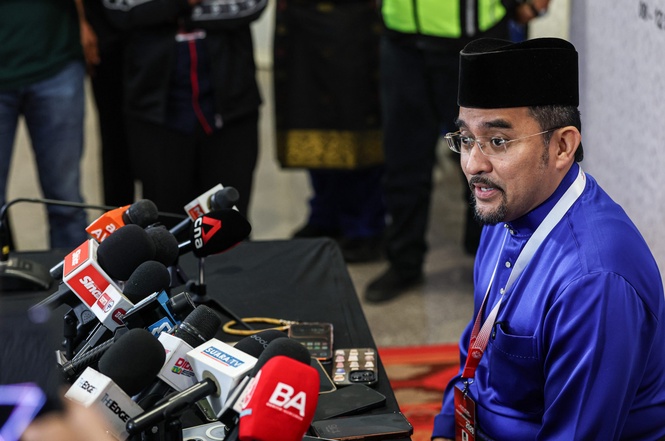
Asyraf said the coalition’s 18-point agreement, as well as the initial agreement preceding its formation, clearly stipulated that the administration should be known as the Malaysia Unity Government.
KUALA LUMPUR: The term “Malaysia Unity Government” remains the agreed basis of the coalition and should not be replaced by references to the “Madani Government”, Umno secretary-general Datuk Dr Asyraf Wajdi Dusuki said.
He said the distinction was important because the government was formed through an agreement involving 18 political parties, meaning Prime Minister Datuk Seri Anwar Ibrahim must continue consulting all parties in the coalition.
“Using the war cry, using the Madani concept, there is no problem.
“But when you highlight the Madani Government over the Malaysia Unity Government, as agreed, that is the first issue,” he told a press conference after the 2026 Umno General Assembly here today.
Asyraf said the coalition’s 18-point agreement, as well as the initial agreement preceding its formation, clearly stipulated that the administration should be known as the Malaysia Unity Government.
“This government is not a one-party government. Initially, there were two parties, BN and PH.
“When (Prime Minister) Datuk Seri Anwar Ibrahim took the oath of office, an agreement involving 18 parties was formalised, and that agreement was called the Malaysia Unity Government formation agreement,” he said.
He said this meant Anwar could not govern as if he were leading a government formed by a single party with an outright majority.
“When the government is a unity government, a government based on unity, consultation must be carried out with all the relevant parties,” he said.
Asyraf also rejected suggestions that Umno or Barisan Nasional had betrayed the coalition, saying the agreement remained binding until the next general election.
“We have never betrayed anyone. Our agreement only applies until the general election,” he said.
He said the recent Johor and Negeri Sembilan state elections did not fall under the same arrangement because the state assemblies had been dissolved, leaving individual parties free to determine their own political partnerships.
“Once the assembly is dissolved, it is up to the parties to determine their respective directions,” he said.
Asyraf said the same principle should apply in Sabah and Sarawak, where local parties should be free to decide whom they wanted to work with politically.
He said there was therefore no immediate threat to the federal coalition, stressing that the parties remained committed to the agreement until its term ended.
He said the priority remained political stability, while the ultimate mandate should eventually be returned to voters.
“The president has also indicated, and the delegates have indicated, that let the people make the decision and let the mandate be handed back to the people,” he said.