.jpg)
By Mihar Dias August 2026
Malaysia is 69.
At that age, a country ought to have acquired some wisdom.
Instead, judging from the early days of this Merdeka month, Malaysia appears to have acquired something else:
selective memory.
The national birthday has brought us a wonderful little political morality play.
Three acts.
Three departures.
Three reminders that in Malaysia, political loyalty can have approximately the shelf life of a carton of fresh milk.
The appropriate title?
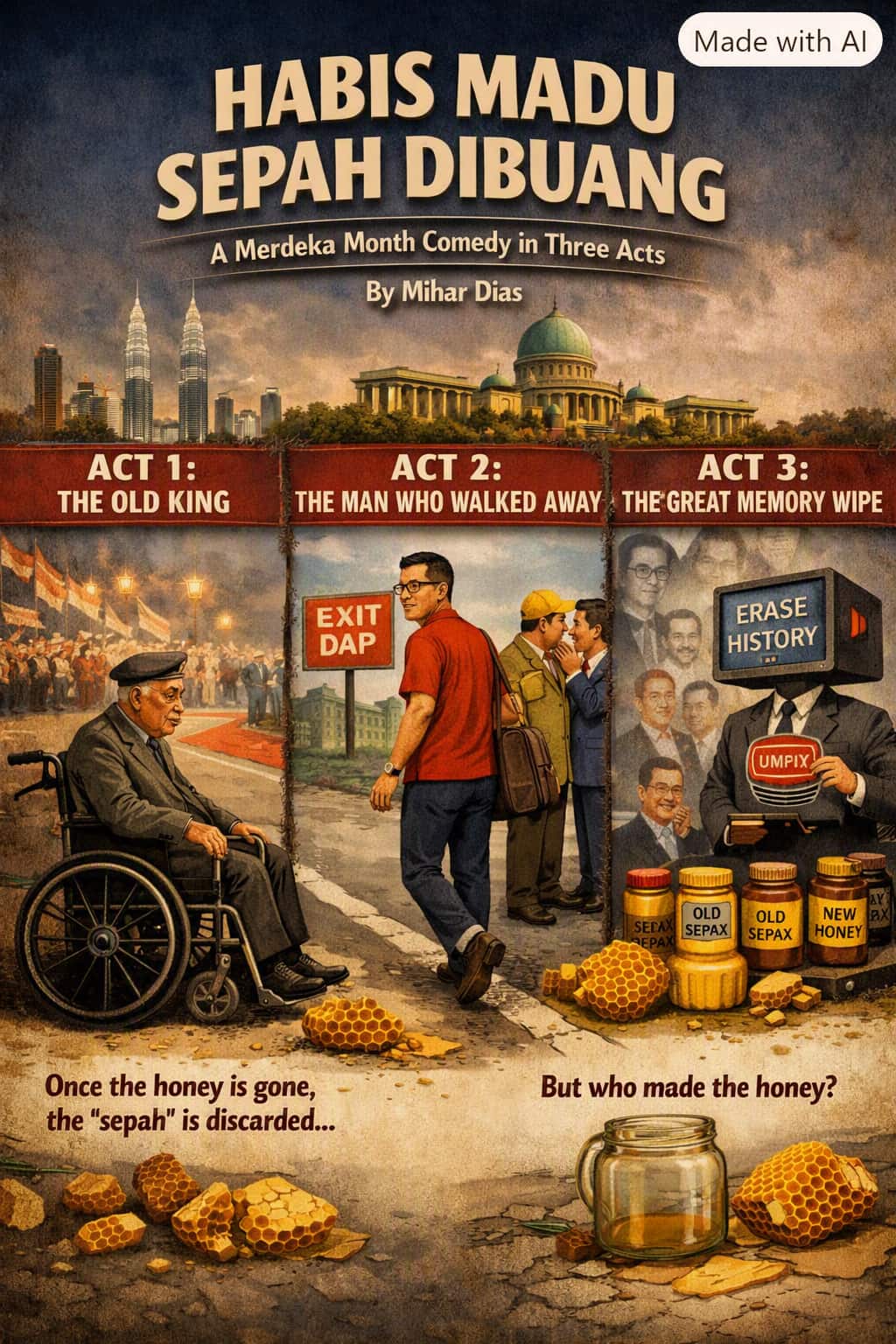
“Habis Madu, Sepah Dibuang.”
Once the honey is finished, throw away the residue.
It is not merely a proverb.
It is practically a national operating system.
And this year's Merdeka cast could hardly be more appropriate.
ACT ONE: THE OLD KING BY THE ROADSIDE
Picture the scene.
Putrajaya.
Merdeka Day.
Flags everywhere.
Red carpets somewhere.
VIPs somewhere else.
Cameras everywhere.
And by the roadside, in a wheelchair, is a 101-year-old former prime minister.
Tun Dr Mahathir Mohamad.
The man who once ruled Malaysia with such authority that ministers reportedly developed a special talent for knowing what he wanted before he said it.
The man who helped transform Kuala Lumpur and created Putrajaya as the administrative capital.
The man who was once the political equivalent of a permanent fixture.
And there he was.
By the roadside.
At 101.
Watching the country celebrate.
There is something almost poetic about it.
The man who helped build the city was reduced to watching its parade from the kerb.
If this were a Malaysian film, the director would probably shout:
“Cut! Too symbolic!”
But nobody cut.
Reality had already written the script.
One wonders whether the seating committee had a meeting.
“Tun Mahathir?”
“Yes.”
“Former prime minister?”
“Yes.”
“101 years old?”
“Yes.”
“Built Putrajaya?”
“Yes.”
“Still alive?”
“Yes.”
“Then?”
“Put him somewhere over there.”
Perhaps there was a perfectly innocent logistical explanation.
Perhaps there was no slight intended.
Perhaps the seating arrangements were dictated by protocol, security, accessibility or some other perfectly rational consideration.
Fine.
But symbolism does not require permission.
And the image was symbolic.
Very symbolic.
There was a time when the question was:
Where is Mahathir sitting?
Now the question was:
Why is Mahathir sitting there?
That is what happens when political relevance evaporates.
Yesterday's king becomes today's spectator.
Which brings us to another Malay proverb:
“Kacang lupakan kulit.”
The bean forgets its skin.
But applying it to Mahathir would be rather unfair.
Mahathir has never forgotten the skin.
He has spent decades reminding everybody else about it.
Perhaps the more appropriate question is whether Malaysia has forgotten its own skin.
Because there is a peculiar Malaysian habit of wanting the benefits of the past while pretending the people who created them no longer matter.
We love the skyscraper.
We forget the architect.
We love the highway.
We forget the engineer.
We love Putrajaya.
We forget the politician who imagined it.
Until, of course, we need somebody to blame.
Then suddenly everybody remembers.
ACT TWO: THE MAN WHO WALKED AWAY
Enter Ong Kian Ming.
Fourteen years in DAP.
Fourteen.
Not fourteen days.
Not fourteen months.
Fourteen years.
And on Merdeka Day, he walks away.
No dramatic midnight coup.
No new party.
No revolutionary manifesto.
No announcement that he has discovered the political equivalent of the Holy Grail.
Just:
I'm leaving.
That alone was enough to produce the inevitable Malaysian reaction.
Speculation.
Conspiracy.
Analysis.
Counter-analysis.
WhatsApp theories.
Facebook experts.
And then Anthony Loke entered the theatre with a proverb:
“Habis madu, sepah dibuang.”
And suddenly one of Malaysia's oldest proverbs acquired a new political life.
The implication was obvious enough to generate another question:
Who is the madu?
And who is the sepah?
Ah.
That is where Malaysian politics becomes entertaining.
Because every political party believes its people are honey.
Until they leave.
Then they become leftovers.
A politician who defects is a traitor.
A politician who joins you is a patriot.
A politician who resigns from your party has lost his principles.
A politician who resigns from the other party has found his principles.
It is a magnificent system.
It requires absolutely no consistency.
Ong's decision is particularly interesting because he has chosen not to immediately jump into another political vehicle.
He says he will not contest GE16 or join another political party for now.
He has, however, said he would campaign for Khairy Jamaluddin if KJ contests.
Now that is delicious.
A former DAP man helping a former UMNO minister?
In Malaysia, this is enough to cause several political ulcers simultaneously.
Somewhere, a political strategist has probably fainted.
But perhaps Ong has discovered something politicians occasionally forget:
You can leave a party without leaving politics.
And you can leave politics without leaving the country.
Maybe that is the mature way to do it.
Or maybe it is political heresy.
Either way, Merdeka is supposed to mean freedom.
Perhaps Ong has simply exercised some.
ACT THREE: THE GREAT MALAYSIAN DISCARD MACHINE
And now comes the third act.
The biggest discard of all.
Not a person.
Not a politician.
Memory itself.
This is where the story becomes bigger than Mahathir or Ong.
Because Malaysia has developed an extraordinary political recycling system.
Nothing is ever truly discarded.
It is simply rebranded.
Former enemy becomes ally.
Former ally becomes enemy.
Former minister becomes commentator.
Former politician becomes chairman.
Former chairman becomes former chairman.
Former reformer becomes establishment.
Former establishment becomes reformer.
And somewhere along the line somebody says:
“We must move forward.”
Translation:
Please forget what we said last year.
This is Malaysia's greatest political talent.
We don't have political contradictions.
We have political evolution.
We don't have U-turns.
We have strategic recalibration.
We don't abandon principles.
We reinterpret them.
And we certainly don't discard people.
We merely reorganise the furniture.
That explains the Merdeka spectacle.
The old man by the roadside.
The veteran politician walking away.
The former allies becoming strangers.
The former strangers becoming allies.
And the public watching the whole circus while waving the Jalur Gemilang.
Perhaps that is the real joke.
We celebrate independence while our politicians remain desperately dependent on one thing:
Being remembered.
THE HONEY PROBLEM
Perhaps Anthony Loke's proverb deserves to be expanded.
Habis madu, sepah dibuang.
But what happens after the sepah is thrown away?
Sometimes it is picked up again.
Washed.
Repackaged.
Given a new label.
And sold back to us as something completely different.
That is Malaysian politics.
Yesterday's “sepah” may become tomorrow's “asset”.
Yesterday's “asset” may become tomorrow's “liability”.
And tomorrow's liability may eventually be introduced as:
“A respected elder statesman.”
At which point everyone suddenly becomes sentimental.
This is why the Mahathir image is uncomfortable.
Not because everyone must agree with Mahathir.
They absolutely do not.
Nor should they.
A man can build Putrajaya and still make political decisions people vehemently disagree with.
A former prime minister can be criticised.
A 101-year-old man can be politically irrelevant.
But a nation should never become so politically petty that it cannot distinguish between disagreement and ingratitude.
That is the danger.
Because if we discard every inconvenient piece of history, eventually we will have nothing left except ourselves.
And then we will have to explain how we got here.
That could be embarrassing.
MERDEKA'S UNINTENDED LESSON
There is a certain irony in all this happening during Merdeka month.
Merdeka is supposed to be about remembering.
Remembering independence.
Remembering sacrifice.
Remembering nation-builders.
Remembering those who came before us.
Yet our political culture sometimes seems to operate on the opposite principle:
Remember only what is useful.
Forget the rest.
If someone is useful, invite him.
If someone is powerful, honour him.
If someone can deliver votes, embrace him.
If someone becomes inconvenient, relocate him.
Preferably somewhere without a microphone.
And if someone leaves?
Find a proverb.
Malaysia has plenty.
THE FINAL PUNCHLINE
So perhaps the three Merdeka “discards” are not really three people.
They are three stages of Malaysian political life.
Act One:
The old king discovers that power has an expiry date.
Act Two:
The loyal party man discovers that loyalty has an expiry date.
Act Three:
The country discovers that memory itself has an expiry date.
And that should worry us.
Because a nation that forgets too easily is condemned to rediscover the same lessons repeatedly.
At considerable cost.
Perhaps, therefore, on our 69th Merdeka, we should retire one proverb and adopt another.
Not:
“Habis madu, sepah dibuang.”
But:
“Jangan lupa siapa yang buat madu.”
Don't forget who made the honey.
As for “kacang lupakan kulit”, perhaps we should stop asking whether Tun Mahathir has forgotten the skin.
Look around.
The more interesting question is:
Have we forgotten the tree?
And if Malaysia continues throwing away its people once the honey is gone, there may come a day when we discover something rather embarrassing.
The bottle is empty.
The honey is finished.
The sepah has been thrown away.
And nobody remembers who made the honey in the first place.
Happy 69th Merdeka, Malaysia.
May we remain independent.
And, if possible, occasionally grateful.

Share your Anak Malaysia stories and stand a chance to win prizes worth up to RM2,880! Find out how to join here. T&Cs apply.
Mihar Dias (mihardias@gmail.com) is a content creator under the Newswav Creator programme, where you get to express yourself, be a citizen journalist, and at the same time monetize your content & reach millions of users on Newswav. Log in to creator.newswav.com and become a Newswav Creator now!
The User Content (as defined on Newswav Terms of Use) above including the views expressed and media (pictures, videos, citations etc) were submitted & posted by the author. Newswav is solely an aggregation platform that hosts the User Content. If you have any questions about the content, copyright or other issues of the work, please contact creator@newswav.com.