.jpg)
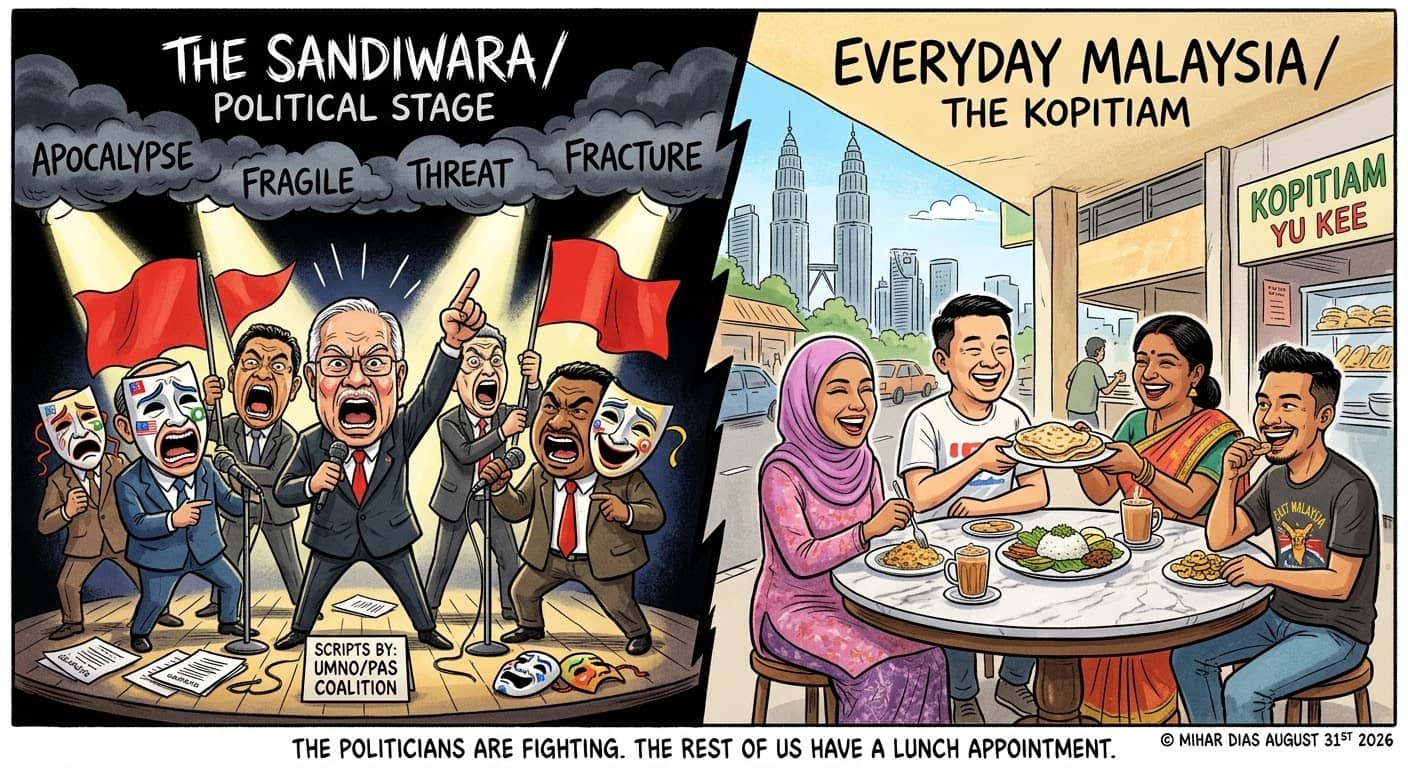
By Mihar Dias August 31st 2026
Malaysia is apparently fragile.
Very fragile.
So fragile, in fact, that we should probably wrap the country in bubble wrap before someone says something unpleasant on Facebook.
That, at least, seems to be the message behind Prof James Chin’s gloomy assessment of Malaysia on the eve of Merdeka.https://focusmalaysia.my/malaysia-is-more-ethnically-fragile-this-merdeka-with-racial-tension-hitting-a-69-year-high/
According to his analysis, Malaya turns 69 this month not with the usual flags, fireworks and patriotic speeches, but with the country supposedly more fractured than at any point since 1957.https://focusmalaysia.my/malaysia-is-more-ethnically-fragile-this-merdeka-with-racial-tension-hitting-a-69-year-high/
That is quite a claim.
One wonders whether Prof Chin has recently spent enough time in Kuala Lumpur.
Because if he had, he might discover something rather inconvenient to his thesis.
Malaysians are not nearly as fragile as their politicians.
Walk around Kuala Lumpur and you will see Malays, Chinese, Indians, Christians, Muslims, Buddhists, Hindus and people of assorted backgrounds sitting at the same kopitiam tables, eating one another’s food, complaining about the same traffic jams and cursing the same electricity bills.
They work together.
They trade together.
They gossip together.
They send their children to schools.
They celebrate each other’s festivals.
They marry across ethnic lines.
They queue together at mamaks.
And, most importantly, they laugh together.
What they increasingly laugh at, however, are the politicians.
This is where the great Malaysian misunderstanding begins.
We keep confusing political theatre with social reality.
A politician says something outrageous about race.
Another politician responds with something even more outrageous.
A religious leader issues a warning.
A party leader discovers that the nation is allegedly under threat.
Social media explodes.
Television commentators become apocalyptic.
And somewhere in the background, Malaysians are watching the spectacle while eating nasi lemak and asking:
“Betul ke ni?”
Then they get on with their lives.
Perhaps this is not a country falling apart.
Perhaps it is a country becoming increasingly sophisticated at recognising sandiwara.
For those who have forgotten, sandiwara means theatre, drama, play-acting.
And Malaysian politics has become rather good at it.
The latest anxiety is the alleged rise of a UMNO-PAS “Malay tsunami”, supposedly capable of sweeping aside the existing political order.
Maybe.
Elections have consequences, and political coalitions can certainly reshape the country.
But to translate an electoral alliance into an impending civilisational breakdown is another matter altogether.
It assumes that Malaysians vote exclusively as members of ethnic tribes rather than as human beings with mortgages, children, businesses, jobs, frustrations and political grudges.
It also assumes that every Malay voter who supports PAS or UMNO has signed up to an ideological manifesto for the subjugation of non-Malays.
That is a rather convenient assumption.
Malaysians are much more complicated than that.
A Malay voter can support PAS because he is religious.
Or because he dislikes UMNO.
Or because he dislikes Anwar.
Or because he likes the local candidate.
Or because his father voted PAS.
Or because the candidate fixed the pothole outside his house.
Or simply because he thinks the government has become unbearable.
Likewise, a Chinese voter supporting PH is not necessarily conducting a theological referendum on Islam.
He may simply want competent government.
This is the problem with analysing Malaysian politics entirely through the prism of ethnic fragility.
Everything becomes evidence of an impending ethnic apocalypse.
If PAS gains seats, it is Malay consolidation.
If UMNO cooperates with PAS, it is Malay unity.
If Chinese voters support PH, it is defensive ethnic voting.
If Indians complain, it is minority anxiety.
If Sabah and Sarawak demand their rights under MA63, it becomes evidence of institutional distancing.
Soon enough, somebody will probably announce that Malaysians are dangerously divided because one table at a mamak ordered roti canai while another ordered thosai.
There are certainly real problems.
Race and religion are exploited by politicians.
Some activists deliberately provoke communal sensitivities.
Social media rewards outrage.
Selective enforcement can damage public confidence.
And there are politicians who would happily set fire to the curtains if it meant gaining another few votes.
These deserve scrutiny.
But that does not necessarily mean Malaysia itself is fragile.
Perhaps the more fragile institution is our political class's capacity to survive without manufacturing enemies.
There is a difference.
Malaysia has been told that it is on the verge of racial catastrophe many times before.
The country survived.
We were told that every election would produce chaos.
We survived those too.
We have survived Mahathir versus everyone.
Anwar versus everyone.
UMNO versus PAS.
PAS versus UMNO.
UMNO versus itself.
Bersatu versus UMNO.
UMNO joining hands with people it once called extremists.
People once called traitors becoming allies.
People once called allies becoming traitors.
Governments collapsing overnight.
Prime ministers appearing and disappearing with bewildering speed.
And through all of this, the country continued.
The nasi kandar remained open.
The mamaks remained crowded.
The Chinese coffee shops continued serving breakfast.
The Hindu temples continued ringing their bells.
Mosques continued calling Muslims to prayer.
And Malaysians continued complaining about politicians.
That is not the behaviour of a population permanently trapped inside ethnic silos.
It is the behaviour of a population that has learned to live with political absurdity.
There is also something rather ironic about declaring Malaysia “more ethnically fragile” while simultaneously observing that Sabah and Sarawak are comparatively calmer.
Perhaps that should tell us something.
Perhaps ordinary Malaysians are not inherently incapable of coexistence.
Perhaps the problem is what happens when politicians discover that identity is an easier campaign tool than policy.
Give people a road to complain about and you need a transport policy.
Give them a racial grievance and you need only a microphone.
Give them a religious grievance and social media will do the rest.
The tragedy is not that Malaysians cannot live together.
The tragedy is that some politicians have discovered that Malaysians can be persuaded to fear one another.
And fear, as every politician knows, is wonderfully cheap.
No manifesto required.
No economic plan required.
No explanation for why the cost of living is rising.
No need to explain why young people cannot afford houses.
Just tell them someone is threatening their race, religion, language or privileges.
Suddenly everyone is distracted.
So yes, Prof Chin is right about one thing.
There are political forces attempting to consolidate Malay-Muslim support.
There are genuine anxieties among minorities.
There are irresponsible voices exploiting race and religion.
And the government must apply the law consistently.
But describing Malaysia as being on the verge of permanent fracture may itself contribute to the very anxiety being diagnosed.
Sometimes the observer becomes part of the drama.
Perhaps the better question this Merdeka is not:
“How fragile is Malaysia?”
It is:
“Why are we so determined to convince ourselves that it is?”
Because outside the political bubble, most Malaysians are doing something remarkably radical.
They are getting on with their lives.
They are buying breakfast.
They are sending their children to school.
They are running businesses.
They are attending weddings and funerals.
They are visiting one another during Hari Raya, Chinese New Year, Deepavali and Christmas.
They are falling in love.
They are arguing about football.
They are complaining about traffic.
And occasionally, when politicians perform their latest racial or religious drama, they sit back with a packet of muruku and watch.
Because Malaysians have seen this movie before.
Several times.
Different actors.
Same script.
Different costumes.
Same sandiwara.
Malaysia does not need bubble wrap.
Perhaps what it needs is fewer politicians who believe the public is stupid enough to confuse their electoral theatre with an actual national breakdown.
And perhaps Prof Chin should spend a little more time in Kuala Lumpur.
Not in the seminar rooms.
Not only in political circles.
But in the kopitiams, mamaks, markets, offices and shopping malls where ordinary Malaysians actually live.
He might discover that the country is considerably less fragile than the people trying to govern it.
And on Merdeka Day, that would be a rather comforting discovery.
Because after 69 years, perhaps Malaysians have finally learned the most important lesson of all:
**The politicians may be fighting each other.
The rest of us have a lunch appointment.**

Share your Anak Malaysia stories and stand a chance to win prizes worth up to RM2,880! Find out how to join here. T&Cs apply.
Mihar Dias (mihardias@gmail.com) is a content creator under the Newswav Creator programme, where you get to express yourself, be a citizen journalist, and at the same time monetize your content & reach millions of users on Newswav. Log in to creator.newswav.com and become a Newswav Creator now!
The User Content (as defined on Newswav Terms of Use) above including the views expressed and media (pictures, videos, citations etc) were submitted & posted by the author. Newswav is solely an aggregation platform that hosts the User Content. If you have any questions about the content, copyright or other issues of the work, please contact creator@newswav.com.