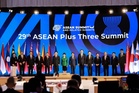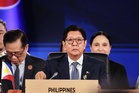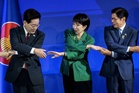
THE 49th Association of Southeast Asian Nations (Asean) Summit — and the Philippines’ chairmanship of the regional bloc — came to a close Tuesday, after producing more than 150 outcome documents, including four major policy declarations.
President Ferdinand Marcos Jr. who emphasized the cultural and political cohesion of its member states and the continuing challenges facing the regional bloc in his closing remarks, handed over to Singapore Prime Minister Lawrence Wong the gavel symbolizing the transfer of the Asean chairmanship to his country.
“The challenges before Asean is increasingly intertwined. Every member state must be able to count on Asean and Asean must be able to count on every member,” Marcos said.
“I am confident that Singapore will lead with purpose, steadiness, and commitment to regional cooperation for which it is known and for which these times demand,” the president said.
Wong said Singapore accepts the challenge to head Asean in 2027. He thanked Marcos for his leadership and “for steering Asean through a difficult year.”
The summits achieved “milestones” and reinforced the region’s commitment to helping each grow together, tackle transnational crimes, and address disputes peacefully.
The Asean leaders, led by President Marcos, as this year’s Asean chairman, adopted key declarations and came up with outcome documents during the summits held in Manila from Nov. 15 to 17.
These declarations focused on artificial intelligence; micro, small, and medium-sized enterprises (MSME); creative industries, and labor standards under the Philippine chairmanship theme, “Navigating Our Future, Together.”
The major declarations that came out from the three-day summit are:
– Asean Leaders’ Declaration on an AI-Powered MSME Growth: Aims to integrate artificial intelligence tools and digital transformation strategies to scale up micro, small, and medium enterprises across Southeast Asia;
– Asean Leaders’ Declaration on Strengthening Asean Cooperation for Micro, Small and Medium Enterprises Development: Outlines collaborative regional frameworks to boost MSME resilience, financing, and market access;
– Asean Leaders’ Declaration on the Establishment of the Asean Center of Excellence for Creative Industries (ACE-CI): Formally establishes a hub in Manila to foster innovation, cultural economy growth, and creative sector collaboration; and
– Declaration on Fair and Ethical Recruitment: Enhances protections and fairer recruitment standards for migrant workers and overseas laborers across Asean member states.
Among the milestones achieved during the summit was the signing the Asean Digital Economy Framework Agreement (DEFA), which aims to double the regional digital economy to $2 trillion by 2030 and advancing regional power grid and maritime security initiatives.
Singapore assumes the Asean chairmanship in 2027, as Asean celebrates 60 years and moves forward with the implementation of Asean 2045: Our Shared Future.
Dialogue partners
After several meetings with dialogue partners on Monday — including China, the Republic of Korea, Australia, and the United Nations — the final-day schedule began with the Asean Plus Three Summit, followed by the Asia Zero-Emission Community (AZEC) Leaders’ Meeting, the Asean-Japan Summit, the Asean-India Summit and the East Asia Summit.
The leaders tackled ways to mitigate the impact of geopolitical shocks that affect households across Asia.
“Our task today is to put our collective strength to work,” Marcos said during the Asean Plus Three (with China, Japan and the Republic of Korea) summit, urging leaders to congregate to ensure that families are safeguarded.
Last-minute arrivals
Several leaders — including US President Donald Trump, arrived at the last minute for the summit. Cambodian Prime Minister Hun Manet arrived in the Philippines to attend the summit on Tuesday morning. He was earlier represented by Deputy Prime Minister Dr. Hang Chuon Naron.
Russia’s foreign minister, Sergey Viktorovich Lavrov, also arrived in Manila on Tuesday morning. Russia’s participation in the summit builds upon the Russia-Asean Commemorative Summit held in Kazan earlier this year.
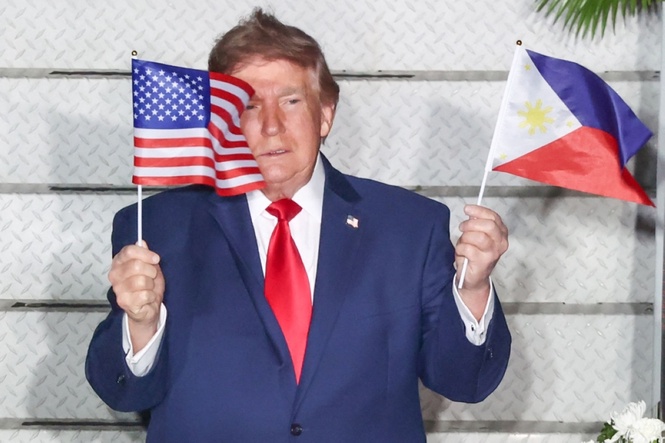
In the late afternoon, United States President Donald Trump arrived in Manila for the Asean-US Special Summit on Tuesday afternoon.
Trump will also have a bilateral meeting with Marcos before he leaves for the Asia Pacific Economic Cooperation (APEC) meeting in China, where he is set to meet with Russian President Vladimir Putin and Chinese President Xi Jinping.
The Asean-US Special Summit concluded the three-day event in Manila.
The visit marks Trump’s first travel abroad since his party suffered deep losses in midterm elections. The White House and stock market alike have been rattled by the departure of Jensen Huang from Nvidia, the dominant provider of advanced microchips crucial to artificial intelligence (AI) systems, last week after admitting to an affair with an alleged Chinese government spy. Beijing has said it was not involved.
Trump was scheduled for a cocktail reception and dinner with other world leaders, as the “guest of honor” at the Asean Summit.
The Asean leaders have been working on a non-aggression pact with China in the contested waters of the South China Sea, a key global trade route. Confrontations have particularly escalated in recent years between Chinese and Philippine coast guard and naval forces in disputed shoals.
Trump was also scheduled to meet with the leaders of the Quad, a group of nations including the US, Australia, India, and Japan that has aimed to counter China’s influence in the Asia Pacific. It will be the first meeting of the Quad leaders since Trump returned to the White House last year.
Trump was then scheduled to sign a trade deal with Thailand, the type of agreement he has relished striking since launching a trade war last year buttressed by steep tariff threats.
On Wednesday, Trump is set to receive a red-carpet welcome and full military honors from President Marcos followed by a state banquet as part of his visit to the Malacañang Palace. Trump and Marcos are expected to affirm their commitment to their countries’ longstanding treaty alliance.
Officials are arranging a possible brief reunion in Malacañang with an old acquaintance — Imelda Marcos — if she’s well enough and gets her doctors’ nod.
Now 97 and wheelchair-bound, the former jetset Philippine first lady and mother of the incumbent president had partied in New York decades ago in her heyday as the controversial wife of President Ferdinand Marcos Sr., who was to be ousted in a pro-democracy 1986 “People Power” public uprising.
But the friendship with Trump endured, with Trump often asking Marcos Jr. and other Philippine officials: “How’s Imelda?” Philippine Ambassador to Washington Jose Manuel Romualdez told The Associated Press. WITH AP