PRESIDENT Ferdinand Marcos Jr. vowed expanded government support for local manufacturers by investing in robotics operations.
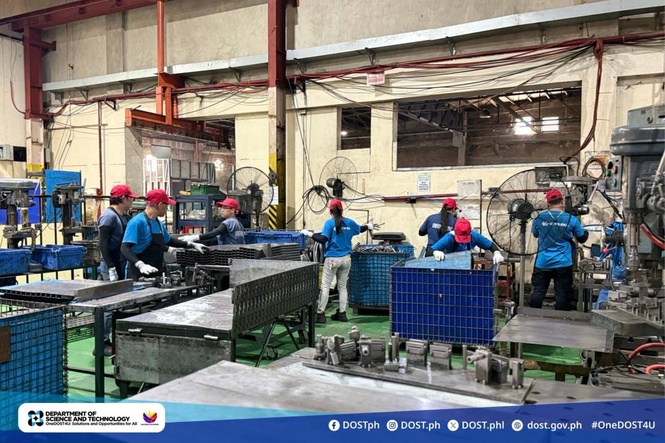
During his visit to the Nuvali Steel Processing Center Inc. (NSPCI) in Biñan City, Laguna on Saturday for the inspection of the Department of Science and Technology’s (DOST) Assistance to Align the Company with Industry 4.0, Marcos lauded the facility for incorporating robotics into its manufacturing processes, describing it as a “state-of-the-art facility.”
“It is fascinating to see the state-of-the-art robotics actually in an industrial setting. We see robots that are merely for display. This is the kind they actually use to manufacture parts,” said Marcos in both English and Filipino.
He vowed that the government will continue to invest more in robotics in other companies.
“The advances that have been made in robotics are really quite impressive. So, it’s very good to see. We will do more of this, not only for Nuvali Steel, but also for the other companies,” said Marcos.
The president said the plant serves as a model for modern industrial automation, producing metal components for automobiles, motorcycles, trucks, aircraft, and heavy machinery, as well as local transport assemblies like jeepneys.
By manufacturing high-spec parts locally that meet international standards, the president emphasized that the nation can significantly reduce its reliance on foreign imports and retain greater economic value within local supply chains.
“We don’t need to import various parts anymore. Most of the motorcycle parts are already coming from here, and therefore, the value-added stays here in the Philippines,” Marcos explained, adding that a resilient local supply chain generates more jobs and boosts domestic production.
Marcos observed that while robotics and artificial intelligence are often seen in experimental or display settings, the NSPCI demonstrates their practical execution in heavy industrial manufacturing.
Meanwhile, DOST Secretary Renato Solidum Jr. told The Manila Times that the incorporation of robotics at the Nuvali steel facility has significantly increased the workforce from 71 to 241 employees, refuting the notion that robots will replace human workers.
This, he said, is because some of the robotics cannot standalone and need people to intervene in the process.
“The more quality production, then the more customers or the more volume of materials the specific customer would need, so you will add more people,” Solidum said.
He added that the DOST is looking into tapping other facilities across the country to modernize their plants by incorporating robots.
“We are engaging many others. For example, the last facility that we visited with the president was the NutriDense food manufacturing. So, they have also some automation, but we think that they needed robotics in some of their operations to reduce the production time and essentially ramp up their production,” he concluded.