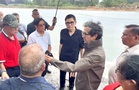
TOWARD the end of August, President Ferdinand Marcos Jr. conducted an aerial inspection of flood-affected towns in Bulacan and Pampanga. While facing the media, he cited climate change as the cause of unprecedented rainfall, which overwhelmed the local flood-control systems.
Although he was not wrong about the reality of climate change, we must veer away from blaming it as the cause of disasters. The danger of this mindset is that it shifts away responsibility and prevents any sense of accountability.
In order to break the cycle of tragedy and “resilience,” the government must step up and take the lead in addressing the hazards brought about by climate change, before they turn into disasters.
Hazard vs disaster
The crucial distinction we must understand lies in the difference between hazard and disaster. The former is an event or phenomenon that has the potential to cause harm, disruption, or destruction. Risk is a function of hazard, exposure and vulnerability.
Disaster is when the hazard turns into a reality. Although we have no control over natural hazards such as earthquakes and typhoons, we are very much capable of preparing for them, so as to minimize the risk and mitigate the damage.
Natural hazards are acts of God; disasters are acts of man, for every decision we make has its consequences. And if we fail to plan, we plan to fail. That is why when society is devastated after a flood or earthquake, we only have ourselves to blame.
The role of the government
Everyone has a part to play in disaster planning and resilience, but we must also recognize that not all roles are the same. The government has the biggest one because of its authority and influence. That is why the Filipino people deserve to be informed about how taxpayers’ money is being spent.
To understand the priorities of the government in disaster resilience, we need to look no farther than the projects that are given the most attention. Far too often, we focus on post-disaster response such as relief goods and shelter. While meeting humanitarian needs is crucial in times of crisis, are we doing anything to actually prevent this from happening?
Shortsighted planning
The problem is not a lack of knowledge — there is no scarcity of it with global best practices — but the absence of visionary leadership, strong political will and good governance. Since the 1970s up until today, I have given various administrations hundreds of recommendations, including short-, medium-, and long-term action plans.
The most notable example was the Parañaque Spillway. It was designed to complement the Manggahan Floodway by diverting excess water from Laguna de Bay to Manila Bay, so that lakefront communities would not suffer from flooding.
This was proposed by my team as part of the World Bank-funded MMetroplan (Metro Manila Transport, Land Use, and Development Planning Project) in 1977, where I was team leader and senior planner. However, it was not constructed.
I proposed it once more in 2009 as part of a Smart (Stormwater Management and Road Tunnel) tunnel, similar to that of Kuala Lumpur. Although it was approved by President Gloria Macapagal Arroyo, it was not acted upon due to a change in administration.
This reveals a critical flaw in our government: We only plan for electoral cycles, not the next generation.
Addressing climate change in the long term
Simply preparing for natural hazards isn’t enough because their strength will continue to increase due to climate change. What was once considered a 100-year flood could occur every other year if we are not good stewards of the environment.
That is why we must look beyond disaster resilience and address the root cause by looking at the biggest contributors.
Shifting to sustainable transportation
The transportation sector is one of the biggest contributors of air pollution in our country, with the toxic fumes emitted by all the cars, motorcycles, buses, jeepneys and trucks plying our roads. The best way to address this is by minimizing our dependence on fossil fuels.
Active transportation is low-hanging fruit, especially because the majority of Filipinos are already walking, biking and riding public transit. And when more people shift from private motoring to active mobility, there will be less pollution and congestion.
The challenge is to improve policy, infrastructure and enforcement to create a transportation system where human-scaled mobility is the preferred choice because it is safe and convenient.
The abundance of renewableenergy sources
The energy sector is the other notable culprit, with around 70 percent of our electricity still generated using fossil fuels. There is no reason why we can’t transition to renewable sources of energy.
Globally, the Philippines is ranked third in geothermal energy due to its position along the Pacific Ring of Fire. With the fifth longest coastline in the world, we have no shortage of water that can be used for hydroelectric power. Sunlight is plentiful with our proximity to the equator, and our country lies in between the wind corridors of the monsoon belt and trade winds.
Investing in renewable energy is not optional given that Filipinos are among the most vulnerable to climate hazards.
The reality of climate change
The reality of climate change is that it did not happen overnight. Rather, the flooding that happened in Bulacan, Pampanga and many other parts of the country is the consequence of our actions and choices as a society that has accumulated over decades and centuries.
That is why we can never blame climate change for the consequences of our maltreatment of the environment. Instead, citizens must do their part by holding the government accountable to ensure that hazards will not become disasters.
As I always say, it is 90 percent less expensive to address hazards before they become disasters, and this also saves human lives, real estate, infrastructure and livelihood.