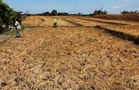
PRESIDENT Ferdinand Marcos Jr. on Friday assured that the government is preparing extensively to cushion the country from the impact of the super El Niño.
In his speech during the inauguration of the Tugbong Solar Pump Irrigation Project in Leyte, Marcos said water conservation and modernized irrigation systems make the country better prepared than in previous droughts.
“This is the kind of approach where we do everything possible to conserve water — digging and constructing catchments and employing various other methods — so that we can store water and ensure the impact of El Niño on us does not become too severe,” said Marcos in Filipino.
“Now, we are better prepared than we were in 2024. Water levels in our dams are higher than they were at the start of 2024,” he said.
He said the government has completed 3,000 solar pump irrigation projects, covering roughly 70 percent of the country’s irrigable lands.
Marcos said the government is utilizing every possible mechanism — from the expanded construction of irrigation systems to measures ensuring water security for households — to cushion the impact of the super El Niño, expected to be the worst on record.
The president came under heavy criticism for urging the people to collect rainwater in buckets to conserve water for the super El Niño, while the Department of Social Welfare and Development distributed water filtration kits to make the collected rainwater safe to drink.
The Tugbong facility spans two sites and covers 115 hectares of agricultural land, which is expected to increase farmers’ harvesting cycles from two to potentially three seasons a year.
Marcos said that by using solar-powered pumps, farmers can save an estimated P20,000 per season on fuel costs, compared to traditional diesel-run pumps.
Leyte Vice Gov. Lorenzo Javier welcomed the Tugbong project, saying solar-powered irrigation would help farmers improve their harvests and increase their income.
Kananga Mayor Manuel Vicente Torres thanked the president for investing in agricultural infrastructure, stressing that dependable irrigation could help farming families sustain their livelihoods and secure their children’s future.
In a related development, Senior Citizens Party-list Rep. Rodolfo Ordanes on Friday urged government agencies and local governments to speed up the deployment of mobile water treatment and desalination systems in communities facing drinking water in preparation for El Niño.
“The lack of clean drinking water is a problem for the entire community. Everyone, young or old, needs safe water, especially as the effects of El Niño intensify,” Ordanes said.
He cited a National Disaster Risk Reduction and Management Council report that 109 localities had declared a state of calamity because of El Niño.
Ordanes urged agencies like the Department of the Interior and Local Government, Department of Environment and Natural Resources, and Department of Health deploy small-scale desalination systems in coastal and island communities and mobile freshwater treatment facilities in inland areas with suitable water sources.
“Not every solution to water shortages requires large plants that could cost billions of pesos. Smaller, commercially available systems can be brought directly to communities,” he said.
Ordanes said the Ilocos Norte provincial government spent P8.5 million for a mobile seawater reverse-osmosis and water filtration system for disaster response.
He also suggested that local governments share mobile treatment units rather than require each barangay to purchase its own equipment.
The Workers’ and Peasants’ Party (WPP), meanwhile, called for an urgent meeting of the National Tripartite Industrial Peace Council to prepare for the effects of El Niño on workers, farmers and their families.
In a statement on Thursday, the WPP urged the secretary of the Department of Labor and Employment to convene the council to discuss measures to protect jobs, wages, crops and food supplies.
It cited Philippine Atmospheric, Geophysical and Astronomical Services Administration’s (Pagasa) Oct. 7 assessment identifying a strong to very strong El Niño that could peak before the end of 2026 and continue into the first half of 2027.
“We cannot stop El Niño, but we can prevent workers and farmers from bearing the brunt of the damage. Preparation is not just about storing water — we also need to protect jobs, income, crops and food,” WPP Secretary-General Allan Montaño said in Filipino.
WPP National President Oscar Morado called on the labor secretary to convene the National Tripartite Industrial Peace Council. “Bring the government, workers and employers together now to agree on concrete preparations. Let us not wait for the fields to dry up and livelihoods to be lost before we meet,” Morado said in Filipino.
The party said the meeting should produce an action plan with clear responsibilities, timelines and monitoring, in coordination with Pagasa, agricultural and irrigation agencies, and local governments.
WPP proposed providing workers with drinking water, proper ventilation, shaded or cool rest areas and appropriate breaks during excessive heat. It also called for adjustments to work schedules and workloads based on actual heat conditions, in consultation with workers and unions, while ensuring that protective breaks do not reduce earnings.
It said authorities must help farmers before crops fail through location-specific planting advice, suitable seeds, irrigation support and accessible crop insurance