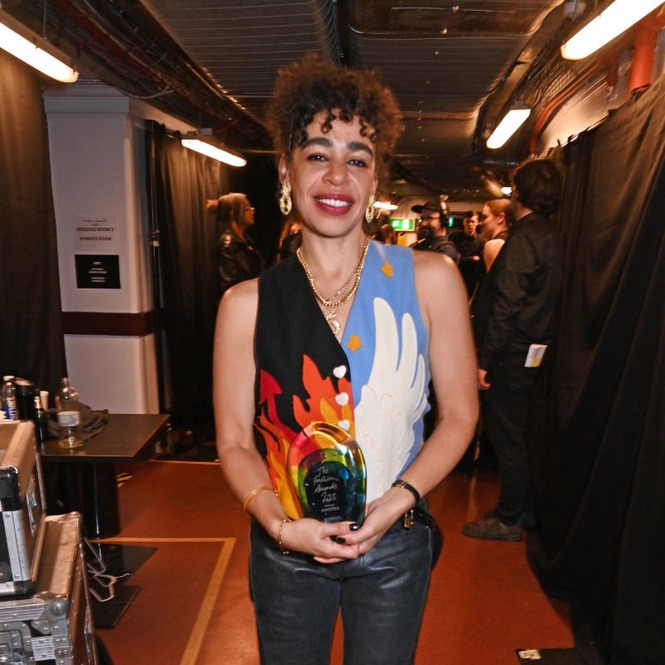
Balenciaga’s new appointment is a designer who has spent nearly two decades making fashion look at the people it usually edits out. Martine Rose, whose appointment as creative director of Balenciaga takes effect on November 16, brings a London sensibility shaped by club nights, football terraces and the friction between subculture and luxury. She had helped shape its first menswear collections under Demna.
Born in Croydon in 1980 to a Jamaican-British family, Martine Rose grew up in South London, where music and dress were inseparable. As a child, she watched her sister and cousins get ready to go out, seeing each outfit as entry into another world. That fascination with clothing as social code stayed. Her references came from club kids, football supporters, pub regulars and a city in motion. She is interested in how people dress, and why.
Who is Martine Rose, the first female Creative Director of Balenciaga?
View this post on Instagram
After a foundation course at Camberwell College of Art, a textiles module drew her in; she graduated from Middlesex University in 2002. With friend and future stylist Tamara Rothstein, she started the T-shirt project LMNOP. They made ten shirts, which a friend’s London Fashion Week showroom introduced to buyers. The venture folded, but she knew she wanted to make clothes. In 2007, she used a GBP 1,500 Prince’s Trust loan to launch her own label, initially focused on men’s shirts.
The label’s rise was not a clean ascent. She worked in bars while designing, and made collections only when she could afford to. In one season, she made a single look. She presented installations or skipped the runway. That constraint shaped the clothes. It took everyday garments and made them feel newly charged: shoulders too broad, trousers pooling over the shoe, a tracksuit with the residue of a night out. What looked awkward to some buyers became widely copied.
Her shows are more than a procession of looks. She has staged them in a Tottenham climbing centre, Seven Sisters Market, a north London community centre and a primary school. They place the collection among its source communities, making casting part of the design. Her clothes feel lived-in and insolent, resisting the idea that luxury must look pristine. She asks who fashion considers worth dressing.
In 2015, newly appointed Balenciaga designer Demna asked her to consult on menswear. He wanted the house’s first menswear runway collection. She brought familiar types redrawn through proportion, humour and social observation. Her input helped establish a language of cropped bombers with exaggerated shoulders, drab tracksuits and knowingly offbeat logos. The opportunity changed her life; her label’s commercial fortunes shifted soon after. The creative director at Balenciaga is returning to a house whose recent history she helped write, now with authority over the whole picture.
Collaborations widened her audience without sanding off the edges. Nike gave her footwear a broader reach, especially the MR4, a hybrid mule and sneaker that turned an unlikely silhouette into a cult object. She has worked with Clarks, Napapijri, Supreme and Tommy Hilfiger. Rihanna and Drake have worn her designs; Kendrick Lamar commissioned tour looks and called working with her a bucket-list moment. Celebrity visibility proves her particular world can travel.
View this post on Instagram
For Martine Rose, her most recent collection, autumn/winter 2026, offers a timely clue this season. Instead of a runway show, she presented it through images, deliberately stripping the presentation back to clothes and silhouette. The line still carried her dissonance: sportswear seemed chopped and resampled, familiar forms turned trompe l’oeil, and historical dress codes took on a camp, gender-fluid charge. The choice suggests she can make a quieter format feel like a considered creative decision.
In the brand’s announcement, she said: “It is a true privilege to be appointed Creative Director of Balenciaga, a House with an extraordinary heritage and a fearless creative spirit.” She also pledged to honour its legacy while shaping its next chapter. The archive matters, but her career suggests she will approach it through people and clothes.
View this post on Instagram
She succeeds Pierpaolo Piccioli and becomes the first woman to lead the 109-year-old house. Known chiefly for menswear, she also faces Kering’s plans to grow women’s ready-to-wear and leather goods. As creative director at Balenciaga, she will have the production, distribution and global reach of a major luxury house, plus the pressure to make that scale feel culturally alive. She need not repeat Demna’s shock or Piccioli’s romance. She must make the house feel as if it sees the world clearly again, and turn that recognition into clothes people want.
The challenge is preserving an independent label’s intimacy at scale. Her path runs through curiosity, odd jobs and financial improvisation, guided by a belief that people on the margins are often more interesting than those in the frame. That instinct now moves from London to Paris. The test: will the next collection notice someone the rest of fashion missed?
(All images: Dave Benett/Getty Images)
Note : The information in this article is accurate as of the date of publication.