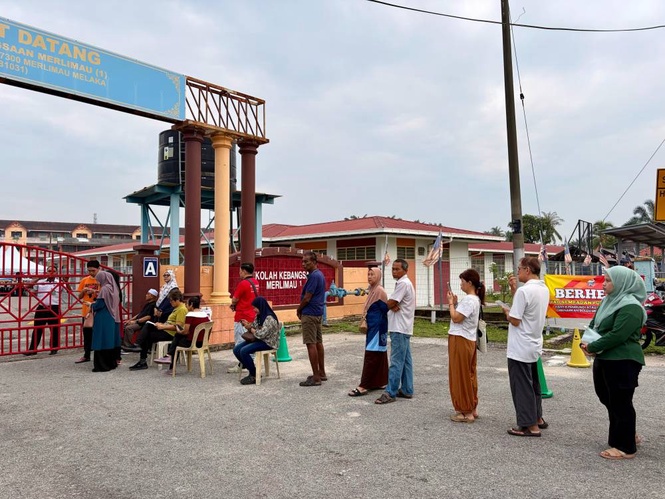
MELAKA voters have turned out in sufficient numbers to meet the Election Commission's (EC) 70 per cent target, giving the 16th state election a strong participation story than the early polling figures had suggested.
At 6pm, turnout was recorded at 70.59 per cent, with 472, 377 voters having cast their ballot papers.
In comparison, the 2021 state election saw voter turnout recorded at 65.85 per cent.
Earlier in the day, the pace of voting had raised questions about whether the target could be achieved, with turnout at just 40.32 per cent at noon and 50.43 per cent by 1.38pm.
But the numbers picked up as the day progressed, suggesting that many voters had chosen to cast their ballots later in the afternoon.
For the political parties, however, the more important question is not whether Melaka has met the EC's target, but what the turnout will mean for the final distribution of seats.
BN-PN, which entered the election seeking a commanding victory under the Muafakat Melaka arrangement, will be looking to see whether its grassroots machinery has successfully brought supporters to the polling stations.
PH, meanwhile, will be hoping that its supporters have responded to the call to prevent another electoral setback following the coalition's performances in Johor and Negeri Sembilan.
The constituency figures provide another dimension to the story.
Serkam recorded 79.08 per cent turnout by 5.10pm, followed by Ayer Molek at 78.57 per cent, Tanjung Bidara at 75.94 per cent and Sungai Rambai at 75.83 per cent.
Bandar Hilir, meanwhile, had recorded the lowest turnout at 5.10pm, at 62.15 per cent.
The differences underline why statewide turnout alone cannot tell the full electoral story. Participation patterns across individual constituencies may prove more revealing, particularly where contests are closely fought.
A high turnout does not automatically translate into an advantage for the incumbent or the opposition. It depends on the composition of the additional voters, their political preferences and how effectively each party has mobilised its supporters.
There is also a broader political significance to the turnout.
The election has been fought against a backdrop of changing political alliances, questions over the strength of established parties and the opposition's ability to retain its support base.
The participation rate suggests that the contest has generated sufficient interest among voters to bring them to the ballot box, despite being a state election held separately from a general election.
But whether that enthusiasm reflects support for a particular coalition, dissatisfaction with the existing political arrangement or simply a desire to have a say in the state's future will only become clearer when the results are announced.
With 28 seats at stake and 79 candidates in the contest, the final outcome will provide a more definitive reading of the political mood in Melaka.