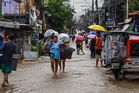
EVERY major flood in Metro Manila now feels like a rerun: the same submerged roads, the same stranded commuters, the same families carrying soaked belongings out of knee-deep water, and the same officials promising that next time will be different. Since Typhoon Ondoy in 2009, four administrations have vowed to make the capital safer. Yet each serious downpour still exposes a city that has learned too little and paid too much.
The figures are staggering. Reported flood-control spending reached roughly P1.9 trillion from 2011 to 2025, while other accounts cite about P1.2 trillion since 2009. The 2012 master plan for Metro Manila and nearby areas was costed at about P351 billion to P352 billion over two decades, yet only about 30 percent had reportedly been completed by 2024. These numbers should inspire confidence. Instead, they raise a damning question: After all that money, why does the capital still drown so easily?
The answer is uncomfortable: Metro Manila does not flood simply because the rain is strong. It floods because the city has been planned, paved, governed and neglected in ways that make disaster predictable. The flood-control funds scandal makes the indictment sharper. Public works were treated as opportunity while communities were left to absorb the water. The August 2026 rains were severe, but the paralysis was not merely an act of nature. It was the bill for treating water as a nuisance to be expelled instead of a force to be managed.
The problem is basin-wide, not barangay-wide. Sierra Madre, Laguna de Bay and Manila Bay form one connected hydrological system, with the metropolis in the middle. Waterfalls from the mountains, rushes through the Marikina-Pasig corridor, backs up against the lake, then struggles toward the bay. High tides slow its exit. Laguna de Bay has too few reliable release points. Inside the city, concrete, clogged drains and garbage-filled esteros turn rainfall into instant runoff. Pumps and cisterns help, but they are bandages on a basin-wide wound.
This is why the debate must move beyond the usual post-disaster checklist. Leaders should stop asking how quickly they can pump water out after every storm and start asking how to build a city that is not paralyzed whenever the sky opens. Heavier rainfall, rising seas, rapid urbanization and the limits of concrete-only solutions are already visible. The future is not waiting politely for the next master plan.
There are three choices. The first is business as usual dressed as progress. River works finish late. Detention tanks are announced with fanfare. Dredging intensifies only when anger peaks. The Parañaque Spillway remains trapped in studies. Stronger cloudbursts become frequent, settlements stay in danger zones, and waste chokes waterways. By the 2030s, “once in a generation” floods may arrive often enough to make the phrase meaningless. This is not a warning about some distant future. It is the road we are already on.
The second path is the expensive gray compromise. Build upstream dams and retarding basins. Upgrade the Pasig-Marikina channel. Construct a controlled spillway from Laguna de Bay to Manila Bay. These are necessary, but not enough. They would reduce peak flows and shorten flooding around the lake, yet still leave the city itself vulnerable. Street-level floods will follow every intense cloudburst if the urban fabric continues to repel water. We will have purchased time, not resilience.
The third path is the only one worthy of a serious capital: A water-smart metropolis that slows, stores, absorbs, cleanses, and releases water by design. Upstream, restored watersheds, retarding basins, and flow-through dams can soften the first surge. Along the Marikina-Pasig system, river capacity must be protected through dredging and strict no-build zones. Laguna de Bay needs a controlled outlet so it can function as a reservoir, not an overflowing bathtub. Inside the city, streets must become sponges through permeable pavements, rain gardens, bioswales, green roofs, recessed parks and underground cisterns. Garbage must be treated as flood control, not just sanitation.
This is not fantasy urbanism. Tokyo has massive underground reservoirs. Singapore regulates water at the source. Copenhagen turned public spaces into cloudburst buffers. China’s sponge-city pilots show that dense urban areas can absorb more rain. Metro Manila even has a small proof of concept beneath Burgos Circle in Bonifacio Global City. The point is clear: The obstacle is not technology. It is priority.
The work plan is clear. In the next three years, government should finish critical gates and channel improvements, open large cisterns, clear the worst esteros, and require sponge-city standards in new developments and road projects. In five to eight years, it should begin the spillway, complete priority upstream storage, and retrofit flood-prone corridors. Above all, the Pasig-Marikina-Laguna-Manila Bay system must be governed as one basin, not as separate agency turf. Real-time forecasting should guide operations. Design standards must assume harsher rainfall, not yesterday’s averages.
The harder work is institutional. The Department of Public Works and Highways, the Metropolitan Manila Development Authority, the Laguna Lake Development Authority, the Department of Environment and Natural Resources, and local governments must stop acting like parts of a broken machine. Flood control also demands transparency after years of projects that spent public money without delivering public safety. Communities in the most dangerous areas must be moved humanely, with livelihood support. Resilience cannot mean forcing the poor to pay first while the system reforms last.
Yes, this will cost money. But so does every flooded classroom, stalled worker, ruined sari-sari store, sick child, and lost day of transport and trade. The false economy is to spend billions on emergency response while leaving the system unchanged. Successive master plans have identified many structural pieces. What is missing is the courage to connect them, fund them honestly, maintain them consistently, and admit that water management is not seasonal work but a permanent test of governance.
The rain will keep coming. That is not negotiable. What remains negotiable is whether Metro Manila keeps meeting every storm with press conferences, procurement controversies and excuses, or finally builds a city designed to survive. A capital that treats water as waste will keep paying for damage after the fact. A capital that designs with water can protect lives, preserve mobility, and restore public trust. Metro Manila can remain a catchment basin that floods by default, or become a water-smart city that turns risk into design. After every flood, delay becomes harder to defend. After every trillion spent, excuses become harder to believe.