.png)
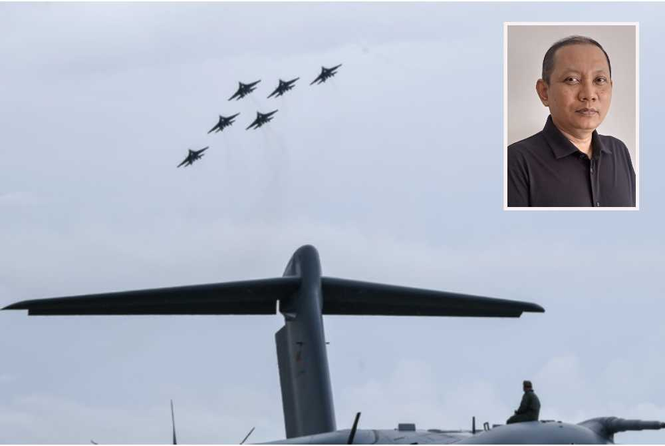
SHAH ALAM — Any proposal to relocate or organise the Langkawi International Maritime and Aerospace Exhibition (LIMA) elsewhere, including Melaka, would be unsuitable, according to defence analyst Zaki Salleh.
Zaki said Langkawi had become an integral part of LIMA's identity since the exhibition was first held in 1991, particularly as a platform for advancing Malaysia's aerospace and maritime industries.
He said one of LIMA's unique strengths was its ability to bring together both aerospace and maritime elements in a single exhibition.
"LIMA is not simply an event that happens to be held in Langkawi. Its organisation is closely linked to the island's strategic location.
"The selection of Langkawi took into account its coastal geography and airport, as well as the development of tourism and the island's economy. If LIMA were organised somewhere other than Langkawi, even the use of the name LIMA would no longer be as appropriate because the event's identity is synonymous with Langkawi," he said yesterday.
On Sunday, Defence Minister Datuk Seri Mohamed Khaled Nordin was reported to have said that the government was exploring alternatives, including Melaka, as a possible venue for LIMA in the future.
However, he said such a move would require significant government investment to ensure the necessary infrastructure was properly developed before the exhibition could be held.
Zaki said Langkawi's runway also had sufficient capacity to accommodate a large number of aircraft, particularly various types of fighter jets suitable for the exhibition's aerial segment.
He added that Langkawi's waters were also suitable for warships to berth, given the navigation channels and sea depth capable of accommodating the draught of large naval vessels.
"At the same time, international exhibitors and delegates who attend the exhibition not only participate in the event, but some also take the opportunity to extend their holidays in Langkawi before returning to their respective countries," he said.
Zaki stressed that LIMA was fundamentally a trade-oriented exhibition focused on the defence industry and international strategic relations, rather than an event whose primary objective was to attract the largest possible number of visitors.
"The government, particularly the Defence Ministry and relevant parties, also needs to reconsider the tendency to use visitor numbers as one of the main measures of LIMA's success.
"The real value of LIMA lies in bringing together governments, armed forces, aerospace and maritime industry players, decision-makers, investors and international delegations, which can generate trade opportunities and strategic cooperation," he said.
Zaki added that the trade value generated by LIMA should not be assessed solely in terms of procurement by the Malaysian Armed Forces (ATM).
Instead, it should also include business opportunities and industrial cooperation at both regional and international levels, he said.
He said Langkawi also offered advantages from a safety perspective, particularly given that several aircraft accidents had occurred during previous aerial displays.
"However, the risk of more serious accidents can be reduced because of Langkawi's location and relatively low population density.
"Open waters are crucial for maritime demonstrations and aerial displays because they provide more suitable space for such activities, including reducing risks to populated areas and the public," he said.
Zaki, who is also a journalist and defence analyst, said he had covered and attended LIMA since 1999 and had witnessed significant improvements and developments in the organisation of the exhibition over the years.
He said proposals to use other locations as a LIMA venue were not new.
Between 2003 and 2005, there had reportedly been speculation about moving the exhibition to Kota Kinabalu, Sabah, which has several similarities with Langkawi in terms of its location and geography.
However, no further action was taken as choosing a new venue would involve substantial costs, he said.
Subang had also previously been considered a suitable location, but its limitations made it more suited to hosting aviation-related events rather than an exhibition combining aerospace and maritime elements.
"The Subang International Air Carnival 2014, held at Subang Skypark from June 12 to 15, 2014, also showed that the location was more suitable for aerospace events or air carnivals. It was only held once.
"Melaka, meanwhile, already has the Melaka International Air Carnival (KUAM) at Melaka International Airport in Batu Berendam, featuring aircraft, helicopters, drones and aviation technology exhibitions," he said.
However, Zaki said KUAM did not have the maritime component that distinguishes LIMA, with its 2023 and 2024 editions focusing more heavily on aerial displays and attracting visitors.
"This is actually what the Melaka government should develop. If it wants to strengthen the aerospace sector and establish Melaka as an aviation event destination, KUAM can be expanded and strengthened without taking on LIMA's identity and name.
"LIMA already has its own brand, history and identity, built together with Langkawi over more than three decades," he said.
He said relocating LIMA would involve more than simply changing the venue, as it could risk separating the exhibition from the original identity that had become one of its greatest strengths.