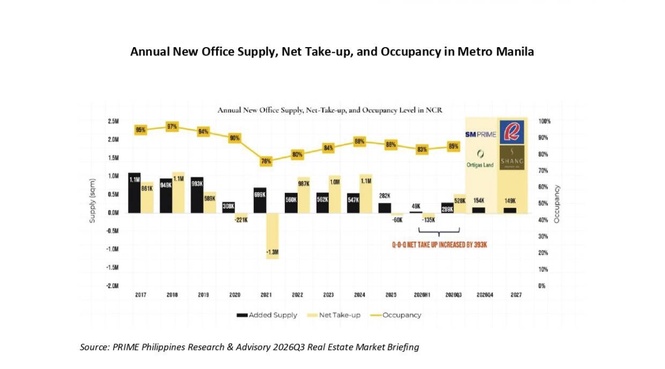
METRO Manila’s office market is absorbing space faster than developers are delivering it, according to the 2026 Q3 Real Estate Market Briefing released in October by real estate advisory firm Prime Philippines. “Metro Manila is building a fraction of the offices it used to,” the report forecasted, “Tenants who wait will pay more.”
The report recorded 528,000 square meters of net take-up in the third quarter, well above the 289,000 square meters of new supply completed in the same period. Occupancy climbed to 85 percent from 83.2 percent in the first half of the year, although it remains one point below the 2025 level.
Occupied office space reached a record 13.4 million square meters, surpassing the 13.3 million square meters recorded in 2024. The rebound comes despite a difficult macroeconomic environment, with inflation at 7.2 percent in September and the Bangko Sentral ng Pilipinas lifting its policy rate to 5 percent.
Meanwhile, only 154,000 square meters of new office space are scheduled for the fourth quarter of 2026 and 149,000 square meters for 2027. Between 2017 and 2025, Metro Manila added an average of 667,000 square meters a year. With construction costs rising and developers holding back new launches, occupiers who delay decisions may find fewer options and firmer rents.
Performance remains uneven across business districts. Bonifacio Global City commands the highest average rent at P1,157 per square meter, up 4.2 percent year on year. Makati’s average slipped 12.3 percent to P1,008, while Ortigas eased 3.3 percent to P735. Alabang posted the sharpest rent increase at 8.7 percent to P761, while the Bay Area rose 4.4 percent to P710 even as its vacancies continue to pile up. Quezon City gained 1.4 percent to P720.
Outsourcing trends
Policy seems to be turning in the market’s favor. Administrative Order 45, signed on July 23, lifted the seven-year moratorium on new information technology parks and centers in Metro Manila. The exemption covers only IT parks and IT centers, and new developers do not receive fiscal incentives. However, it allows qualified buildings to market themselves as Philippine Economic Zone Areas (PEZA) locations again.
Prime expects higher occupancy in projects with pending applications, including Arca South 1 in Taguig, Yuchengco Centre and Altaire in Makati, Parqal in the Bay Area, and One Trium Tower in Alabang.
Prime’s cost model shows why outsourcing firms (IT-BPM) weigh talent and wages above rent. Occupancy costs P2,523 per agent each month in Metro Manila, just 7.5 percent of an agent’s wage. In Cebu and Davao, that share falls to about 6 percent, and the combined cost of wages and occupancy is 8.1 percent lower in areas outside Metro Manila, 10.8 percent lower in Cebu, and 15.7 percent lower in Davao. Most of the savings come from wages.
The industry’s growth is shifting toward higher-value work. IT and digital services generate $33.3K in annual revenue per full-time employee (FTE), and global capability centers (GCCs) generate $32.3K, compared with $20.1K for contact center and business process services. Health care services sit in between at $22.4K, while game development and animation trail at $14.9K and $10.1K.
Contact centers still dominate the $53.4 billion industry, accounting for 63.5 percent of revenue. GCCs follow at 16.3 percent, IT and digital services at 11.4 percent, and health care services at 8.4 percent.
The productivity gap has direct implications for office demand. Each dollar of GCC or IT revenue requires roughly 40 percent fewer seats than a dollar earned by a contact center. Growth led by these segments will lift revenue faster than headcount. The shift is already visible in leasing, with IT-BPM firms accounting for 20.1 percent of Metro Manila office demand in 2026 Q3, up from 16.2 percent a year earlier. Prime expects the next wave of demand to favor capability over headcount, with landlords competing for fewer but higher-value seats. TMT