
Behind the roar of the engines and the visual spectacle of every liftoff at Europe's Spaceport in French Guiana, a critical division is at work whose efforts may go unnoticed unless something goes wrong: the Flight Safety Division.
This team has a clear mission: to ensure the absolute protection of the population and technical staff from the moment the rocket leaves the launch pad until all its stages have been deactivated and fallen back to Earth.
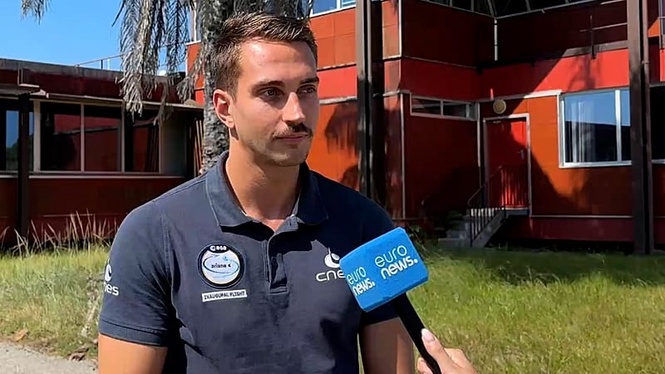
Euronews interviewed Léonard Buchaillot, a flight safety engineer at France's National Centre for Space Studies (CNES), to understand how safety is managed around a launch of this scale.
Real-time monitoring and trajectory analysis
Safety work does not begin with engine ignition. Hours before liftoff, specialists process and assess meteorological data in real time to rule out weather-related risks in Kourou.
Once the flight sequence has begun, the division takes charge of ballistic tracking:
- Trajectory analysis: the exact position of the rocket is tracked millisecond by millisecond, comparing its behaviour with theoretical models.
- Scope for intervention: the team retains the capacity to act and supervise the vehicle while it is flying over the ocean and until the launcher has passed through the atmospheric band and begins to overfly continental areas.
The red button: when and why a rocket is neutralised
Decision-making in the event of an anomaly is lightning fast. To avoid any risk on the ground or uncontrolled deviations of a hundreds-of-tonnes giant loaded with propellant, engineers work with predefined limits known as flight corridors.
If telemetry shows that Ariane 6 is deviating from the calculated trajectory and crosses the limits of that safety corridor, the protocol is automatic and non-negotiable: a neutralisation command is sent. This order triggers the launcher's self-destruct systems to break it up in a controlled way over clear ocean areas before it can pose a danger.
Léonard Buchaillot, ingeniero de seguridad aérea del CNES
High-intensity training under extreme pressure
In the flight control room there is no room for doubt or improvisation. A margin of error of just a few seconds can make the difference between a mission being safely aborted or an accident.
For that reason, the safety team undergoes continuous training through highly demanding weekly simulations. These regular drills recreate critical launcher failures in real time to fine-tune staff coordination, keep operational certifications up to date and ensure that the response to any emergency is automatic, accurate and coordinated.
This text was translated with the help of artificial intelligence. Report a problem : [feedback-articles-en@euronews.com].
