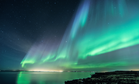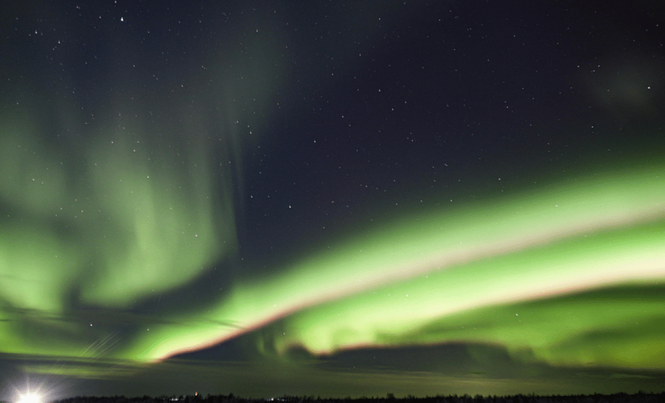
A cloud of charged particles launched by the Sun is expected to reach Earth overnight, creating conditions that could produce visible auroras across parts of the northern United States. According to NOAA, the incoming solar event may generate a G1 to G2 geomagnetic storm, giving skywatchers in as many as 19 states a chance to witness the Northern Lights if weather and space conditions align. While no widespread outbreak is expected, the event arrives during a period of heightened solar activity that continues to produce impressive displays around the world.
An Earth-Bound Solar Eruption Could Trigger a Rare Nighttime Display
The event began several days ago when the Sun released acoronal mass ejection (CME), an immense cloud of magnetized plasma traveling through interplanetary space. Unlike the intense flash of radiation produced by a solar flare, a CME carries billions of tons of charged particles that require days to reach Earth. Once the cloud collides with Earth’s magnetic field, it can disturb the planet’s magnetosphere and produce a geomagnetic storm.
Forecasts indicate this particular CME has the potential to generate G1 (Minor) or G2 (Moderate) geomagnetic storm conditions. While these levels are far below the strongest storms capable of producing auroras across much of the continental United States, they are often sufficient to bring the lights into view across the northern tier of the country. Visibility depends on multiple variables, including cloud cover, local light pollution, and the orientation of the interplanetary magnetic field when the solar material reaches Earth. Even a relatively modest storm can produce surprisingly vivid displays if those conditions align at the right moment.
Skywatchers hoping for a glimpse should expect activity to develop overnight as the CME interacts with Earth’s magnetic environment. The most favorable viewing conditions generally occur far from city lights, with an unobstructed view toward the northern horizon.
Which States Have the Best Opportunity to See the Aurora
The strongest viewing potential is expected near the U.S.-Canada border, where geomagnetic activity is naturally more intense. The best chances include northern portions of Washington, Idaho, Montana, North Dakota, South Dakota, Minnesota, Wisconsin, Michigan, and Maine.
Auroras may also become visible farther south if the storm briefly strengthens. Under those circumstances, observers in parts of Oregon, Wyoming, Nebraska, Iowa, Illinois, Indiana, Ohio, New York, Vermont, and New Hampshire could catch the faint glow near the northern horizon.
Even if the lights appear weak to the naked eye, modern smartphone cameras frequently reveal colors and structures that human vision cannot easily detect in low-light conditions. Long-exposure photography has become one of the most effective ways for casual observers to capture auroras during moderate geomagnetic storms. Clear skies remain one of the biggest factors determining whether the event becomes memorable or goes unnoticed.
Natural conditions may reduce visibility in some locations. The lingering twilight following the recent summer solstice keeps northern skies brighter later into the evening, while the bright Full Strawberry Moon may wash out fainter auroral structures.
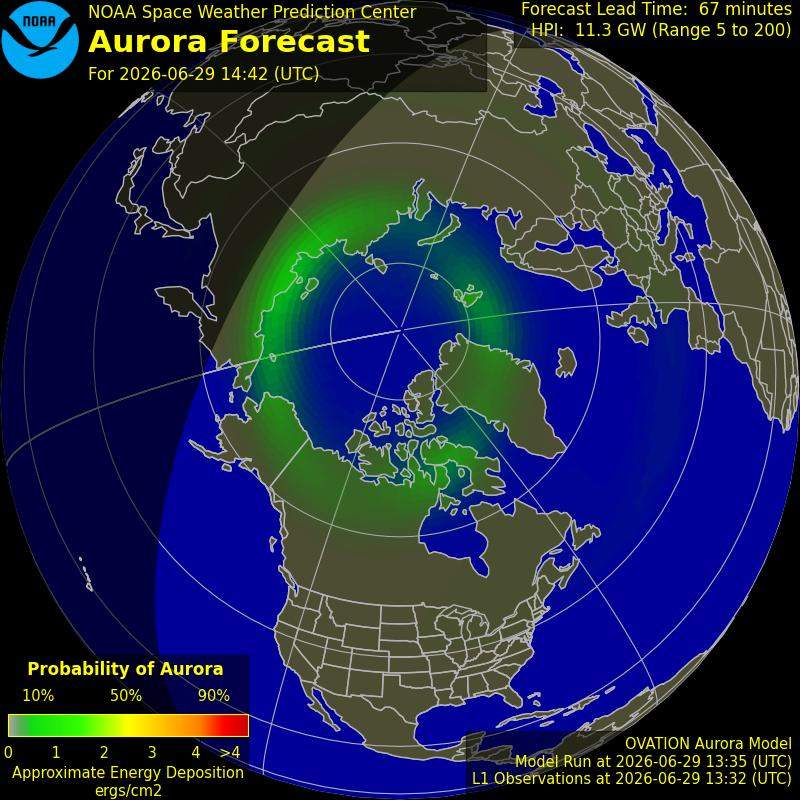
NOAA Says Solar Conditions Could Intensify Overnight
According to NOAA’s Space Weather Prediction Center, enhanced geomagnetic activity is expected as the CME arrives at Earth. The agency’s forecast indicates that conditions may strengthen during the early hours as the solar material begins interacting with the planet’s magnetic field.
Space weather forecasting remains a dynamic science because the exact strength of a geomagnetic storm cannot be determined until the solar cloud actually reaches Earth. One of the most influential variables is the Bz component of the interplanetary magnetic field. When that magnetic field turns southward, it connects more efficiently with Earth’s magnetic field, allowing greater amounts of solar energy to enter the magnetosphere. This process fuels brighter and more widespread auroras.
For that reason, forecasts are updated frequently throughout the event. A storm initially expected to remain minor can strengthen rapidly if magnetic conditions become favorable, while a stronger forecast may weaken if the solar cloud arrives with a different magnetic orientation than expected. Scientists continuously monitor incoming solar wind data to refine predictions in near real time.