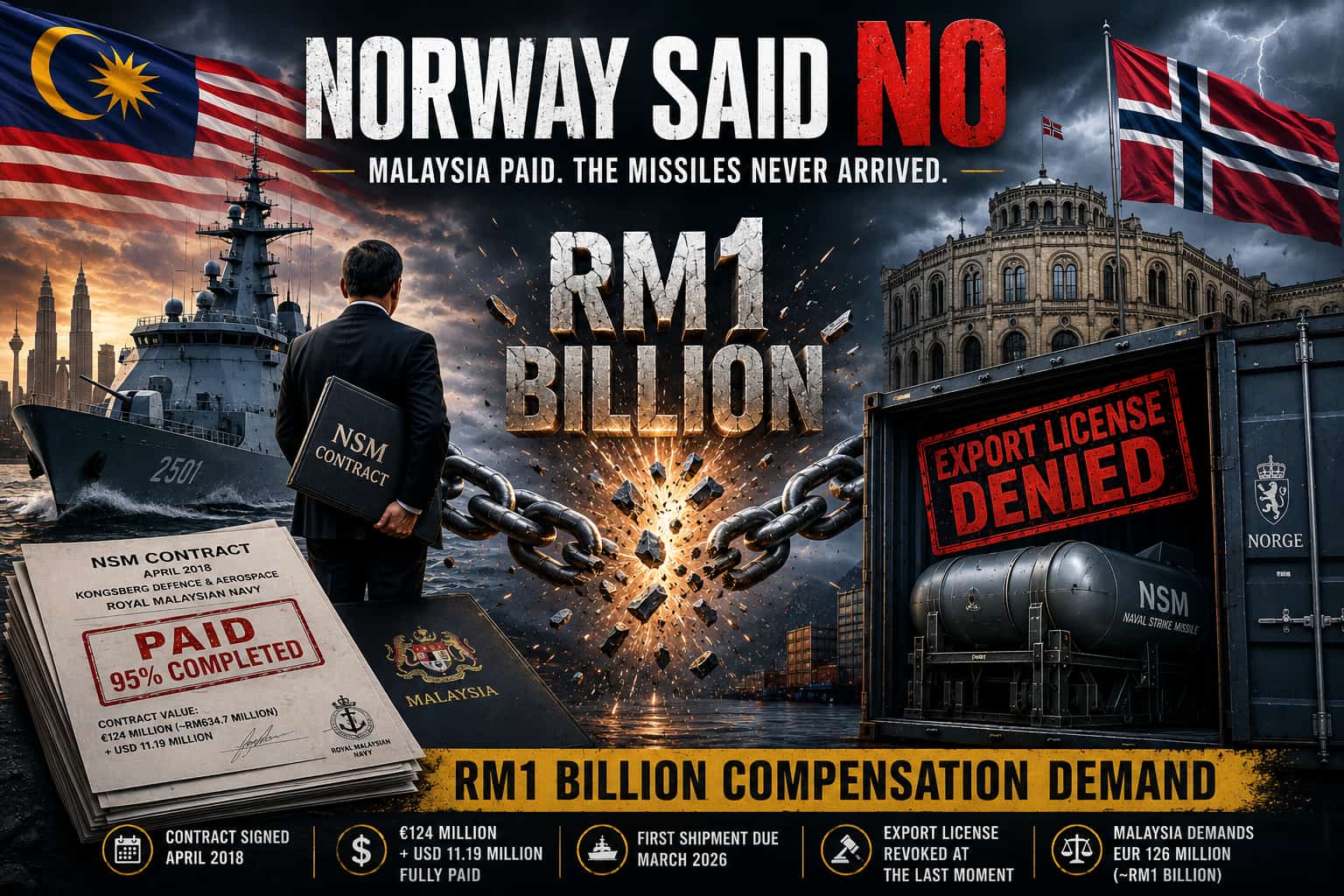
This story deserves more attention than it has received. Because what happened here isn't just a defense procurement dispute. It's a fundamental question about whether a country that pays for something in good faith, over eight years, honouring every contractual obligation, can have the product withheld at the last moment by the seller's government for reasons that were never disclosed in the contract.
The original deal was signed in April 2018 between Kongsberg Defense and Aerospace and the Royal Malaysian Navy: a €124 million (approximately RM634.7 million) contract to supply Naval Strike Missiles (NSM) for six new Maharaja Lela-class Littoral Combat Ships. A second contract for NSM launchers on the KD Jebat and KD Lekiu frigates added another USD 11.19 million. Malaysia fulfilled both contracts. Every payment. On schedule.
Then, a few days before the first shipment was due to leave Norway in March 2026, Oslo informed Kuala Lumpur that the export license would not be approved. No warning. No renegotiation. No alternative. Just a phone call and a revocation. Norway's stated reason was national security grounds, later described as "stricter controls of certain technologies," believed to relate to a US-made gyroscope component within the NSM system. The Norwegian government has not publicly detailed the specifics.
Prime Minister Anwar Ibrahim was incandescent. "Signed contracts are solemn instruments. They are not confetti to be scattered in so capricious a manner," he said in a statement after calling Norwegian Prime Minister Jonas Gahr Støre to convey Malaysia's "vehement objection". In diplomatic language, that is about as strong as it gets.
The financial stakes are now significant. Malaysia has issued a formal notice of demand seeking EUR 126 million, approximately USD 251 million or close to RM1 billion, covering direct losses from payments already made, plus indirect losses. Malaysia had paid more than 95% of the contract value before the cancellation.
Euronews reported that Kongsberg itself distanced from the decision, stating that export licensing is handled entirely by Norwegian authorities. Norway has not publicly commented on the revocation or on Malaysia's demand for compensation.
The deeper issue raised by this incident is one that applies far beyond the NSM and Malaysia. If European defense suppliers can revoke export licenses on delivered or near-delivered contracts citing vague national security grounds, with no compensation mechanism and no transparency, what exactly is the value of those contracts to any buyer outside NATO? Malaysia is asking that question loudly. It should be.
My Opinion
"If European defense suppliers reserve the right to renege with impunity, their value as strategic partners flies out the window." That's Anwar's line and it's exactly right. Malaysia isn't just fighting for RM1 billion here. It's establishing a principle that contract commitments mean something. The alternative, a world where powerful countries can simply decide mid-delivery that they don't want to complete a deal, is a world where the smaller players cannot plan, cannot invest, and cannot trust.
Ronny M (ronny76netstuff@gmail.com) is a content creator under the Newswav Creator programme, where you get to express yourself, be a citizen journalist, and at the same time monetize your content & reach millions of users on Newswav. Log in to creator.newswav.com and become a Newswav Creator now!
The User Content (as defined on Newswav Terms of Use) above including the views expressed and media (pictures, videos, citations etc) were submitted & posted by the author. Newswav is solely an aggregation platform that hosts the User Content. If you have any questions about the content, copyright or other issues of the work, please contact creator@newswav.com.