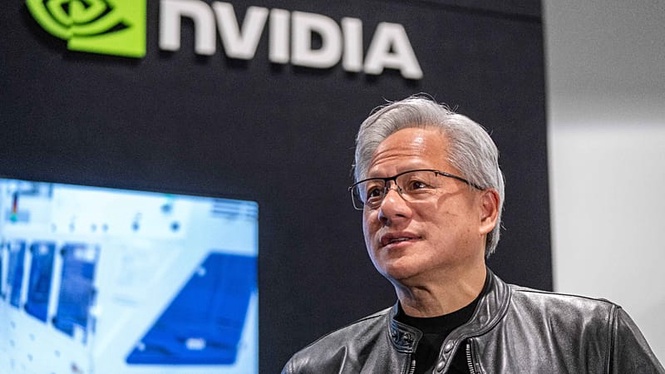
Nvidia reinstated Jensen Huang as president, CEO and board member on Monday, effective immediately. The decision comes just eleven days after Huang's resignation.
The board voted unanimously to bring Huang back after a series of meetings with him left directors satisfied with his "candor and ability to lead", the firm said in a statement.
Nvidia shares jumped over 30% from their Friday close at the start of US trading on Monday following the announcement. The rally spread across Wall Street, with both the Nasdaq Composite and the S&P 500 up more than 4% in early trading.
Depending on the close, the stock is on track to add more than $1 trillion (€910bn) in market capitalisation on Monday, potentially making it the first in history to do so.
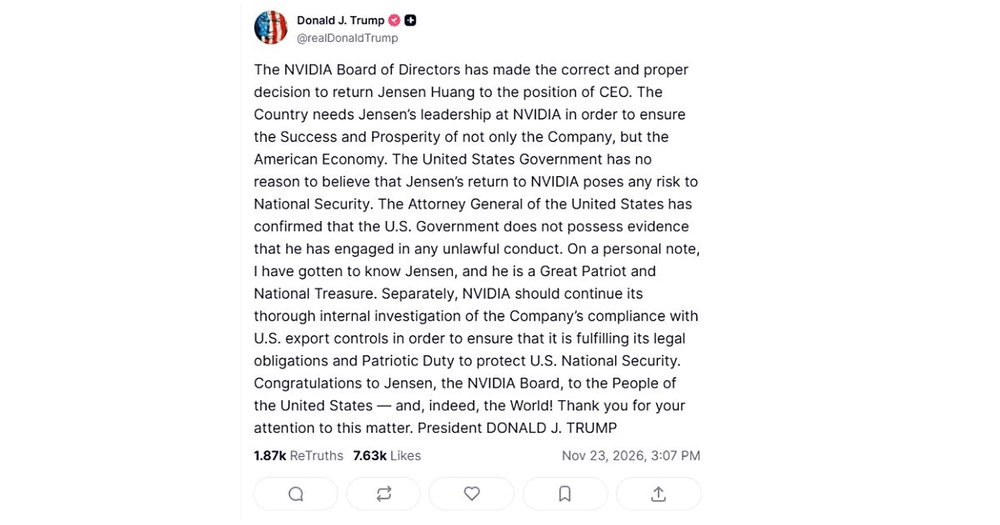
US President Donald Trump hailed the decision in a social media post, writing that Nvidia's board had made the "correct and proper decision" and adding that "the country needs Jensen's leadership at NVIDIA in order to ensure the success and prosperity of not only the company, but the American economy".
Trump, who had publicly called for Huang's return and on Friday described him as "one of the truly most brilliant minds in the world", later told US broadcaster CNBC he had been "speaking to the board directly and indirectly" about the decision.
"The board was placed in a very bad position. I think the board acted really responsibly," he said.
Huang has been one of AI's most visible champions as he fuelled the boom in the sector through deals that helped finance Nvidia's suppliers and customers as they built the infrastructure that runs on its chips.
Huang has built a close relationship with Trump since the president returned to the White House, making frequent trips to Washington and negotiating directly with the administration over chip exports to China.
Nvidia also gave $25 million (€23m) to Trump's White House ballroom project, according to a donor list published by The Washington Post.
His departure left investors asking whether Nvidia could keep up the pace of dealmaking and whether its customers would stick to the spending plans that had helped drive the AI boom originally.
The decision came less than two weeks after the Nvidia co-founder resigned following reports of extramarital affairs, including one with Chinese businesswoman Alice Huang, who was alleged to be a spy.
US Attorney General Todd Blanche said on 12 November that the FBI was investigating reports that she had worked for the Chinese government and that the Justice Department had yet to reach a conclusion.
Meanwhile, Beijing has rejected the espionage allegations.
Reacting to the Nvidia board's decision, Trump rebuffed the claims by stating that "the United States Government has no reason to believe that Jensen's return to NVIDIA poses any risk to National Security."
He also told CNBC that Huang "didn't know about" advanced Nvidia chips going to China.
The board said it had received input from senior US government officials and was also confident that Huang's return posed no national security risk.
The decision stands in stark contrast to the board's position last week.
Nvidia had said it would consider internal and external candidates to replace Huang, who had signalled he was willing to return if asked. While Nvidia reported better-than-expected quarterly results last week, board chair Harvey Jones told investors that the board did not intend to reinstate Huang.
On Monday, Jones said the board believed Huang was "the right person to lead NVIDIA" and that bringing him back was in the interests of shareholders, employees, partners and customers.
He also thanked Colette Kress for serving as interim CEO. Kress will remain CFO, and Jones will stay on as chair.
Huang said he was honoured to return and would take on the role with "the greatest humility and renewed commitment."
RelatedNvidia also clarified that a committee of independent directors would continue investigating reports that Huang had been targeted by a foreign intelligence effort. The committee has hired independent lawyers, and Huang supports the investigation and has pledged to cooperate, the company said.
A separate committee of independent directors will oversee trade compliance and national security risks, with help from specialist lawyers and advisers.
The company said it would continue to cooperate with any government investigations and inquiries.
Huang is still due to face questions from three US House committees on 1 December in a session that will be a transcribed interview, but will not be open to the public.