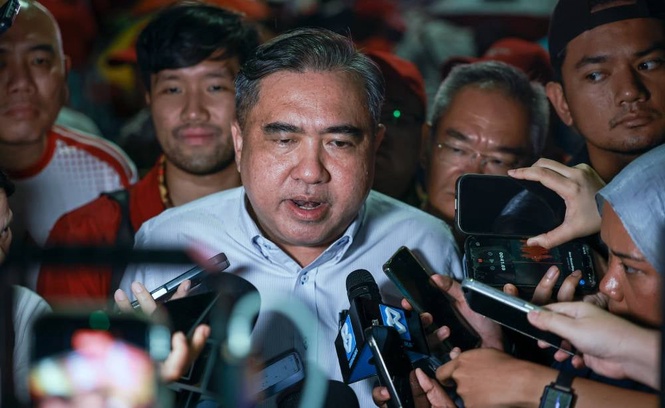
ANTHONY Loke's departure from the Cabinet may appear to be a straightforward ministerial change. But in the delicate political balance of Malaysia's unity government,, one resignation could open up a much bigger political conversation.
For DAP, the immediate task is to find someone to take over the Transport Ministry.
For Prime Minister Datuk Seri Anwar Ibrahim, he can either make a straightforward replacement or use the opportunity to review the wider Cabinet line-up.
The circumstances surrounding Loke's resignation make the situation unusual.
The DAP secretary-general submitted his resignation letter to Anwar on Sept 28 in protest against the conditional royal pardon granted to former prime minister Datuk Seri Najib Razak, which allows him to serve the remainder of his SRC International sentence under house arrest.
But Loke agreed to continue serving until Najib returned home.
On Nov 10, the Kuala Lumpur High Court issued a fresh order allowing Najib to serve the remainder of his sentence under house arrest, following an application by the Attorney-General's Chambers seeking clarification of the earlier order.
This brings the question of Loke's departure into sharper focus. Who will take his place as Transport and what could the change mean for DAP's position in government?
Among those who could be considered are Entrepreneur Development and Cooperatives Minister Steven Sim Chee Keong, Digital Minister Gobind Singh Deo, Housing and Local Government Minister Nga Kor Ming, and Minister in the Prime Minister's Department (Federal Territories) Hannah Yeoh.
Deputy ministers such as Teo Nie Ching and Liew Chin Tong could also feature in discussions about the party's pool of future future leaders.
The vacancy also presents DAP with an opportunity to demonstrate that its leadership is genuinely multiracial, with capable younger leaders ready to take on greater national responsibilities.
Its choice of successor could show whether its talent pool extends beyond established senior figures and whether leadership renewal is possible across generations and ethnic backgrounds.
Can DAP produce a successor who not only manages a major ministry but also reflects the diversity of the party it says it wants to be?
But perhaps the more interesting political question is whether Transport will remain under DAP.
Cabinet appointments are made by the Yang di-Pertuan Agong on the advice of the Prime Minister. DAP can put forward a recommendation and negotiate with Anwar, but the final decision rests with him.
Anwar could retain the portfolio for DAP, appoint someone from another component party or consider a wider redistribution of responsibilities.
If DAP loses Transport, it will have to decide whether to accept a different allocation or negotiate for another position.
The issue is not simply the prestige attached to a ministry. It is about the influence each party wields in a government dependent on cooperation among political partners with different interests.
Loke's departure is also not the only Cabinet matter requiring attention.
Finance Minister II Datuk Seri Amir Hamzah Azizan's three-year term as a senator is due to end on Dec 11. If he is to remain in the Cabinet, his Senate appointment would need to be renewed.
This raises the possibility of two ministerial changes within a relatively short period, although it does not necessarily mean a major reshuffle is imminent.
Asked about the possibility on Nov 10, Anwar said it was too early to consider one.
Nevertheless, the vacancy at Transport and the impending end of Amir Hamzah's Senate term give the Prime Minister an opportunity to review whether the current distribution of portfolios still serves the government's priorities.
A wider reshuffle could involve moving ministers, elevating deputy ministers or redistributing responsibilities among coalition partners.
But such changes would require political negotiations. A reshuffle perceived as favouring one partner at the expense of another could create fresh tensions.
For Anwar, the challenge is to ensure that any Cabinet changes serve the government's priorities rather than merely accommodate competing political interests.
Ultimately, Malaysians are less concerned about which party controls which ministry than whether the government delivers.
Transport users want reliable trains, safer roads and better public transport, not another round of political negotiations.
Loke's resignation began as a statement of political principle over Najib's house arrest. It could end up becoming a test of DAP's leadership renewal and Anwar's ability to manage the coalition.
One minister's departure may create one vacancy. But if DAP uses it to rethink its leadership and Anwar uses it to reshape his Cabinet, the consequences could reach far beyond the Transport Ministry.