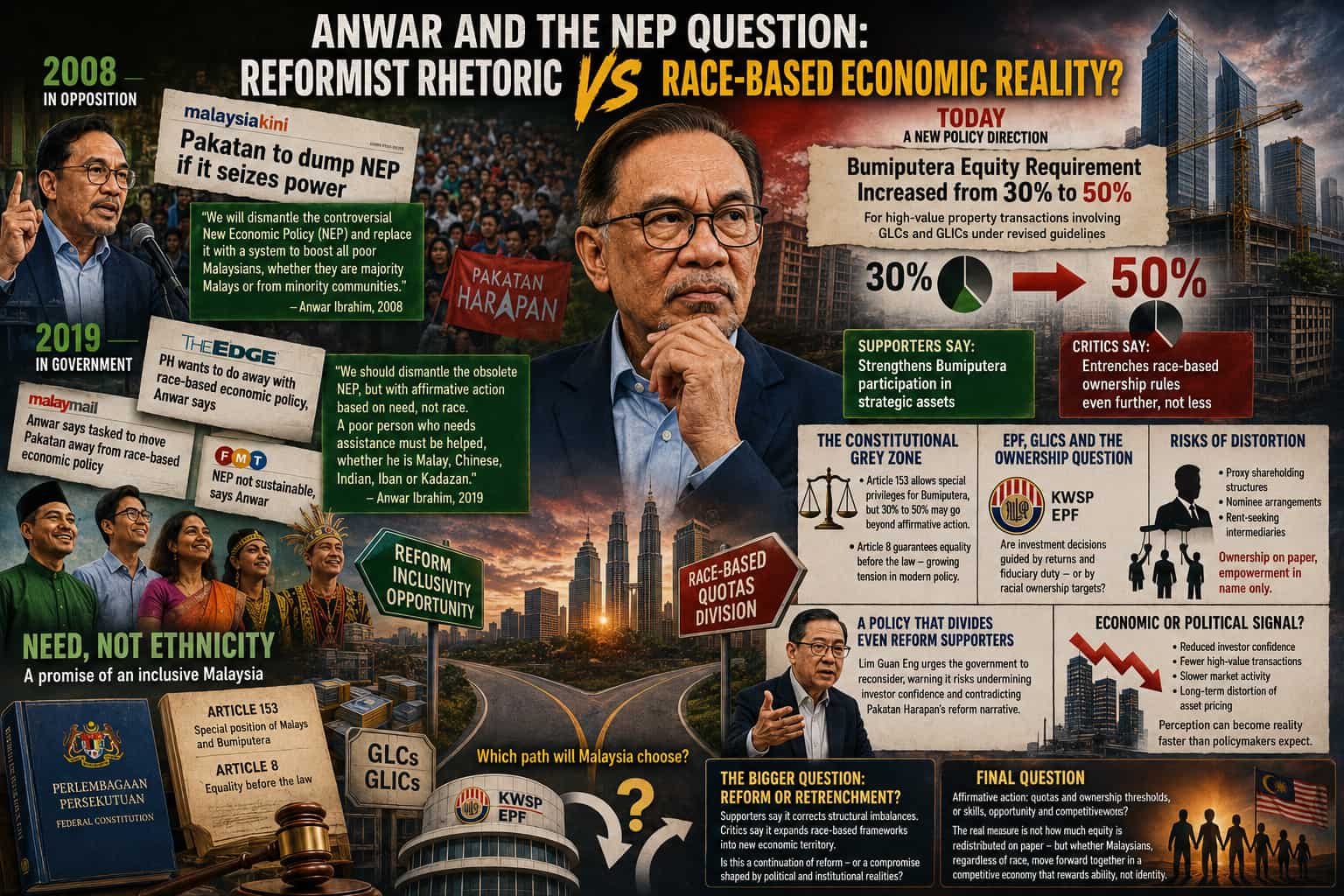
Once upon a time, Dato' Seri Anwar Ibrahim sounded very clear about one policy that divides Malaysians: the New Economic Policy (NEP) had run its course.
As M. Krishnamoorthy - a former associate professor, author, media coach, and journalist - highlighted, back in 2008, when he was still in opposition, headlines such as “Pakatan to dump NEP if it seizes power” captured a bold promise: that a future government under Pakatan would move away from race-based economics and replace it with a needs-based system.
Fast forward to 2019, and the message appeared largely consistent. Reporting by The Edge and other outlets quoted Anwar describing the NEP as “obsolete” and “not sustainable”, arguing instead for affirmative action that helps the poor regardless of race. Malay, Chinese, Indian, Iban or Kadazan - the framing was simple: need, not ethnicity.
At the time, it sounded like a clear ideological direction: Malaysia was supposed to be moving beyond race-based economic engineering toward a more inclusive model of redistribution.
But today, a new policy direction is raising uncomfortable questions.
From NEP Reform to Equity Expansion?
The latest controversy centres on a policy expanding Bumiputera equity requirements from 30% to 50% for high-value property transactions involving Government-Linked Companies (GLCs) and Government-Linked Investment Companies (GLICs), under revised Property Acquisition Guidelines.
Supporters say this strengthens Bumiputera participation in strategic assets.
Critics say it does something very different: it entrenches race-based ownership rules even further, not less.
And for many observers, the question is no longer technical - it is political.
The Constitutional Grey Zone
Lawyer and activist Siti Kasim has been among those warning that the policy may stretch the original spirit of Article 153 of the Federal Constitution.
While Article 153 allows for special privileges for Bumiputera, critics argue that pushing equity requirements from 30% to 50% may go beyond affirmative action into deeper structural preference.
At the same time, Article 8 guarantees equality before the law - creating what some describe as a growing tension between constitutional protection and modern economic policy.
But the issue does not end in law books.
It spills directly into real money.
EPF, GLICs and the Ownership Question
One of the more sensitive concerns is that the policy affects GLIC-linked transactions - including institutions tied to retirement savings like the Employees Provident Fund (EPF).
This raises a difficult question:
Are investment decisions being guided by returns and fiduciary duty - or by racial ownership targets?
Siti argues that this could open the door to:
• proxy shareholding structures
• nominee arrangements
• rent-seeking intermediaries
In short, ownership may increase on paper - without real economic empowerment underneath it.
A Policy That Divides Even Reform Supporters
Perhaps the most politically sensitive part is not opposition from critics - but discomfort within reformist circles themselves.
DAP veteran Lim Guan Eng has publicly urged the government to reconsider, warning that expanding equity requirements risks undermining investor confidence and contradicting the broader reform narrative Pakatan Harapan once championed.
For supporters who once rallied behind the idea of a post-racial economic framework, the shift feels less like evolution - and more like reversal.
Economic Signal or Political Signal?
Economists and critics argue that forcing higher equity thresholds in high-value transactions sends a clear message to investors: ownership is no longer purely market-driven.
Even if well-intentioned, the concern is about perception:
• reduced investor confidence
▪︎ fewer high-value transactions
• slower market activity
• long-term distortion of asset pricing
And in a region where capital flows quickly to policy-friendly environments, perception can become reality faster than policy makers expect.
The Bigger Question: Reform or Retrenchment?
Supporters of the policy insist it is about strengthening Bumiputera participation in strategic sectors and correcting structural imbalances that still exist decades after the NEP was introduced.
But critics see a different pattern forming: instead of moving away from race-based frameworks, Malaysia may be expanding them into new economic territory.
And that brings the debate back to Anwar Ibrahim himself.
Is this a continuation of reform - or a compromise shaped by political and institutional realities?
Final Question
Malaysia’s economic debate has never really been about numbers alone.
It is about philosophy.
Should affirmative action be defined by helping the needy and not ethnicity, ownership thresholds, and quotas? Or should it evolve into a system built on skills, opportunity, and competitiveness?
Because in the end, the real measure is not how much equity is redistributed on paper, but whether Malaysians, regardless of race, are genuinely moving forward together in a competitive economy that assists the poor, rewards ability, and not identity.
By: Kpost
Newswav , Newswav , YouTube/SitiKasim , Malaymail
Kpost (ckhorsk@gmail.com) is a content creator under the Newswav Creator programme, where you get to express yourself, be a citizen journalist, and at the same time monetize your content & reach millions of users on Newswav. Log in to creator.newswav.com and become a Newswav Creator now!
The User Content (as defined on Newswav Terms of Use) above including the views expressed and media (pictures, videos, citations etc) were submitted & posted by the author. Newswav is solely an aggregation platform that hosts the User Content. If you have any questions about the content, copyright or other issues of the work, please contact creator@newswav.com.