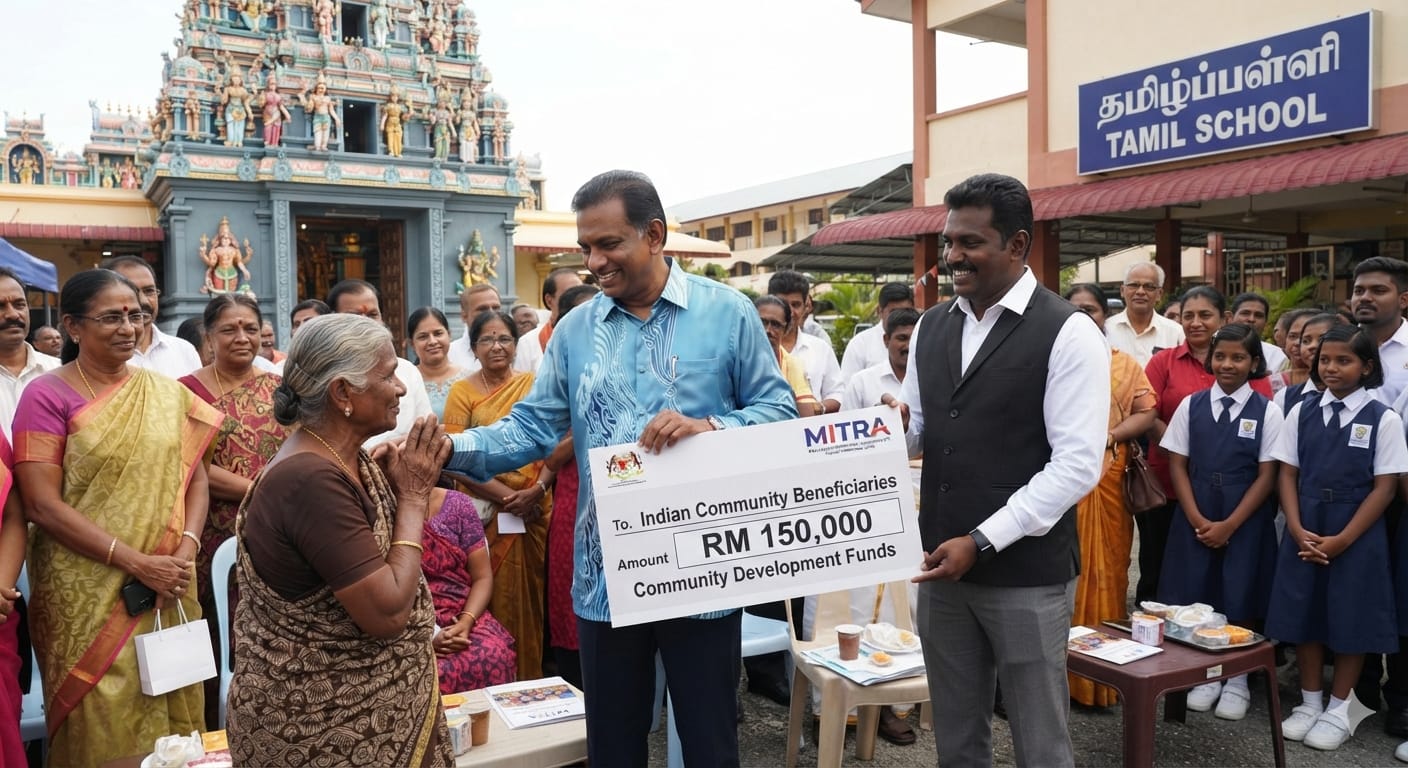
Every few years, the Malaysian Indian community hears a familiar announcement. A minister steps onto a stage, cameras begin flashing, and millions of ringgit are promised under banners of empowerment, transformation, and inclusive development. For a brief moment, hope rises. Parents imagine better opportunities for their children. Young entrepreneurs begin to dream of expanding their businesses. Community organisations believe that perhaps, this time, meaningful change is finally within reach.
Then comes the waiting.
Applications are submitted. Forms are filled. Supporting documents are gathered. Committees are formed. Evaluations are conducted. Meetings follow meetings. Somewhere along the journey, excitement quietly fades into uncertainty. People begin asking the same question they have asked for years: When will the help actually arrive?
This has long been the story surrounding the Malaysian Indian Community Transformation Unit (MITRA). Created with the noble intention of uplifting the Malaysian Indian community through education, entrepreneurship, skills development and socioeconomic programmes, MITRA has often struggled under the weight of bureaucracy, shifting leadership priorities and inconsistent delivery. For many ordinary Malaysians, the agency became associated more with announcements than with measurable outcomes.
It is against this backdrop that recent developments deserve careful attention rather than immediate celebration or outright criticism.
Human Resources Minister Datuk Seri R. Ramanan recently announced that more than 700 Malaysian Indian entrepreneurs will benefit from the newly introduced Uyarvu MADANI Grant Programme. At the same time, Prime Minister Datuk Seri Anwar Ibrahim approved an additional RM50 million allocation, raising MITRA’s total budget from RM100 million to RM150 million.
These are not insignificant developments.
Credit should be given where it is due.
Compared with the slower pace witnessed previously, there is clearly greater administrative momentum. Securing an additional RM50 million from the federal government is not a routine achievement. Expanding programmes to reach hundreds of entrepreneurs within a relatively short period suggests that the machinery is beginning to move more efficiently than before. Leadership should always be judged fairly criticised when it fails, but acknowledged when it delivers.
However, context remains important.
Many Malaysians will remember that only months earlier, MITRA chairman Prabakaran announced that RM652,000 had been distributed to just 128 Indian micro-entrepreneurs in Johor. That announcement quickly became a symbol of public frustration, as many questioned how a RM100 million allocation could appear to move so slowly at ground level. Critics wondered whether the agency had become trapped in administrative processes while the community continued waiting outside.
Today, the narrative appears somewhat different.
The budget has increased.
The number of beneficiaries has increased.
The pace appears faster.
Yet when viewed over a longer period, both leadership phases combined have reached only 828 individuals.
That contrast tells its own story.
Yes, progress is happening.
But the scale remains limited.
Across Malaysia, thousands of Indian-owned businesses operate quietly without ever making headlines. They are mechanics repairing vehicles in Klang, grocery shop owners in Sungai Siput, Akka kadai operators in Penang, flower sellers outside temples, home-based food entrepreneurs in Johor Bahru, digital freelancers navigating online markets, and young graduates attempting to launch start-ups from modest beginnings.
Every one of them contributes to Malaysia’s economy.
Every one of them faces rising costs, changing consumer behaviour, increasing competition and limited access to capital.
Helping 700 entrepreneurs is meaningful.
But transforming an entire community requires far more than that.
This is where MITRA must begin to evolve.
For decades, development programmes targeting minority communities have largely focused on distributing financial assistance. While such assistance remains necessary, especially for lower-income groups, grants alone rarely create long-term prosperity. They provide temporary relief. They reduce immediate pressure. They create breathing space.
What they do not automatically create is sustainable success.
Real transformation requires systems, not just interventions.
Imagine if every Malaysian Indian student who struggled academically received structured support, mentorship and alternative pathways instead of quietly dropping out of the education system. Imagine if entrepreneurs received not only funding but also access to mentors, financial advisors, digital marketing expertise and broader market networks. Imagine if Tamil schools became centres of innovation where technology, entrepreneurship and cultural identity were developed side by side. Imagine if graduates entered structured leadership pipelines connected to industries, corporations and emerging sectors.
That is what transformation truly looks like.
Not merely the distribution of cheques.
But the creation of lasting change.
Success should not be measured by how much money is spent, but by what changes after it is spent.
How many businesses remain operational and profitable three years after receiving assistance?
How many students successfully complete their education because of targeted support?
How many families permanently escape the cycle of poverty?
How many entrepreneurs grow from small operations into sustainable enterprises that employ others?
These are the indicators that truly matter.
The Malaysian Indian community has become increasingly aware of this reality. It is no longer satisfied with announcements alone. It demands results. It compares promises with outcomes. It questions implementation and expects accountability from those in positions of leadership.
This should not be mistaken for cynicism.
It is a sign of progress.
History has shown that when communities feel unheard, they respond decisively. The political shift of 2008 demonstrated that even a numerically smaller voting bloc can significantly influence national outcomes when frustration reaches a tipping point. In many constituencies, the Indian vote became a decisive factor.
That lesson remains relevant today.
The Malaysian Indian community is no longer asking merely for representation.
It is asking for tangible progress.
Better schools.
Better employment opportunities.
Stronger and more competitive businesses.
Greater access to professional careers.
Real pathways for upward mobility.
MITRA has the potential to play a meaningful role in achieving these goals but only if it refuses to become complacent.
The additional RM50 million allocation should not be viewed as a kilometre.
It should be seen as a starting point for deeper transformation.
The real challenge lies in defining success.
If success simply means spending RM150 million, then MITRA has misunderstood its purpose.
If success means assisting 700 entrepreneurs, then it has made a respectable beginning.
But if success means building a generation of confident, capable and competitive Malaysians who can thrive in a rapidly changing economy, then the work has only just begun.
Education must remain central to this effort.
Too many students continue to fall behind due to financial hardship, unstable environments or lack of exposure to opportunities. Many who fail SPM quietly disappear into low-income employment without structured pathways back into education or skills training.
MITRA must intervene earlier.
It must focus not only on responding to failure, but on preventing it.
Investment in Technical and Vocational Education and Training is essential. Partnerships with universities, industries and emerging sectors must be strengthened. Tamil schools should be supported not only as educational institutions but also as cultural pillars that nurture identity, confidence and aspiration.
Communities that successfully balance identity with innovation are the ones that thrive.
Those that fail to do so risk being left behind.
As Malaysia moves steadily towards a knowledge-based economy, the Malaysian Indian community cannot afford to remain anchored in outdated development models.
Grants alone will not close the gap.
Investment in people will.
Investment in systems will.
Investment in confidence will.
One day, MITRA’s success should not be measured by how much money it has distributed, but by how many individuals no longer require assistance because they have achieved stability and success on their own.
That should be the ultimate goal.
Not dependency.
But empowerment.
Datuk Seri R. Ramanan deserves recognition for accelerating momentum and demonstrating that improved implementation is possible. However, communities rarely remember how much money was announced at a press conference. They remember whether their lives improved because of it.
MITRA’s true legacy will not be defined by its budget.
It will be defined by whether it changed lives.
When that happens, MITRA will finally fulfil the promise embedded in its name not merely transforming figures on paper, but transforming the future of an entire community.
Annan Vaithegi opinion writer on society, culture, and public affairs.
Annan Vaithegi (annanvaithegi@icloud.com) is a content creator under the Newswav Creator programme, where you get to express yourself, be a citizen journalist, and at the same time monetize your content & reach millions of users on Newswav. Log in to creator.newswav.com and become a Newswav Creator now!
The User Content (as defined on Newswav Terms of Use) above including the views expressed and media (pictures, videos, citations etc) were submitted & posted by the author. Newswav is solely an aggregation platform that hosts the User Content. If you have any questions about the content, copyright or other issues of the work, please contact creator@newswav.com.