Political Analysis & Commentary
By Sandra Segaran Arumugam
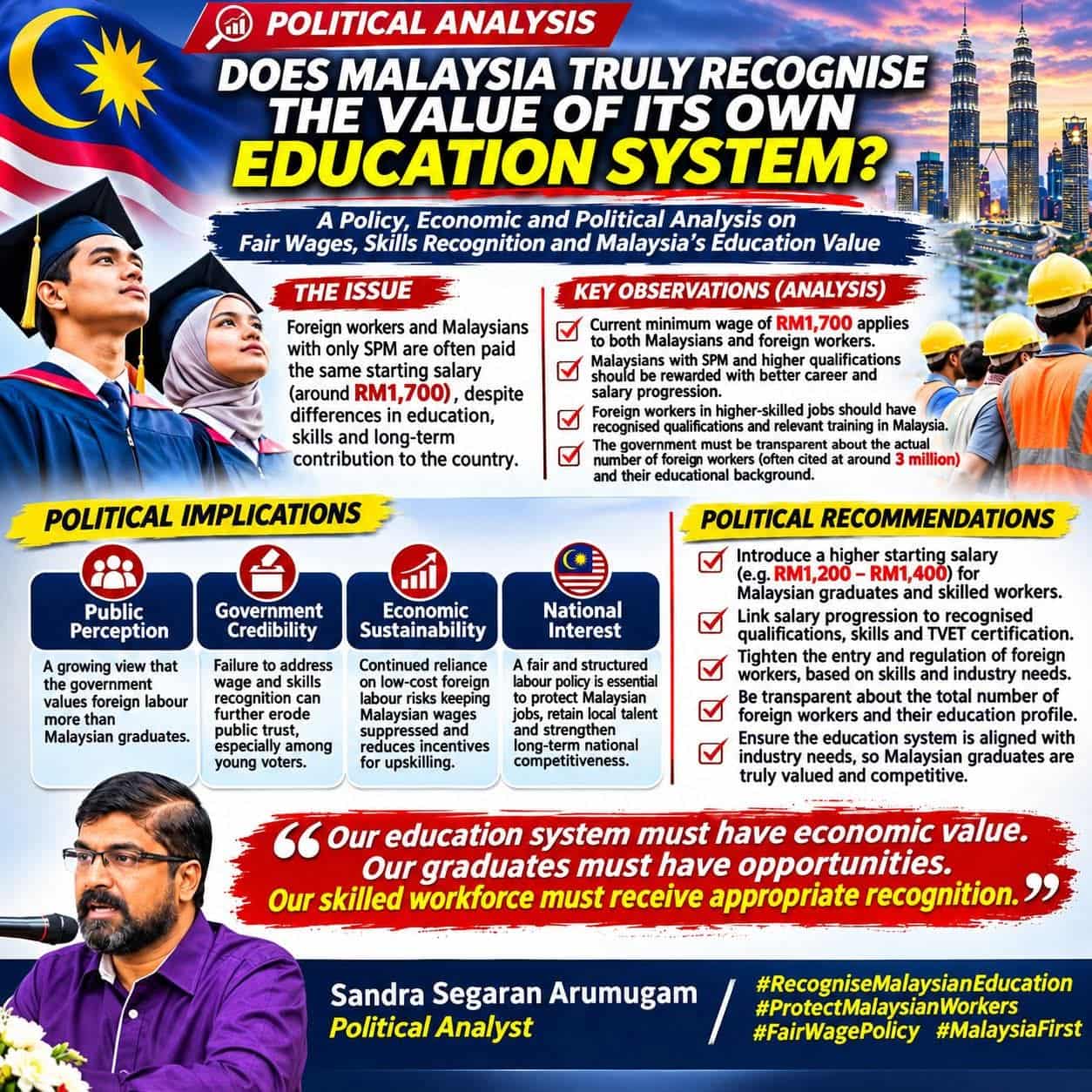
Equal minimum wages for Malaysians and foreign workers must come with stronger recognition of education, skills and qualifications
Malaysia's current minimum wage policy raises an important question about how seriously the government values education, professional qualifications and the future of our local workforce.
Under the current policy, Malaysian citizens and foreign workers in the private sector are entitled to the same minimum basic salary of RM1,700 per month, subject to the applicable legal exemptions.
I am not questioning the rights of foreign workers to receive fair wages. Every individual who contributes to the Malaysian economy deserves fair treatment and protection under the law.
However, I strongly believe that the government must reconsider whether our existing employment and wage policies sufficiently recognise the educational achievements, professional qualifications and skills acquired by Malaysians.
Consider this situation: A Malaysian who has successfully completed the Sijil Pelajaran Malaysia (SPM) after years of schooling enters the employment market and receives the same minimum basic wage as a foreign worker who may not possess an equivalent educational qualification.
This raises a fundamental question: What message are we sending to our younger generation about the value of education?
Malaysian parents invest their hard-earned money in their children's education. Students spend years attending primary and secondary schools, pursuing higher education, obtaining professional qualifications and developing technical skills.
Some even take education loans and make significant financial sacrifices to obtain diplomas and university degrees.
Yet, when they enter the employment market, their starting salaries may not adequately reflect their additional qualifications and skills.
What is the real value of education if our employment market fails to recognise the differences in qualifications, competencies and productivity?
The growing dependence on foreign labour
I also wish to highlight Malaysia's continued dependence on foreign workers.
Official government statistics indicate that Malaysia had approximately 2.08 million registered low-skilled foreign workers as at August 2026.
This figure highlights the importance of reviewing our foreign workforce policies, particularly in relation to employment sectors, workforce planning, skills development and national productivity.
The government must provide greater transparency regarding the composition of our foreign workforce, including their employment sectors, qualifications and contributions to the national economy.
More importantly, Malaysia must ensure that the recruitment of foreign workers does not undermine opportunities for local workers or discourage younger Malaysians from pursuing higher education and professional development.
What can Malaysia learn from Singapore?
Malaysia should also examine how neighbouring countries, particularly Singapore, manage their foreign workforce and skilled employment sectors.
Singapore has established employment eligibility requirements for foreign professionals, including qualifying salary thresholds for Employment Pass applicants.
Although Singapore's employment framework is different from Malaysia's, there are valuable lessons to be learned about connecting employment eligibility, professional qualifications, skills and economic productivity.
Malaysia should consider developing a more structured employment and wage progression framework that rewards qualifications, technical certifications, professional competencies and relevant working experience.
Foreign workers who wish to progress into higher-skilled employment should also be encouraged to undertake recognised training and obtain relevant qualifications through accredited institutions.
Similarly, Malaysians holding SPM certificates, diplomas, degrees and professional qualifications must have meaningful opportunities for career advancement and better remuneration.
Minimum wage should be a starting point, not a career ceiling
Let me make one point absolutely clear.
The minimum wage is an essential legal protection for workers. It must remain a basic safeguard against unfairly low salaries, regardless of nationality.
However, minimum wage should not become the benchmark for valuing every employee regardless of qualifications, skills, experience, responsibilities and productivity.
The government must encourage employers to establish transparent salary structures that recognise differences in educational achievements and professional capabilities.
A graduate with specialised qualifications, for example, should have a meaningful opportunity to progress beyond entry-level remuneration.
Likewise, an experienced technical worker who has acquired industry-recognised certifications should receive appropriate recognition for those competencies.
This is how a country builds a skilled, competitive and productive workforce.
Are we investing in education without rewarding achievement?
My greatest concern is whether Malaysia is creating a situation in which young people begin questioning the value of pursuing higher education.
If students spend years obtaining academic and professional qualifications but find that the employment market offers insufficient financial recognition, what incentive will the next generation have to invest in further education?
This is not simply an employment issue. It is also an economic and national development issue.
Malaysia cannot aspire to become a high-income nation while failing to establish a meaningful connection between educational achievement, employment opportunities, skills development and salary progression.
Our education system must produce economic value. Our graduates must have opportunities. Our skilled workforce must receive appropriate recognition.
The government must therefore look beyond minimum wage adjustments and develop a comprehensive human capital strategy that protects local employment opportunities while ensuring foreign labour contributes positively to national productivity.
Time for a policy review
My concern is not about competing with foreign workers.
My concern is whether Malaysia is doing enough to protect, develop and recognise its own human capital.
Respecting foreign workers and recognising the achievements of Malaysian workers are not contradictory objectives. Both can and must exist within a fair and productive employment system.
The government must review its foreign workforce management, employment policies and wage progression framework to ensure that Malaysians receive meaningful opportunities to advance according to their education, qualifications, skills and experience.
After all, what is the purpose of investing billions in education if the country fails to create an employment environment that recognises the value of that investment?
Respect foreign workers. Protect Malaysian opportunities. Recognise the value of Malaysian education.
Malaysia must not only educate its people. It must also reward their achievements.
Author's perspective:
This article represents the author's personal views and political analysis on Malaysia's education, minimum wage and foreign workforce policies.
Sandara Segaran (chandransandran71@gmail.com) is a content creator under the Newswav Creator programme, where you get to express yourself, be a citizen journalist, and at the same time monetize your content & reach millions of users on Newswav. Log in to creator.newswav.com and become a Newswav Creator now!
The User Content (as defined on Newswav Terms of Use) above including the views expressed and media (pictures, videos, citations etc) were submitted & posted by the author. Newswav is solely an aggregation platform that hosts the User Content. If you have any questions about the content, copyright or other issues of the work, please contact creator@newswav.com.