-T5N-List-(Twitter)-(1).jpg)
By P Gunasegaram
It could be either but it is impossible to say from public accounts that do not give enough information for an educated conclusion to be made. There are serious signs though that things may not be well with the Battersea development project on the banks of the Thames in London touted to cost over RM50 billion 11 years ago.
Further to my article, here is a list of five concerns that need to be dealt with urgently:
- The dismissal of its CEO who has taken the case to a tribunal. The Financial Times (FT) reported worrying allegations by the CEO that properties have been listed in the books at values inflated by hundreds of millions of pounds, which could translate to billions in ringgit.
- The holding company, Battersea Project Holding Company Ltd (BPHC), is Jersey-registered which means its accounts are not publicly available. Why that extreme secrecy which is reserved usually for companies that operate in the dark?
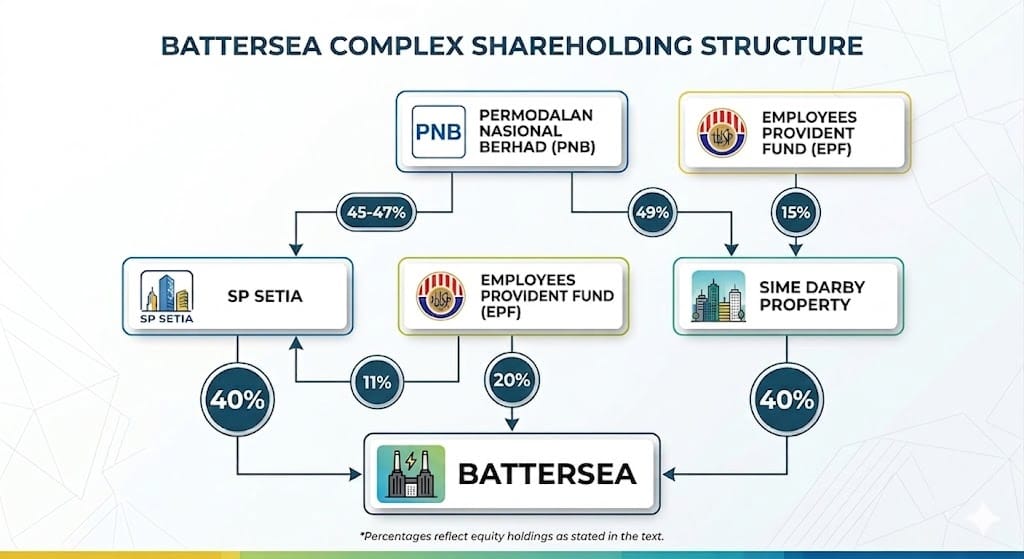
- A company owned by the Employees Provident Fund (EPF - 65 per cent) and Permodalan Nasional Bhd or PNB (35 percent), bought the entire Battersea commercial development for some RM8.8 billion and received a 5-year profit guarantee from Battersea, showing strong conflicts because of shareholding links (see chart). Is something being hidden here?
- Why are SP Setia and Sime Darby Properties, two prominent Government-linked companies (GLCs) owned by PNB, silent on these developments? Why are they not responding in greater detail to the damning allegations being made?
- Why are EPF and PNB, Malaysia’s largest funds managing over RM1 trillion and nearly RM350 billion respectively, silent on such a potentially large problem in which they have such substantial interests? Why are there no assurances backed by solid figures as to the long-term viability of Battersea?
It is important that these issues are addressed and dealt with early so that we do not get major surprises in future. It is necessary to demonstrate that Battersea is really viable through disclosure, especially when there are suspicions of cover-up. Otherwise, if it’s bad news, come clean, own up and deal with it.
Share of scandals
We have had more than our share of scandals previously. Remember Bumiputra Malaysia Finance or BMF, the largest banking loss of its time in the eighties, which lost some RM2.5 billion through property loans to dubious Hong Kong businessmen, much of it made after signs were uncovered years earlier.
And what about Bank Negara Malaysia’s RM32 billion foreign exchange losses in the 1990s by speculating on the currency markets when reports were circulating for years before that about the central bank’s questionable trading practices. It was the first time ever that a central bank had been caught out over billions of losses for currency trading.
And yes, there was the notorious 1MDB case involving no less than the prime minister of the day Najib Razak and RM42 billion in losses and perhaps a RM100 billion in opportunity costs. That’s been billed as the largest single kleptocracy in the world.
Despite reports as far back as 2013, much of it at that time reported by KINIBIZ, it only blew open from 2015 onwards and action was taken only after Barisan Nasional lost in the 2018 elections
We don’t need any more dubious world records. The unmistakable lesson from all of these massive losses is that much of the losses could have been avoided if early action had been taken earlier.
A check with the Companies House service, which lists UK companies, show that the main Battersea holdings company, Battersea Project Holding Company Ltd (BPHC) is not domiciled in the UK but in Jersey, a tax haven where accounts are not disclosed. Other significant Battersea companies were also domiciled there.
Why the secrecy?
Why should a project which is 40 per cent owned each by Malaysia’s property developers, SP Setia and Sime Darby Property with the remaining 20 per cent by the EPF be so secretive about its business? None of them are hedge funds.What’s there to hide?
The main business of Battersea, the development of a high-end commercial development accompanied by luxury residences, is put under a holding company in Jersey when it is owned by two public listed companies in Malaysia and a pension fund makes no sense at all, unless…
What is available in Companies House are the accounts of the Battersea Power Station Development Company or BPSDC which manages the Battersea Power Station estate ultimately on behalf of Battersea Project Holding Company (BPHC), the holding company of the 42-acre regeneration project.
As befits a management company, BPSDC is small, generating revenue for 2024 of £20.6 million and a loss of some £780,000.
At the ongoing employment tribunal in London which is hearing former CEO Donagh Sullivan’s allegation that he was dismissed (in June last year) because he said that undeveloped land was valued at several hundred million pounds above professional estimates is revelatory. Battersea denied this.
But still it is an indictment against Battersea shareholders - the trio of SP Setia, Sime Darby Property and EPF - that they did not disclose this very relevant piece of information to their shareholders and members together with their replies to the allegations.
Battersea concedes “challenges”
In their defence of O'Sullivan's allegations, Battersea itself indicated that there were problems. The FT quoted Battersea as saying that O’Sullivan was hired to formulate a plan to secure a “good financial return” for its investors — which include two publicly listed Malaysian companies and a Malaysian state pension fund.
“The development to date had been costly and the investors faced a ‘commercial challenge’ given the ‘significant historic costs incurred on the project’, the company’s defence filing said, according to the FT.
That’s clear admission by Battersea of problems faced. Its trio of shareholders would have had a clear obligation to lay that before their own shareholders and members and clarify some more to reassure them. But to date it has not been done.
In a statement to this writer, management company BPSDC said O’Sullivan’s claims were wrong but gave no further details. At the time of writing, there was no reply to the request by this writer for the holding company’s accounts.
In fact, the statement had a positive note about Battersea : “With the recent appointment of a master planner to shape the remaining 16 acres of the regeneration project, and with construction of two new Gehry-designed buildings set to commence in the coming months, Battersea Power Station is entering its next chapter and looking at how it can evolve the already thriving neighbourhood for the future needs of London and beyond.”
No mention at all about the “commercial challenge” O’ Sullivan was supposed to handle.
The question to be asked is, if O’Sullivan’s allegations are true, how far up the food chain was management aware? Was the Battersea board aware? Who was aware at SP Setia, Sime Darby Property, EPF and PNB? If anyone there was aware, what did they do about it? If they were not, why?
We can continue asking myriad questions. In 2015, the value of the total project was RM53 billion. How much is it now? Over RM100 billion? What are the losses?
Ideally, Battersea should find other buyers than its major shareholders or raise funds somewhere else for the development. But selling the commercial development to a company owned by EPF (65 per cent) and PNB (35%) for a massive RM8.8 billion smacks of a rescue of Battersea, whose shareholders are GLCs and EPF.
In the absence of information stating otherwise, it is fair to conclude that this interlocking arrangement was there merely to show - falsely - that the project was doing well. An explanation is owed to the public why this was done and those responsible for this arrangement must be brought to account
Possible complicity
Looking back, it looks like there was support and complicity for the project at the very top. When Battersea was launched in 2013, attendees included then PM Najib Razak, British PM David Cameron, London mayor and subsequent British PM, Boris Johnnson, and hundreds of people flown in business class from Malaysia to attend it, including some very senior editors. It was a spending spree by the man who was spearheading the project, Liew Kee Sin.
He remained chairman of Battersea even after he left SP Setia where he was already in conflict, staying as its chief executive even as he and his partners set up Eco Ardence/Eco World in direct competition with SP Setia. And even as he was Battersea chairman, he was negotiating to buy land adjacent to Battersea for the Eco World group, in clear conflict.
Liew could not have been in that position without the support from the very top - the PM at the time, Najib Razak.
(P Gunasegaram says that Battersea, EPF, PNB, SP Setia and Sime Darby Property will do well to remember that old adage: A stitch in time saves nine.)
P Gunasegaram (t.p.guna@gmail.com) is a content creator under the Newswav Creator programme, where you get to express yourself, be a citizen journalist, and at the same time monetize your content & reach millions of users on Newswav. Log in to creator.newswav.com and become a Newswav Creator now!
The User Content (as defined on Newswav Terms of Use) above including the views expressed and media (pictures, videos, citations etc) were submitted & posted by the author. Newswav is solely an aggregation platform that hosts the User Content. If you have any questions about the content, copyright or other issues of the work, please contact creator@newswav.com.