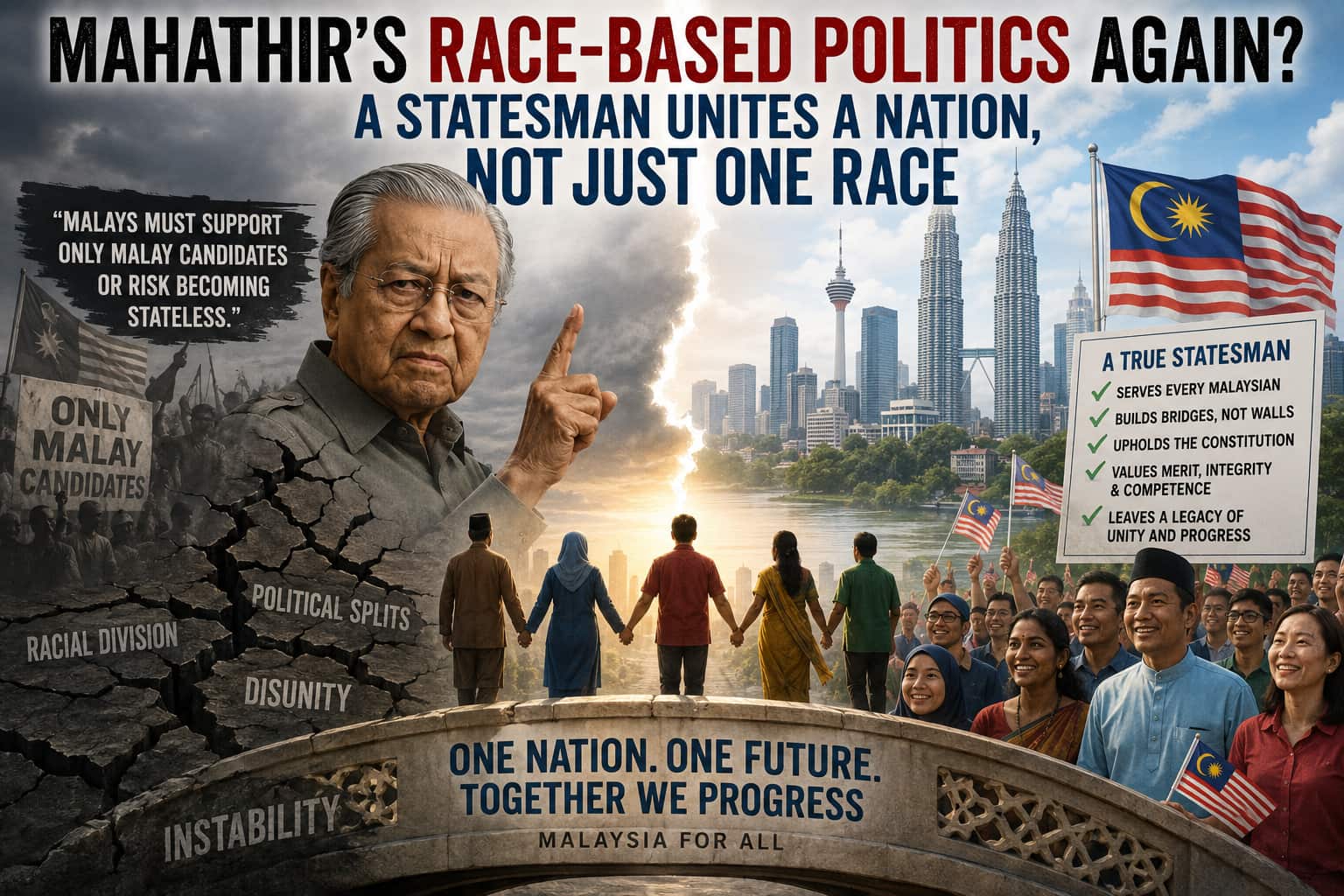
A true statesman is remembered for bringing people together, strengthening national unity, and building a future that benefits every citizen regardless of race, religion or background.
History often judges leaders not only by the roads they build or the economies they manage, but by whether they leave behind a more united nation.
Former prime minister Tun Dr Mahathir Mohamad has once again stirred controversy after urging Malay voters to support only Malay candidates in future elections, regardless of political party. In his Facebook post, Mahathir argued that Malays must remain loyal to fellow Malays if they wish to preserve Malaysia as "Tanah Melayu", warning that failure to do so could eventually leave Malays "stateless."
Such remarks have reignited long-standing criticism that Mahathir continues to rely on racial narratives to mobilise political support, even decades after leaving office. Many would agree that portraying elections as a racial struggle risks deepening divisions in Malaysia's already diverse society rather than encouraging cooperation among its people.
Malaysia's Constitution already recognises the special position of the Malays and Bumiputera while simultaneously protecting the legitimate rights of all other communities. The country's founders envisioned a nation where different races could coexist under one flag, with political leaders serving every Malaysian instead of championing only one ethnic group.
Many believe that asking voters to choose candidates solely based on race undermines democratic values. Elections should ideally be contests of integrity, competence, vision and public service - not ethnicity. A capable representative should earn support because of leadership qualities and policies, regardless of racial background.
Mahathir himself has repeatedly acknowledged that Malay disunity has weakened the community. During his political career, he led several different parties, including UMNO, Bersatu and Pejuang, while political realignments contributed to further fragmentation within Malay politics. Some observers therefore argue that blaming others for Malay divisions overlooks the role that constant political splits have played over the years.
Beyond race, Mahathir has also earned a reputation for publicly criticising many of his own political successors, often questioning their leadership after they assumed office. This pattern has contributed to prolonged political instability, with successive administrations facing relentless attacks from their predecessor instead of receiving constructive support during national challenges.
Supporters may view Mahathir as a defender of Malay interests. However, his detractors may argue that repeatedly framing politics through racial lenses risks alienating fellow Malaysians and weakening the sense of shared national identity that is essential for long-term stability.
Malaysia's future will ultimately depend not on which race wins an election, but on whether its leaders can inspire confidence across every community. Great leaders protect the interests of all citizens. A true statesman builds bridges between races, strengthens national unity, and leaves behind a legacy that future generations can proudly inherit - not one remembered for deepening divisions in an already diverse nation.
By: Kpost
Information Source:
Kpost (ckhorsk@gmail.com) is a content creator under the Newswav Creator programme, where you get to express yourself, be a citizen journalist, and at the same time monetize your content & reach millions of users on Newswav. Log in to creator.newswav.com and become a Newswav Creator now!
The User Content (as defined on Newswav Terms of Use) above including the views expressed and media (pictures, videos, citations etc) were submitted & posted by the author. Newswav is solely an aggregation platform that hosts the User Content. If you have any questions about the content, copyright or other issues of the work, please contact creator@newswav.com.