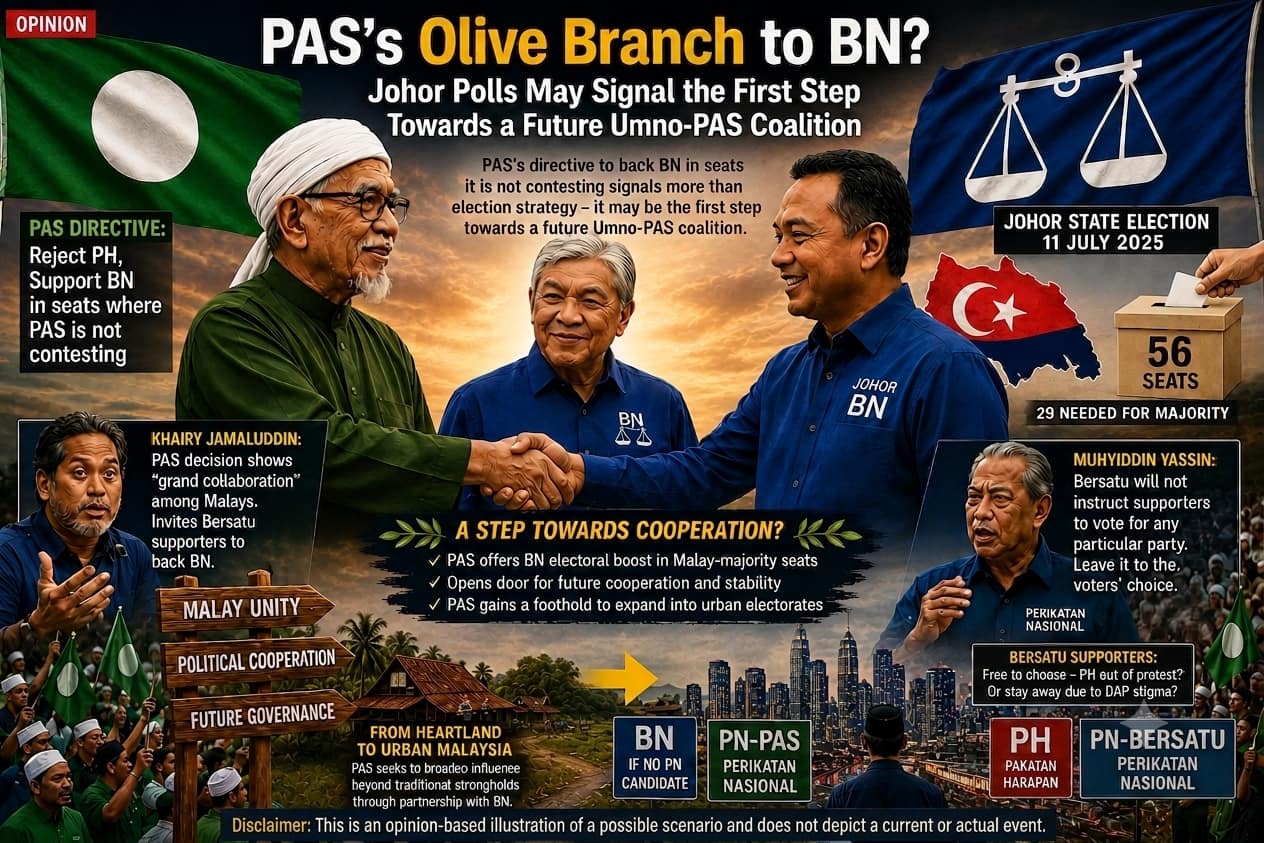
The Johor state election is shaping up to be more than a contest for 56 seats. It is increasingly becoming a test of political realignment, with PAS sending one of its clearest signals yet that it may be preparing the ground for closer cooperation with Barisan Nasional (BN), despite both parties officially contesting under different banners.
PAS president Tan Sri Abdul Hadi Awang's directive urging supporters to reject Pakatan Harapan (PH) even in constituencies where PAS is not contesting has raised eyebrows across the political landscape. In practical terms, this means encouraging PAS supporters to vote for BN candidates in straight fights against PH.
Such a move goes beyond ordinary election strategy. It reflects a calculated political message that PAS sees BN as a more acceptable partner than PH when forced to make a choice.
The instruction also provides BN with a potential electoral advantage in Malay-majority constituencies where PAS enjoys grassroots influence. More importantly, it offers BN a glimpse of how cooperation with PAS could translate into electoral gains without a formal alliance.
Former Umno Youth chief Khairy Jamaluddin quickly welcomed PAS's decision, describing it as evidence of a "grand collaboration" among Malays. His appeal for Bersatu supporters to also back BN further reinforced the narrative that sections within Umno remain receptive to rebuilding political ties with their former Muafakat Nasional partner.
While Johor BN leaders have repeatedly maintained that they intend to govern independently, politics has often demonstrated that post-election realities can differ significantly from campaign rhetoric. If no coalition secures a comfortable majority, PAS could emerge as a valuable political partner in ensuring government stability.
From PAS's perspective, this goodwill gesture may be more than an act of Malay-Muslim solidarity. It could represent an investment in future political returns.
Unlike previous decades, PAS now faces a strategic dilemma. The party has built a formidable presence in conservative heartland states but has struggled to gain meaningful traction in highly urbanised and economically developed regions like Johor, Selangor and Penang.
Working more closely with BN could offer PAS a stepping stone into these urban electorates, allowing the party to gradually expand its influence beyond its traditional strongholds.
Rather than relying solely on ideological appeal, PAS may recognise that governing alongside BN in selected states could normalise its image among moderate and urban Malay voters who have historically been reluctant to support the Islamist party.
In this sense, Johor could become a political laboratory for PAS's long-term national ambitions.
However, not everyone within Perikatan Nasional appears comfortable with PAS's approach.
Tan Sri Muhyiddin Yassin took a markedly different position by refusing to instruct Bersatu supporters to vote for BN in seats where PN is absent. Instead, he left the decision entirely to individual voters, acknowledging that many Bersatu members still harbour deep resentment towards Umno following years of political rivalry.
Political analysts believe this difference in strategy exposes underlying tensions within PN.
Some argue that disgruntled Bersatu supporters could even cast protest votes for PH rather than support BN, particularly if they perceive PAS as prioritising its relationship with Umno over coalition solidarity.
Others contend that longstanding perceptions surrounding DAP will continue to discourage most Malay Bersatu voters from returning to PH, limiting any significant electoral swing.
Regardless of which assessment proves accurate, PAS's directive has shifted attention from electoral arithmetic to broader political intentions.
The party appears to be signalling that its long-term objectives extend beyond simply winning seats under the PN banner. Building trust with BN, strengthening Malay-Muslim political cooperation and positioning itself as a future governing partner could prove equally important.
If this strategy succeeds, Johor may be remembered not only for deciding the composition of its next state government but also as the beginning of a new chapter in Malaysian politics - one where PAS gradually re-establishes itself alongside BN while using that partnership as a platform to penetrate Malaysia's urban political landscape.
Whether this ultimately leads to a formal Umno-PAS coalition remains uncertain. Yet PAS's latest electoral directive suggests that the road towards such a possibility may already have begun.
By: Kpost
Information Source:
TheStar , Fmt , TheSun , Fmt , Fmt
Kpost (ckhorsk@gmail.com) is a content creator under the Newswav Creator programme, where you get to express yourself, be a citizen journalist, and at the same time monetize your content & reach millions of users on Newswav. Log in to creator.newswav.com and become a Newswav Creator now!
The User Content (as defined on Newswav Terms of Use) above including the views expressed and media (pictures, videos, citations etc) were submitted & posted by the author. Newswav is solely an aggregation platform that hosts the User Content. If you have any questions about the content, copyright or other issues of the work, please contact creator@newswav.com.