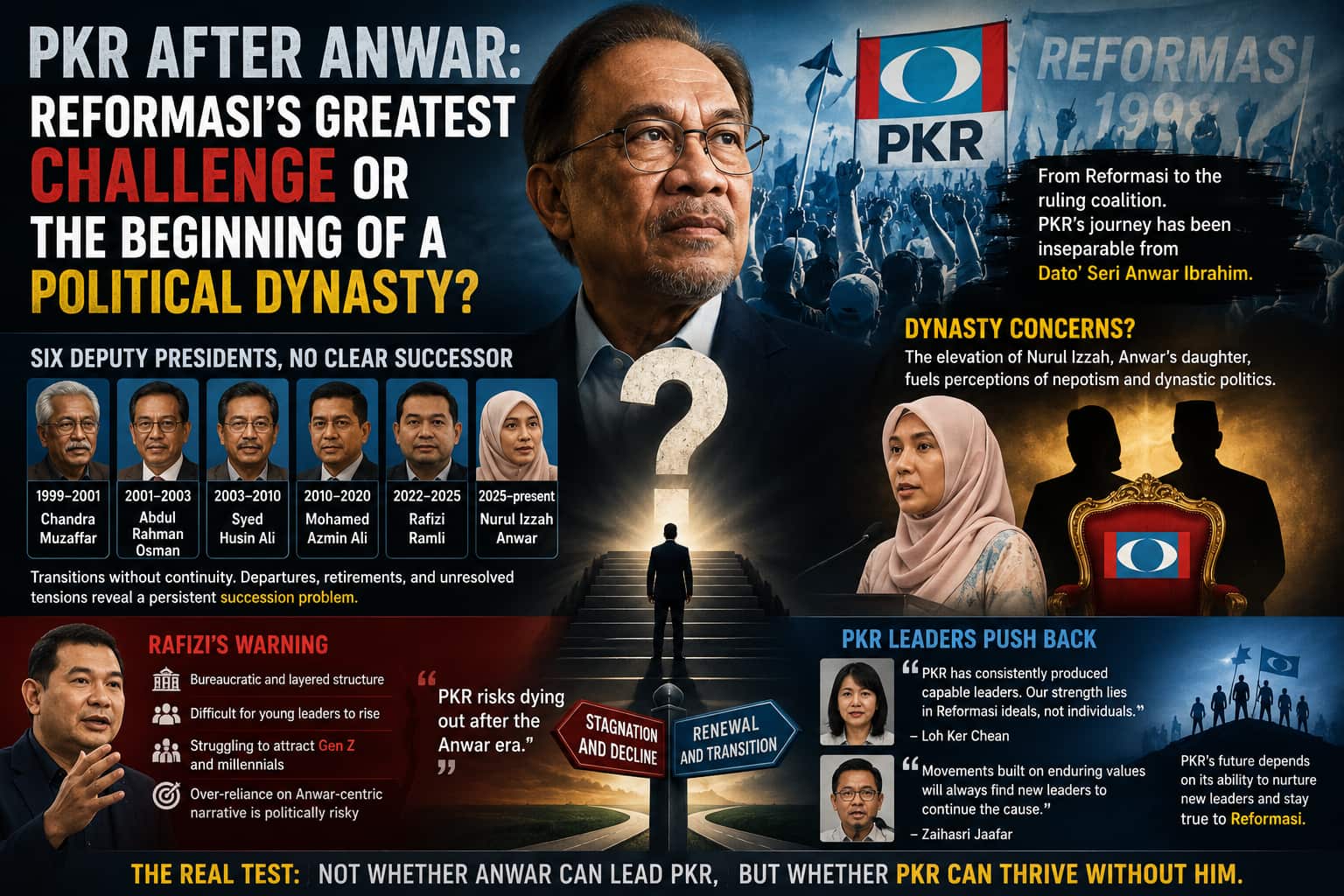
For more than two decades, the story of Parti Keadilan Rakyat (PKR) has been inseparable from the political journey of Dato' Seri Anwar Ibrahim. Born out of the Reformasi movement in 1999 following Anwar's dismissal and imprisonment, the party successfully transformed itself from an opposition force into the leading party of Malaysia's ruling coalition.
However, as PKR approaches its third decade, a growing question is becoming increasingly difficult to ignore: What happens after Anwar?
The debate has intensified following remarks by former PKR deputy president Dato' Seri Rafizi Ramli, who warned that the party risks fading into irrelevance after the Anwar era due to bureaucratic stagnation and the absence of a convincing succession plan.
His criticism strikes at a longstanding issue within PKR. Since its inception in 1999, the party has had six deputy presidents:
Chandra Muzaffar (1999–2001)
Abdul Rahman Osman (2001–2003)
Syed Husin Ali (2003–2010)
Mohamed Azmin Ali (2010–2020)
Rafizi Ramli (2022–2025)
Nurul Izzah Anwar (2025–present)
What stands out is that none of these deputy presidents, despite occupying the party's second-highest office, ultimately emerged as a clear and undisputed successor to Anwar. Some left the party, some retired from frontline politics, while others failed to consolidate support within PKR's power structure.
This pattern inevitably invites comparisons with Tun Mahathir Mohamad, whose political legacy was often criticised for lacking a stable succession framework despite producing several deputies over his lengthy political career.
The latest leadership transition has also raised questions about nepotism within the party. The elevation of Nurul Izzah, Anwar's daughter, reinforces perceptions that PKR is evolving into a dynastic political party rather than a merit-based movement.
While Nurul Izzah possesses considerable political experience and has long been active in the Reformasi movement, her defeat in the Permatang Pauh parliamentary seat and her current lack of an official government position have nevertheless fuelled debate over her appointment. As a result, her rise to the deputy presidency inevitably raises questions about whether PKR is cultivating leadership through open competition or family lineage.
Rafizi's warning goes beyond personalities. He argues that PKR's political narrative remains overwhelmingly centred on Anwar. For decades, the party's mission was unmistakable: make Anwar prime minister. That objective has now been achieved.
The challenge today is defining the next chapter.
According to Rafizi, a party that builds its entire future around securing Anwar a second term risks postponing rather than solving the succession question. Even if PKR succeeds electorally, leadership renewal cannot be delayed indefinitely.
His concerns are compounded by what he describes as an increasingly bureaucratic party structure that makes it difficult for younger leaders to rise through the ranks. In an era where political competition increasingly revolves around attracting Gen Z and millennial voters, parties that fail to regenerate leadership may struggle to remain relevant.
PKR leaders have strongly rejected this assessment. Figures such as Loh Ker Chean and Zaihasri Jaafar argue that PKR has consistently produced capable leaders over the years and that the party's strength lies in its Reformasi ideals rather than any single individual.
They point out that many prominent politicians across Malaysia's political landscape were developed within PKR's ecosystem, including Rafizi himself. In their view, movements built upon principles of justice, accountability, and reform can survive leadership transitions as long as those values remain relevant.
Yet history shows that political parties often struggle when founding figures overshadow institutional development. The true test of a mature political party is not merely winning power but demonstrating that leadership can be transferred smoothly without creating uncertainty or internal conflict.
As Anwar approaches the latter stage of his political career, PKR faces perhaps its most important challenge since its formation. The question is no longer whether Anwar can lead PKR. It is whether PKR can prove it is capable of thriving without him.
The answer may determine whether the party remains a dominant force in Malaysian politics for decades to come - or whether it becomes another political movement remembered primarily through the legacy of its founder.
By: Kpost
Information Source:
Kpost (ckhorsk@gmail.com) is a content creator under the Newswav Creator programme, where you get to express yourself, be a citizen journalist, and at the same time monetize your content & reach millions of users on Newswav. Log in to creator.newswav.com and become a Newswav Creator now!
The User Content (as defined on Newswav Terms of Use) above including the views expressed and media (pictures, videos, citations etc) were submitted & posted by the author. Newswav is solely an aggregation platform that hosts the User Content. If you have any questions about the content, copyright or other issues of the work, please contact creator@newswav.com.