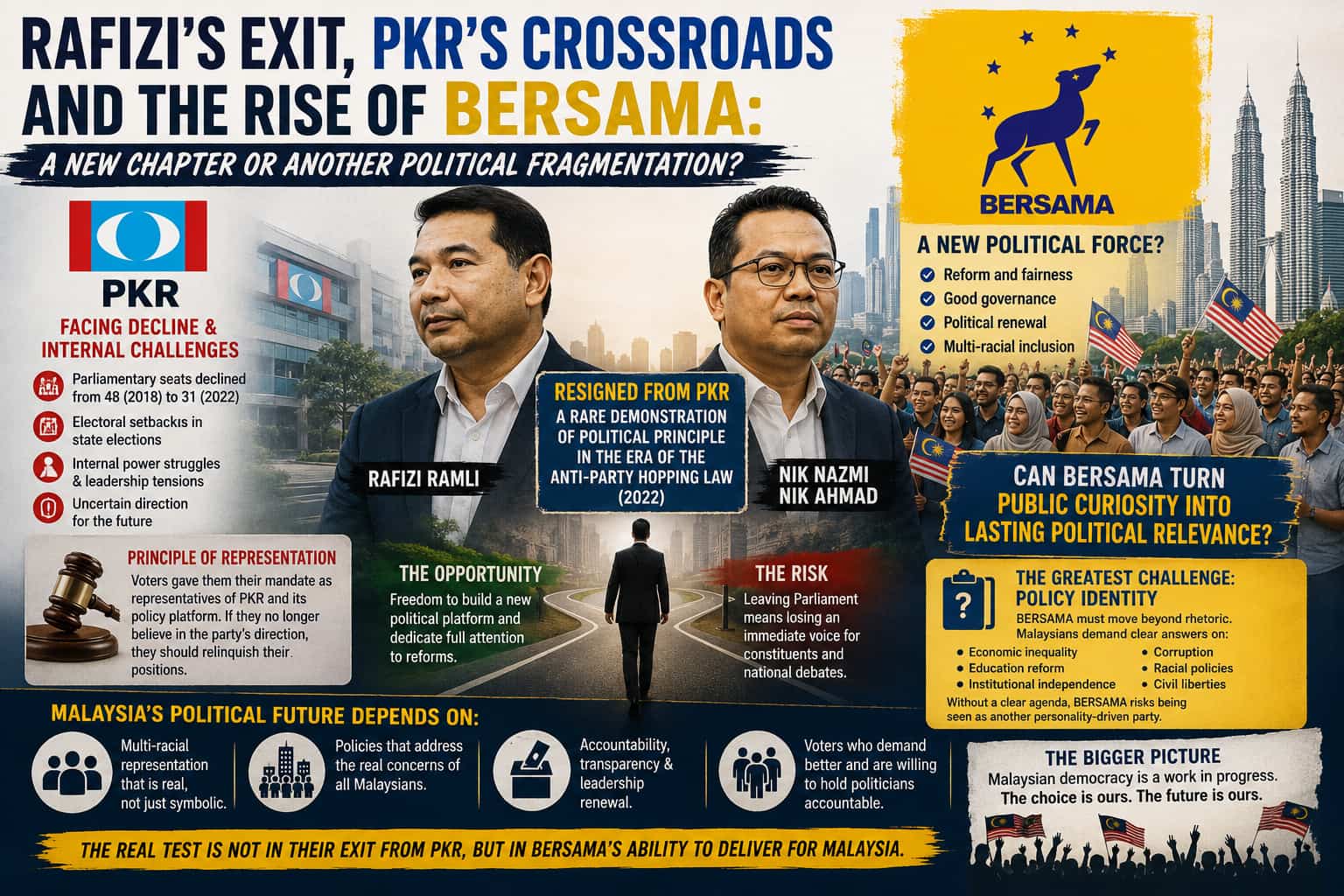
The resignation of Dato Seri' Rafizi Ramli and Nik Nazmi Nik Ahmad from Parti Keadilan Rakyat (PKR) and their subsequent involvement in takeover a new political party, BERSAMA (Parti Bersama Malaysia / Malaysia United Party), has emerged as one of the most significant political developments in Malaysia recently.
Beyond the personalities involved, the move has reignited debates about party loyalty, political accountability, multi-racial representation, and the future direction of Malaysian politics.
For decades, party defections have been a recurring feature of Malaysia’s political landscape. However, what distinguishes Rafizi and Nik Nazmi’s departure is that it comes in the era of the anti-party hopping law introduced in 2022. Unlike many politicians who simply switch allegiances while retaining their parliamentary positions, both leaders chose to resign from PKR, a move that many observers regard as a rare demonstration of political principle, as highlighted during an episode of The Gut Shot Podcast on its YouTube channel.
The argument behind such a decision is straightforward. Voters gave them their mandate as representatives of PKR and its policy platform. If they no longer believe in the party’s direction, some contend they should relinquish their positions rather than continue benefiting from a mandate secured under a different political platform. In this regard, their resignations represent a departure from the opportunistic political culture that has often characterised Malaysian politics.
Nevertheless, the move also comes with practical consequences. By stepping away from Parliament, Rafizi loses an immediate platform to influence national debates and represent his constituents directly. Supporters argue that this sacrifice allows him to dedicate his full attention to building BERSAMA into a credible political force. Critics, however, question whether abandoning elected office weakens the very reform agenda he has long championed.
The emergence of BERSAMA also shines a spotlight on PKR’s internal challenges. Once viewed as the dominant reformist force in Malaysian politics, PKR has struggled to maintain momentum in recent years. The party’s parliamentary representation has declined significantly since its peak following the 2018 general election, while electoral setbacks in several state elections have raised concerns about its future trajectory.
Many analysts believe the split reflects deeper tensions between PKR’s established leadership and a younger generation seeking greater influence. Interestingly, the disagreement does not appear to stem from major ideological differences. Instead, it is widely perceived as a struggle over leadership, party direction, and political relevance. Such internal conflicts have become increasingly common in Malaysian political parties where long-serving leaders often dominate decision-making structures.
Yet the greatest challenge facing BERSAMA may not be its organisational structure but its policy identity. While Rafizi and Nik Nazmi have spoken broadly about reforms, fairness, good governance and political renewal, the party has yet to present a comprehensive policy framework that clearly differentiates it from existing political alternatives.
Malaysians are increasingly demanding specific answers on issues such as economic inequality, education reform, institutional independence, corruption, racial policies, and civil liberties. Without a clearly articulated agenda, BERSAMA risks being perceived merely as another political vehicle centred on personalities rather than ideas.
At the same time, the party’s commitment to multi-racial politics reflects an important reality. Malaysia today is far more urbanised, interconnected and economically integrated than it was several decades ago. Younger voters increasingly prioritise issues such as employment opportunities, cost of living, housing affordability and quality governance over traditional ethnic narratives.
These political shifts open new avenues for progress while testing the adaptability of political parties. While multi-racial parties are often viewed as the future of Malaysian politics, successfully representing diverse communities requires more than symbolic inclusivity. It demands policies that address the concerns of all Malaysians while navigating sensitive issues surrounding race, religion and national identity.
Ultimately, the success or failure of BERSAMA will depend less on the popularity of its new founders and more on its ability to offer a compelling vision for Malaysia’s future. The party must demonstrate that it can move beyond reformist rhetoric and provide practical solutions to the nation’s challenges.
The larger lesson from this political development is that Malaysian democracy remains a work in progress. Voters increasingly expect accountability, transparency and genuine leadership renewal. Whether BERSAMA becomes a transformative force or simply another chapter in Malaysia’s long history of political fragmentation will depend on how effectively it connects with ordinary Malaysians across the country.
As Malaysia approaches future elections, recent political developments have sparked growing public curiosity. Rafizi Ramli’s departure from PKR has opened a new debate about representation, political integrity, and the future of reform politics. The real test now lies not in their decision to switch political parties as a means of renewing momentum in their political struggle, but in whether BERSAMA can transform public curiosity into lasting political relevance.
By: Kpost
Information Source:
Kpost (ckhorsk@gmail.com) is a content creator under the Newswav Creator programme, where you get to express yourself, be a citizen journalist, and at the same time monetize your content & reach millions of users on Newswav. Log in to creator.newswav.com and become a Newswav Creator now!
The User Content (as defined on Newswav Terms of Use) above including the views expressed and media (pictures, videos, citations etc) were submitted & posted by the author. Newswav is solely an aggregation platform that hosts the User Content. If you have any questions about the content, copyright or other issues of the work, please contact creator@newswav.com.