Every election season in Malaysia seems to come with a familiar tradition.
No, not campaign posters hanging from every lamp post.
Not ceramahs that somehow manage to block traffic.
Not politicians suddenly remembering the importance of potholes.
It’s the annual revival of the race card.
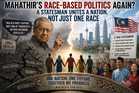
This time, former prime minister Tun Dr Mahathir Mohamad once again made headlines by urging Malays to support Malay candidates regardless of political party, arguing that Malays must unite politically to preserve Malaysia as “Tanah Melayu.”
Predictably, the statement dominated social media. Supporters applauded it as a reminder to protect Malay interests. Critics dismissed it as another example of race-based politics that belongs to another era.
But amid all the noise, perhaps the more interesting question is this:
Is anyone still listening?
Not everyone, certainly.
Because Malaysia in 2026 is a very different country from the one many veteran politicians first entered.
Young Malaysians don’t wake up every morning wondering which race their Grab driver belongs to.
They’re wondering why the fare has gone up.
They aren’t lying awake worrying whether the cashier at the supermarket is Malay, Chinese or Indian.
They’re wondering why groceries cost more than they did six months ago.
Their biggest concern isn’t the ethnicity of the engineer building the MRT.
It’s whether the train arrives on time.
That doesn’t mean race doesn’t matter.
Of course it does.
Malaysia’s history, Constitution and social fabric mean discussions about ethnicity will always remain important. The special position of Malays and Bumiputera is constitutionally recognised, while the rights and interests of other communities are also protected. These are legitimate topics for political debate.
But there’s a growing difference between discussing race responsibly and making race the answer to every political question.
For too long, some politicians have treated race as the master key capable of unlocking every election.
Economic slowdown?
Race.
Political instability?
Race.
Poor governance?
Race.
Traffic jams?
Give it another election cycle.
The problem is that reality has become far more complicated than the script.
Today’s Malaysians live in a country where their daily lives are deeply interconnected.
The doctor treating your parents may not share your ethnicity.
The software engineer developing Malaysia’s next successful startup may come from a different community.
Your favourite nasi lemak stall, accountant, lawyer, mechanic or teacher might belong to any race.
Most people simply care whether they’re good at what they do.
Competence has quietly become more important than identity for many younger voters.
And that’s a profound political shift.
The internet has also made old political formulas harder to sustain.
In previous decades, politicians largely controlled the narrative.
Today, everyone has Google.
Everyone has YouTube.
Everyone has TikTok.
Everyone has WhatsApp.
Sometimes that’s a blessing.
Sometimes it’s an absolute disaster.
Social media has undoubtedly fuelled misinformation, outrage and conspiracy theories. Algorithms reward anger because anger generates engagement.
Fake news travels faster than corrections.
Anonymous accounts manufacture outrage for clicks.
Political influencers discover that fear is an excellent business model.
Foreign actors have also shown increasing interest in exploiting social divisions around the world, and Malaysia is hardly immune to online disinformation campaigns.
In other words, racial tensions do not emerge from one speech or one politician alone.
They are amplified by economic anxiety, sensationalist media, partisan politics, online echo chambers and decades of accumulated mistrust.
Blaming any single individual oversimplifies a much larger problem.
But neither should we pretend that political rhetoric carries no consequences.
Words matter.
When respected national figures frame elections primarily as contests between ethnic groups, they reinforce the idea that fellow citizens are political competitors before they are neighbours.
That makes genuine national unity harder to achieve.
Ironically, the issues that dominate coffee shop conversations today rarely have anything to do with race.
People complain about salaries.
Housing.
Education.
Floods.
Healthcare.
Taxes.
Corruption.
Public transport.
Government efficiency.
The cost of raising children.
These problems are stubbornly colour-blind.
Inflation doesn’t ask your ethnicity before emptying your wallet.
A traffic jam doesn’t separate motorists into racial lanes.
A shortage of affordable housing affects young families regardless of the language they speak at home.
Perhaps that’s why younger Malaysians increasingly ask different questions of politicians.
Not “What race are you?”
But “What can you actually do?”
Can you improve schools?
Can you reduce corruption?
Can you create jobs?
Can you attract investment?
Can you fix public services?
Can you govern without turning every disagreement into another episode of Malaysia’s longest-running political soap opera?
Those questions may ultimately prove far more important than ethnicity.
None of this means Malaysia has solved its racial challenges.
It hasn’t.
Prejudice still exists.
Economic disparities remain.
Sensitive issues continue to require careful handling.
Political parties themselves are still largely organised along communal lines.
The work of building trust remains unfinished.
But there is also another Malaysia that rarely appears in political speeches.
It is the Malaysia where colleagues from different backgrounds solve problems together every day.
Where university students become lifelong friends despite different religions.
Where neighbours exchange food during Hari Raya, Chinese New Year, Deepavali, Gawai and Christmas without waiting for politicians to tell them it’s acceptable.
Where businesses succeed because talent matters more than race.
That Malaysia is real too.
Perhaps even more real than the one portrayed during election campaigns.
Malaysia’s greatest strength has never been that everyone thinks alike.
It’s that people with different histories, cultures and beliefs somehow continue finding ways to build a country together.
That’s messy.
Sometimes frustrating.
Occasionally noisy.
But it’s infinitely more productive than constantly reminding citizens why they should fear one another.
The race card isn’t disappearing overnight.
It still works on some voters.
It still generates headlines.
It still dominates social media for a few news cycles.
But each year, it appears to resonate with a smaller audience than before.
Not because Malaysians have stopped caring about their identities.
But because they have started caring even more about competence, accountability and results.
And that’s probably a healthier direction for any democracy.
After all, history rarely remembers leaders simply for telling people who to fear.
It remembers those who gave people something better to believe in.
The Daily Durian (zaynp100@yahoo.com) is a content creator under the Newswav Creator programme, where you get to express yourself, be a citizen journalist, and at the same time monetize your content & reach millions of users on Newswav. Log in to creator.newswav.com and become a Newswav Creator now!
The User Content (as defined on Newswav Terms of Use) above including the views expressed and media (pictures, videos, citations etc) were submitted & posted by the author. Newswav is solely an aggregation platform that hosts the User Content. If you have any questions about the content, copyright or other issues of the work, please contact creator@newswav.com.