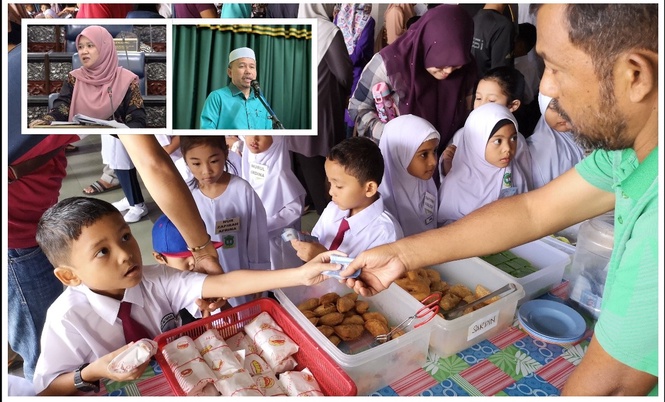
Recently, Education Minister Fadhlina Sidek had instructed school canteens to remain open during Ramadan, to allow non-Muslim students to enjoy their meals comfortably.
“I don’t want non-Muslim children to eat in storerooms and inappropriate places when all schools have canteens.
We (the ministry) recommend that canteens stay open throughout Ramadan, particularly for schools with non-Muslim students,“ she said.
PAS however, disagrees with the education minister.
In a statement on Tuesday (March 11), the PAS ulama council described the ministry's directive for school canteens to remain open during Ramadan as controversial and "excessive".
Its chief, Pokok Sena MP Datuk Ahmad Yahaya, said closing school canteens during Ramadan was a societal norm to respect Muslims who were fasting and claimed that Fadhlina had acted hastily when issuing the directive.
So who is right and who is wrong here? Should non-Muslim students also temporarily fast or eat out of sight as a sign of respect to fasting Muslim students or should Muslims students accept that they are fasting because they are practising an obligation of their faith, and those who are not of their faith, are not obliged to undertake the practise?
This is actually a very complex question to answer.
When extended, this question can actually be expanded to include many other questions related to identity and interfaith relationship, and cuts to the very nature of a religion or an identity.
It can, for example, be extended to include the question of whether you are obliged to go to a vegetarian restaurant or provide vegetarian food, because one person in your team or family is a vegetarian?
It can also be extended to ask the question as to whether you have an obligation to respect or honour a symbol of an identity of a religion that you do not believe or identify with. For religious adherents or nationalists from a different country, their religious scriptures or national flag are sacred objects. For you it is just a book and a piece of cloth. If you need a book to do something like act as a door stopper or if you need a cloth to wipe your table with, can you use the religious books or national flag of some other faith for the purpose, because to you, it is just a book and a piece of cloth? If you do this, do the religious adherents or nationalist have a right to take your action as an outrage?
In secular western countries like France, you can’t wear large crosses, Jewish kippas or Islamic headscarves in schools.
“When you walk into a classroom, you shouldn’t be able to identify the pupils’ religion just by looking at them '' the French Education Minister Gabriel Attal said in an interview.
Being a secular country, France does not approve of religious influences in a public setting. To maintain its secular ideology, it imposes its secular ideology on minority religious groups, and forces them to conform to the majority views and practices.
In many ways, what France is doing is not very different from what Pas is asking for in regards to the canteen closure during the fasting month.
Just like how the French do not see any fault in imposing its secular practices on its religious minorities, Pas also likely does not see any problem in imposing its religious practices on minorities of other faiths.
So how now brown cow? How is right and who is right in these sorts of arguments?
Categorically, I doubt whether this question will ever be answered satisfactorily. This is an age-old question after all. If this sort of question can be answered, it wouldn’t have festered for as long as it has.
At the crux of this question is the fundamental question of what is an identity, what is the purpose of a religion, how should the relationship between a majority and a minority be governed and whether Malaysia is a secular state or a Islamic state. These are all very big questions. Each of them might take a lifetime or more to answer.
An identity is not something that is only experienced internally, but also something that is validated externally. When you say that you are Hindu or a Malaysian, you are not just experiencing your Hindu-ness or Malaysian-ness internally. Your Hindu-ness and Malaysian-ness also needs to be validated externally by others.
External validation is obtained via identity markers. Every identity has an identity marker, which will be used by every identity group to seek external validation for its identity. You cannot, for example, slaughter a cow in a place where Hindus form the majority or sashay around with a pig where Muslims or Jews form the majority. If you do otherwise, it will be taken as an affront to their identity, which will in turn give members of the identity group the right to behave in a hostile manner towards you.
The education ministry is interpreting fasting during Ramadan as an internal practice by the Muslims, but PAS is seeing it as an identity marker that requires external validation from others. You can argue until the cock crows, but I doubt the question as to who is right and who is wrong will ever be conclusively answered.
Religion is also a multidimensional concept. It is a practice, a philosophy, a supernatural concept, an identity and often, a foundation of a community or a nation. From a secular point of view, we tend to see religion chiefly as a practice that an individual undertakes for their private and internal wellbeing, but in non-secular traditions, religion is also seen as an identity and a foundation for the nation or a community. If we see religion as just a private practice for the sake of one's individual internal wellbeing, then non-Muslim students obviously should not be stopped from eating just because Muslim students are fasting for the sake of their internal wellbeing. But if we see religion as an identity or a foundation for a community or nation, then our judgement will likely be different.
There is also a question of how the relationship between a majority or a minority should be governed in the question of whether canteens should be allowed to open during the fasting month. Theoretically, a minority is obliged to recognise the privileges and authority of the majority while the majority is expected to treat the minority with respect and dignity. If canteens are open during Ramadan for the non-Muslim minority students however, are non-Muslim minorities recognising the authority and privileges of the Muslim Majority? If it is closed however, is the Muslim majority treating the non-Muslim minority with dignity and respect? Again, we can debate until the cows come home, but still we will likely reach no conclusion.
Finally, the question whether a school canteen should be open during Ramadan is also raising the question of whether Malaysia is an Islamic state or a secular state. Since our then Prime Minister, Mahathir Muhammad, had declared in the year 2002, that Malaysia is a “fundamentalist Islamic state”, a controversy has been raging as to what the article 3 of the constitution means.
Article 3 of the constitution says that “Islam is the religion of the Federation, but other religions can also be practised safely and peacefully in any part of the Federation”. Those who advocate for the idea that Malaysia is an Islamic state tend to focus on the first half of the statement while those who advocate for the idea that Malaysia is a secular state tend to focus on the second half. For now at least, the jury is still out on who will eventually triumph.
Practically speaking, I think there is really no point in debating these questions, because some questions can only be answered if they are not raised in the first place, and these are amongst such questions.
These questions are akin to the question as to whether you trust your spouse. If you trust them, the question of whether you trust them will not arise in you at all. If it arises, then it will likely never be resolved.
But what if these questions have arisen? What can we do then?
Well, the way I see it, what we can do is the same as what a person who cannot trust their spouse can do.
We cannot expect them to let go of their mistrust or talk maturely about their mistrust, because if they could do that, this problem would not have arisen in the first place.
So what we can do in practical terms, is just accept that we are all just going to have to act immaturely about the entire dispute, and exact a tit-for-tat measure against the people who we are in a relationship with, so that we are not the only one miserable in the relationship.
What can we hope to gain by making our other half just as miserable as they make us, you might ask?
Well, other than the pleasure of knowing that we are not going to be only one miserable in the relationship, if we succeed in making them miserable enough to the point that they break down and surrender to us, then we can then gain the pleasure of feeling superior to them and experience the joy of dominating them. We can forever tell them how they are damaged goods and they are lucky that we did not discard them despite them being so damaged, and force them to do what we want them to do, to compensate us for letting them be with us despite being so damaged.
My point here is, if we are all good people, this question of whether the canteen should be open during the fasting month would not have arisen at all.
Now that it has arisen, then at least we should have the self-awareness of knowing that we are not a very good people.
If we have self awareness, one of two things can happen.
The first thing that can happen is that our awareness will make us ashamed of our lack of virtues to the point that it will motivate us to become better people. If we succeed in becoming better people, then this canteen question, like many other questions, will just disappear by itself and not arise again.
If we can’t do that, then our second option is to just accept that we are not as good as we think we are and aim to be strong. We can aim to be strong by practicing to subdue others. If we become strong enough and subdue everybody, we can dominate everyone and earn the right to feel superior to everybody, which hopefully, will compensate us adequately for our lack of virtues.
If you read all this to see whether it will end on a positive note, I am afraid I am going to have to disappoint you. There is no happy ending to this sort of relationship. This is as good as it gets.
Nehru Sathiamoorthy is the author of “While Waiting for the World to end”. He was a columnist at FMT and a frequent contributor to the South China Morning Post, The Star, Malaysia-Today, MalaysiaNow, MalaysiaKini and Focus Malaysia.
TheRealNehruism is a content creator under the Newswav Creator programme, where you get to express yourself, be a citizen journalist, and at the same time monetize your content & reach millions of users on Newswav. Log in to creator.newswav.com and become a Newswav Creator now!
The User Content (as defined on Newswav Terms of Use) above including the views expressed and media (pictures, videos, citations etc) were submitted & posted by the author. Newswav is solely an aggregation platform that hosts the User Content. If you have any questions about the content, copyright or other issues of the work, please contact Newswav.