.jpg)
By Mihar Dias February 2026
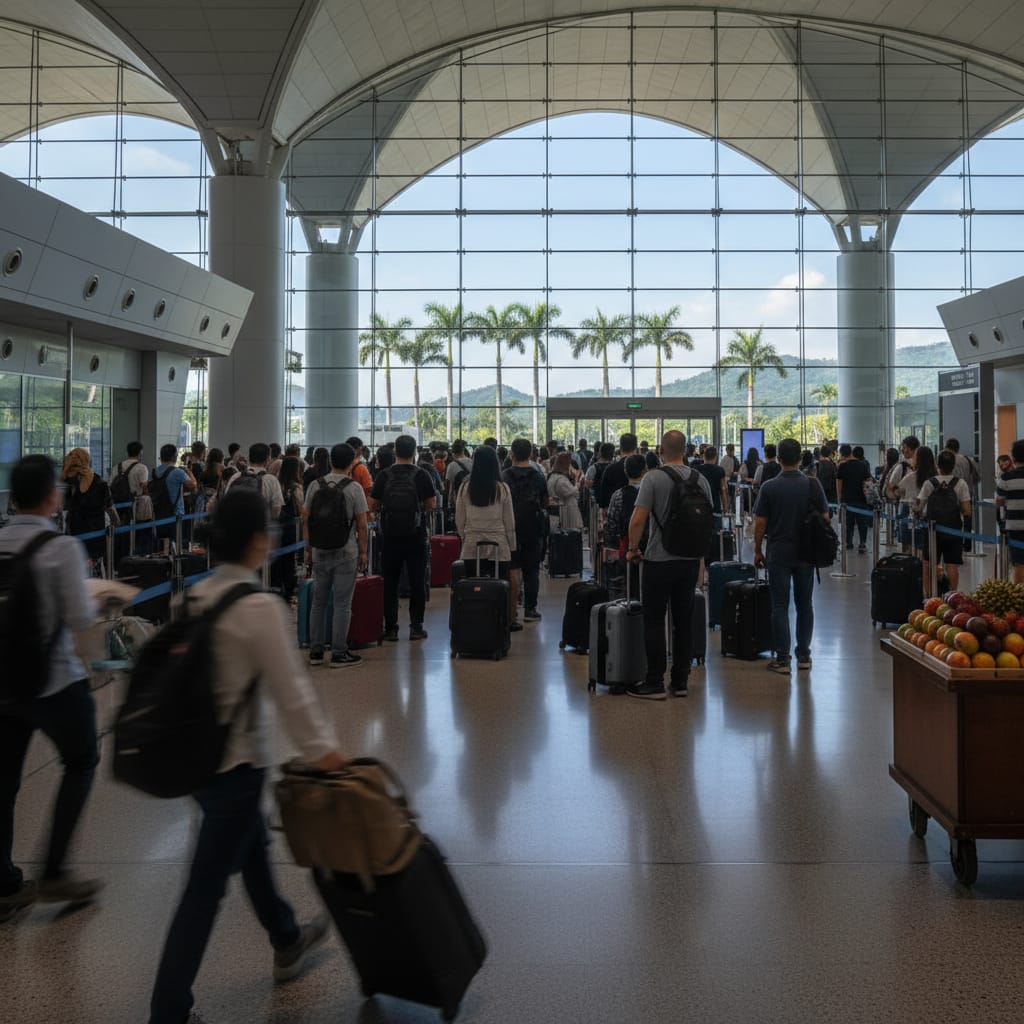
Penang International Airport recently offered travellers a uniquely Malaysian welcome experience: not just immigration clearance, but a free lesson in national management philosophy.
Passengers waited for hours in snaking queues while officials quickly clarified the situation.
Nothing was wrong, they said.
The problem was simply — too many tourists.
According to authorities, congestion occurred because multiple flights landed close together, bringing thousands of passengers into immigration halls within a short period.
In other words, the airport experienced the shocking phenomenon of… airplanes arriving.
A Very Predictable Surprise
Here is what makes this explanation deliciously ironic.
Passenger growth at Penang airport has been no secret. The airport handled about 7.47 million passengers in 2024, cementing its position as Malaysia’s second busiest hub.
The state has even projected more than eight million arrivals as international routes expand.
So congestion did not appear suddenly like a monsoon storm.
It arrived politely, years in advance, carrying forecasts, statistics, and PowerPoint slides.
Yet somehow, when queues formed, everyone behaved like relatives seeing an unexpected guest at dinner — smiling nervously while whispering, “Why never tell earlier?”
The Malaysian Growth Paradox
Malaysia has a curious relationship with success.
We love announcing it. We celebrate rising tourist arrivals, new flight routes, and booming economic indicators. Press releases glow with optimism.
But when success requires planning — extra counters, better scheduling, larger terminals — enthusiasm becomes noticeably quieter.
Penang airport, for instance, has long operated with limited aircraft bays and infrastructure already described as struggling to keep pace with demand.
This makes blaming tourists somewhat like blaming diners for a restaurant’s lack of tables.
Customers did not create the shortage.
They merely revealed it.
Reactive Governance, Our National Sport
To be fair, Malaysia does not ignore problems.
We simply prefer to address them only after they become embarrassing.
Take the sudden enthusiasm for autogates, now promoted as the solution to congestion.
Autogates are useful, yes.
But in Malaysia they often function less as planning tools and more as emergency medicine — deployed after the patient has already collapsed in public.
This reflects a broader pattern experts often note in infrastructure management: capacity planning tends to lag demand, rather than anticipate it. Slot scheduling coordination, staffing flexibility, and predictive passenger flow modelling — standard practice in many regional airports — are still catching up here.
In short, we manage growth reactively, not proactively.
The Cycle We Know Too Well
If history is any guide, the script will unfold predictably:
Queues will ease temporarily.
Officials will declare improvements.
Passenger numbers will keep rising.
Infrastructure will lag again.
And once more, tourists will be blamed.
Because in Malaysia, congestion is rarely treated as a systems issue.
It is treated as a timing issue — as though development itself is a punctual train that simply arrived too early.
Final Call Before Boarding
The real lesson from Penang airport is not about tourism.
It is about planning.
Tourists did not jam the system.
They exposed it.
Until we stop celebrating growth without investing equally in readiness, Malaysia will continue practicing its most refined administrative skill:Being perpetually surprised by things we knew were coming.
Reminder: If you're travelling this CNY avoid delays by being early. Expect crowds.
Mihar Dias (mihardias@gmail.com) is a content creator under the Newswav Creator programme, where you get to express yourself, be a citizen journalist, and at the same time monetize your content & reach millions of users on Newswav. Log in to creator.newswav.com and become a Newswav Creator now!
The User Content (as defined on Newswav Terms of Use) above including the views expressed and media (pictures, videos, citations etc) were submitted & posted by the author. Newswav is solely an aggregation platform that hosts the User Content. If you have any questions about the content, copyright or other issues of the work, please contact creator@newswav.com.