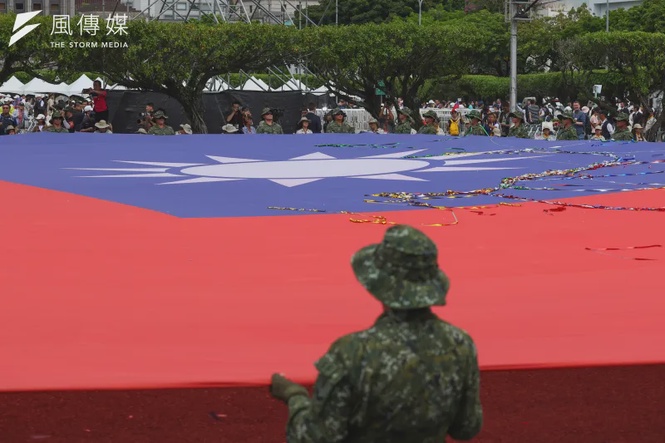
More than thirty years ago, long before I had settled in Taiwan, I visited the island and offered a piece of advice to the then-ruling Kuomintang: give the Blue Sky and White Sun emblem to the nation as its rightful flag, design a new party flag befitting a modern democratic party, and reclaim your anthem from the state.
The KMT declined. I was not surprised.
Three decades have passed. I have now lived in Taiwan for thirty years, and I find myself returning to the same suggestion. The idea itself has not changed much. But my feelings about it have changed enormously.
The Weight of What Is Being Asked
When I was young, I saw this primarily as a matter of institutional logic. How could a democracy's national flag bear an emblem nearly identical to a political party's? How could a nation's anthem open with the words "The Three Principles of the People, the founding creed of our party" — where "our party" refers explicitly to the KMT?
Today, I understand more deeply what it means to ask a century-old party to relinquish its most cherished symbols.
The Blue Sky and White Sun is not just a design. It carries the weight of revolution, nation-building, the Northern Expedition, the War of Resistance against Japan. It holds the youth, sacrifice, glory — and also the defeat, exile, and suffering — of generations of KMT members. For many, it is bound up in the living memory of their parents and grandparents. Likewise, "The Three Principles of the People, the founding creed of our party" is not a verse easily erased. It records how an entire political movement understood itself across a century of history.
This is why I use the word "give." Not abolish. Not confiscate. Not strip away.
The Act of Giving, Not Surrendering
There is a dignity in the act of giving that surrender cannot possess. To abandon something one never valued is meaningless. To relinquish something deeply loved — for the sake of a larger community — is an act of genuine moral weight.
That is what I am proposing. Not that the KMT deny its own history, but that it stand before the nation and say with pride: this flag was ours. It accompanied us through revolution, through the founding of a republic, through war and loss and migration. Today, the Republic of China belongs to all its citizens, and so we give this flag to the nation.
Then the KMT raises a new flag — one that belongs to this democratic era, not to the party-state of the past.
I believe that moment would not be a moment of loss. It would be a moment of dignity — even of moving solemnity.
Taiwan Is No Longer the Same Country
The Republic of China today is not the Republic of China of a century ago. After Taiwan's democratization and multiple peaceful transfers of power, this state no longer belongs to any single party. The government is determined through free elections by the people of Taiwan, Penghu, Kinmen, and Matsu. The KMT itself has governed, lost power, returned to office, and lost power again — a cycle that may seem ordinary now, but is anything but.
The contrast across the Taiwan Strait could not be sharper. On the flag of the People's Republic of China, one large star — representing the Chinese Communist Party — dominates four smaller stars orbiting it. More than seventy years on, the CCP insists on its role as the permanent leader of the state. On this side of the strait, the Republic of China has already traveled a fundamentally different road.
We are no longer the same kind of country.
A Simple Exchange With Profound Meaning
If the KMT gives its flag to the nation, the nation should give something back: the party's own anthem.
"The Three Principles of the People, the founding creed of our party" was always a party anthem. The phrase "our party" is the language of a political organization addressing itself. Asking citizens who support different parties — or no party at all — to sing those words at national ceremonies is a historical awkwardness left over from the party-state era. It is time to resolve it.
The solution is straightforward. The Republic of China already has a well-known and beloved second national song: the Flag Anthem, long used at flag-raising ceremonies and international sporting events. Elevating it to national anthem requires no new composition, no politically charged debate about who gets to redefine the nation. The current national anthem would simply return to its original owner. The KMT would have its hymn back.
Give the party flag to the nation. Take the anthem back.
The Final Step of a Long Journey
The KMT of thirty years ago could not have done this. It had only just begun to emerge from the party-state system. Asking it, psychologically and symbolically, to accept that the Republic of China no longer belonged to the KMT was perhaps too much to ask.
But thirty years have passed.
The KMT has governed and stepped down, governed and stepped down again. In practice, it has already completed the transformation from owner of the state to participant in the state. What remains is one final act of courage: completing that transformation at the level of history and symbol.
A party that can face its own history honestly does not need to possess everything that history left behind. The KMT need not deny its revolutionary legacy, its role in founding the republic, its years of resistance against Japan. It can acknowledge all of it and still say, with maturity and grace: this was our history. Today, it belongs to something larger than us.
I made this suggestion more than thirty years ago. I make it again today, with a much deeper appreciation for how much it asks — and why it is worth asking.
Give the party flag to the nation. Not because that flag has lost its meaning, but precisely because it carries so much.
*The author is a veteran of the 1989 pro-democracy movement and currently serves as Deputy Secretary-General of the Legislative Yuan Human Rights Promotion Association.