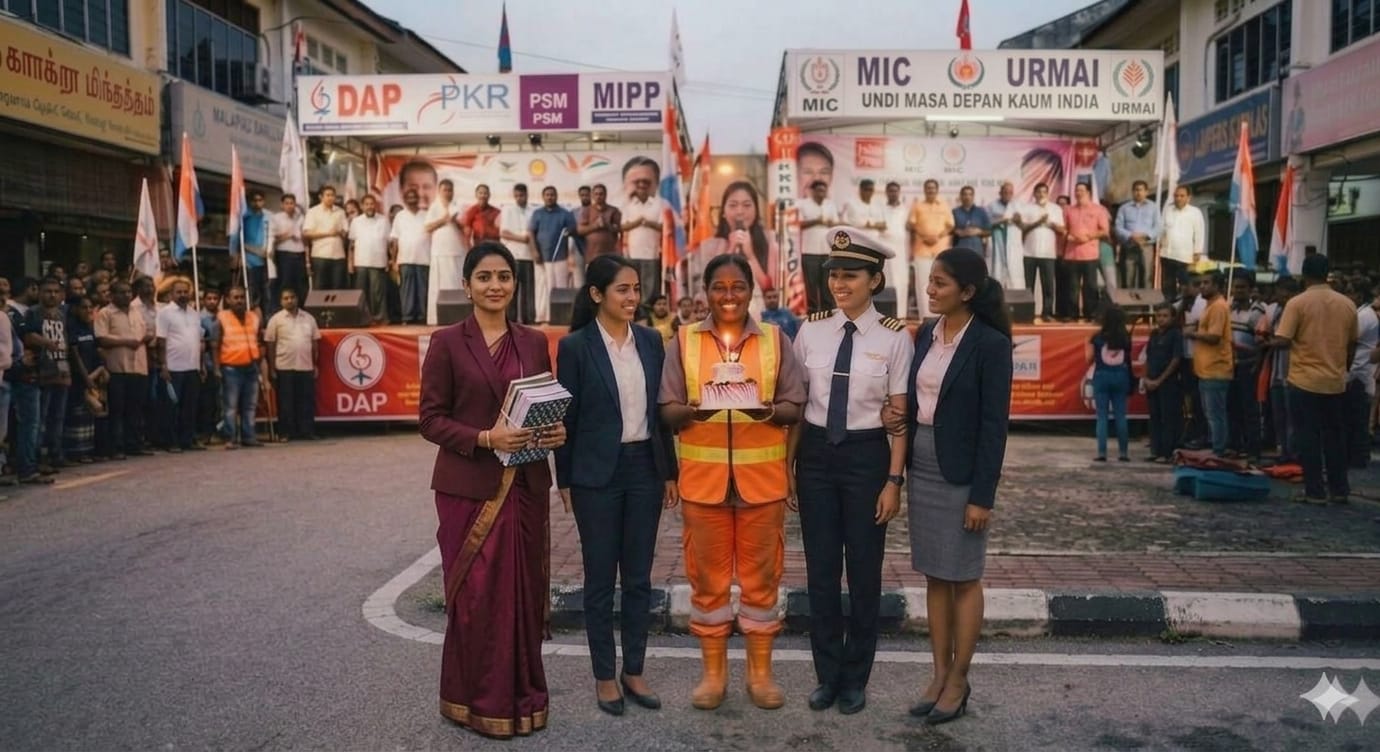
The Numbers vs. The Narrative: Fragmentation on the Ballot. The numbers coming out of the Election Commission for the 2026 Negeri Sembilan state election read like a historic milestone on paper. Seventeen Indian candidates are stepping into the ring, blanketing eight key battleground seats where the Indian swing vote holds the power to make or break kingmakers. But a closer look at this sudden explosion of diversity reveals a deeper, more troubling fragmentation.
The lineup is scattered across an unprecedented ideological spectrum. Pakatan Harapan (PH) has split its representation, with PKR fielding three candidates G. Manivannan in Jeram Padang, Datuk Dr. G. Rajasekaran in Sri Tanjung, and S. Mugunthan in Seremban Jaya. Meanwhile, the DAP counters with its own three J. Arul Kumar in Nilai, S. Veerapan in Repah, and an overlapping, highly contentious push behind their own version of S. Mugunthan in Seremban Jaya.
Then comes Bersatu, breaking away to field an aggressive slate of five candidates, including V. Saravana Kumar (Nilai), R. Mahendran (Seremban Jaya), Sanjeevan (Jeram Padang), and the 23-year-old newcomer M. Leevineshwaraan (Sri Tanjung). Add to this mix three candidates from Perikatan Nasional’s MIPP wing including Dr. P. Kumar in Lobak and Sathes Kumar Nilameham in Lukut the solitary, principled stand of S. Tinagaran (Cikgu Tina) for the Parti Sosialis Malaysia (PSM) in Rahang, and two traditionalists under the Barisan Nasional/MIC banner.
What looks like a bounty of choice is actually a hyper-fragmented battlefield. The Indian community is not being offered a unified vision; it is being sliced into electoral fractions, turning a collective political voice into a chaotic volume of competing megaphones.
The Broken Promise of "Equal Treatment"
To understand the exhaustion behind the current campaign, one must look back at the genesis of the "Big Wave" that shattered Malaysia’s old political order. There was a time when Pakatan Harapan with DAP, PKR, and even PAS unified in a singular opposition front captured the imagination of the Indian working class.
During that era of tectonic shifts, the old guard of Barisan Nasional, led by the towering, uncompromising figure of Tun Samy Vellu, issued a grim prophecy: if the Indian community abandoned the MIC, they would become invisible in the corridors of power. "You will be lost in government," they warned. "No one will voice your pain in Parliament."
The opposition counter-narrative was electric. Indian candidates running under the PKR and DAP banners did not promise the sun, the moon, or an Indian version of the New Economic Policy (NEP). They did not offer exclusive quotas, special privileges, or transactional handouts. Instead, they promised something far more revolutionary: pure, unadulterated equal treatment. They spoke of a meritocratic Malaysia where a child of an estate worker would stand on the exact same footing as anyone else.
Today, that soaring idealism has slowly faded. The grand promises of structural equality have been watered down into the same transactional, piece-meal politics the community was told they were escaping. The fierce battle for universal rights has morphed into a frantic numbers game, leaving voters to wonder if they are choosing leaders or simply filling ethnic quotas on a ballot sheet.
The Chameleons of Convenience: The Sanjeevan Paradigm
Nowhere is this shift clearer than in Bersatu’s pick for Jeram Padang: Sanjeevan. His trajectory highlights the murky nature of modern political activism.
As the founder of MyWatch, Sanjeevan built his profile fighting police misconduct and deaths in custody. His activism nearly cost him his life in 2013 when he survived a near-fatal gunshot to the chest in Bahau a case later classified as "No Further Action" (NFA). Yet, the crusader narrative is tangled. Once a PKR member, his path involves high-profile extortion arrests, subsequent court acquittals, and the official revocation of his Datukship by the Pahang Palace in 2021. His evolution forces a tough question: Are these candidates genuine shields for a vulnerable community, or are they political chameleons navigating shifting winds?
The Seremban Jaya Civil War: Loud Promises, Convenient Silences
The apex of this political absurdity is on full display in N.24 Seremban Jaya. Once considered a fortress of shared reformist ideals, the seat has descended into an ideological civil war. Here, the internal fractures of the ruling alliance are laid bare as PKR and DAP candidates directly lock horns, overlapping and cannibalizing the same voter base while Bersatu's R. Mahendran watches from the wings.
During the glittering nightly ceramahs, both the PKR and DAP machinery make towering promises. They speak passionately about local economic upliftment, modernizing infrastructure, and empowering the urban poor. But the true measure of a politician is not found in what they shout into a microphone; it is found in what they choose to remain completely silent about when the community’s heritage is on the chopping block.
When the raw, bleeding issue of kuil haram rears its head, these candidates suddenly lose their voices. When local councils issue demolition notices or corporate developers claim land where shrines have stood for generations, the loud reformists become masters of bureaucratic evasion. They point fingers at local council jurisdictions, hide behind pending court orders, and speak in whispered, cautious tones so as not to upset the broader racial status quo.
The same calculated cowardice applies to the existential fight for Tamil vernacular education. Right-wing pressure groups and mainstream nationalists frequently demand the complete abolition of vernacular schools, lazily blaming them for a lack of national unity. Yet, Tamil schools are explicitly protected under Article 152(1) of the Federal Constitution, which guarantees the right to preserve, teach, and learn in any mother tongue.
Instead of aggressively invoking this constitutional shield to demand fair funding, structural repairs, and permanent land titles for dilapidated Tamil schools in Negeri Sembilan, the local PKR and DAP candidates tread softly. They remain silent, refusing to weaponize the constitution in public debates because they fear losing majoritarian swing votes. They want the Indian vote in Seremban Jaya, but they refuse to shoulder the political risk of defending the community’s core cultural pillars.
The Illusion of the Youth Weapon
To distract from structural failures, parties have deployed the youth card. Bersatu is championing 23-year-old M. Leevineshwaraan in Sri Tanjung as the youngest candidate in the state election.
This mirrors 2018, when P. Prabakaran won the Batu parliamentary seat at just 22 years old before joining PKR, a move hailed as a generational shift. Today, Leevineshwaraan is packaged the same way to bring anti-establishment energy into the State Legislative Assembly (ADUN).
However, the Indian youth face rampant underemployment and systemic exclusion from high-tech industries. Can a young newcomer truly advocate for structural change within an ethnic-nationalist coalition like Bersatu? Precedent shows that without a fiercely independent backbone, youth candidates quickly turn from radical changemakers into obedient party foot soldiers.
The Optics of Election Season
As polling day nears, the visual theater in Negeri Sembilan has reached performative absurdity. Politicians who were entirely invisible for four years have suddenly discovered an intense love for ordinary citizens.
Leaders who usually dine in air-conditioned rooms are now hunched over local coffee shop tables, staging breakfast, lunch, and dinner photos for social media. Simultaneously, a petty "war of flags" chokes the streets. Party workers are obsessed with physical altitude ensuring their banner flies higher than their opponent's flag while ignoring the deteriorating infrastructure of the neighborhoods they want to represent. The parties care about flags flying high; the people care about leaky roofs.
The True Heroes: The Story of M. Kavitha
While politicians throw money into flags, the true heart of the community exists outside politics. Consider M. Kavitha, a humble Seremban street sweeper whose four daughters organized a beautiful public birthday celebration for her on the very streets she cleans.
For decades, mainstream media and local politicians ignored Kavitha’s quiet war against poverty. Yet, through backbreaking manual labor, she raised four daughters to become highly successful professionals. When the video went viral and radio stations interviewed them, a profound truth emerged: through all her years of hardship, Kavitha never mentioned a single politician who stepped in to help. Her daughters succeeded because of her sweat, discipline, and collective resilience. Her story is a stark reminder that the Indian working class survives despite their politicians, not because of them.
The Ultimatum: "Bye-Bye and Goodbye"
The politicians running in Negeri Sembilan would do well to drop their arrogance and study the recent electoral shifts in places like Johor. The days of treating the Indian community as a reliable, easily bought "fixed deposit" are officially over. The contemporary Indian voter is highly sophisticated, deeply observant, and quietly ruthless.
They understand the mathematics of power perfectly. They know that a politician’s mandate is not a lifetime appointment; it is a temporary, four-to-five-year lease. The community is watching the morning breakfasts, they are measuring the height of the flags, they are noting the strategic silences on temple demolitions, and they are remembering the long years of neglect that preceded this sudden influx of attention.
The message echoing from the streets of Seremban Jaya to the estates of Jeram Padang is clear: the community no longer has time for theatrical representation, token youth candidates, or chameleons of convenience. If a representative fails to perform, refuses to listen, or treats their cultural and constitutional grievances as secondary, the lease will not be renewed. For those who mistake temporary power for permanent privilege, the electorate is ready to deliver a swift, unceremonious eviction from office proving that true power belongs to the hand that holds the pen, not the face on the billboard.
“Power in this country is not a lifetime inheritance; it is a short-term lease signed by the hand that holds the pen. If you trade your principles for strategic silence during your term, do not be surprised when the electorate quietly hands you your eviction notice.” - Annan Vaithegi
Annan Vaithegi (annanvaithegi@icloud.com) is a content creator under the Newswav Creator programme, where you get to express yourself, be a citizen journalist, and at the same time monetize your content & reach millions of users on Newswav. Log in to creator.newswav.com and become a Newswav Creator now!
The User Content (as defined on Newswav Terms of Use) above including the views expressed and media (pictures, videos, citations etc) were submitted & posted by the author. Newswav is solely an aggregation platform that hosts the User Content. If you have any questions about the content, copyright or other issues of the work, please contact creator@newswav.com.