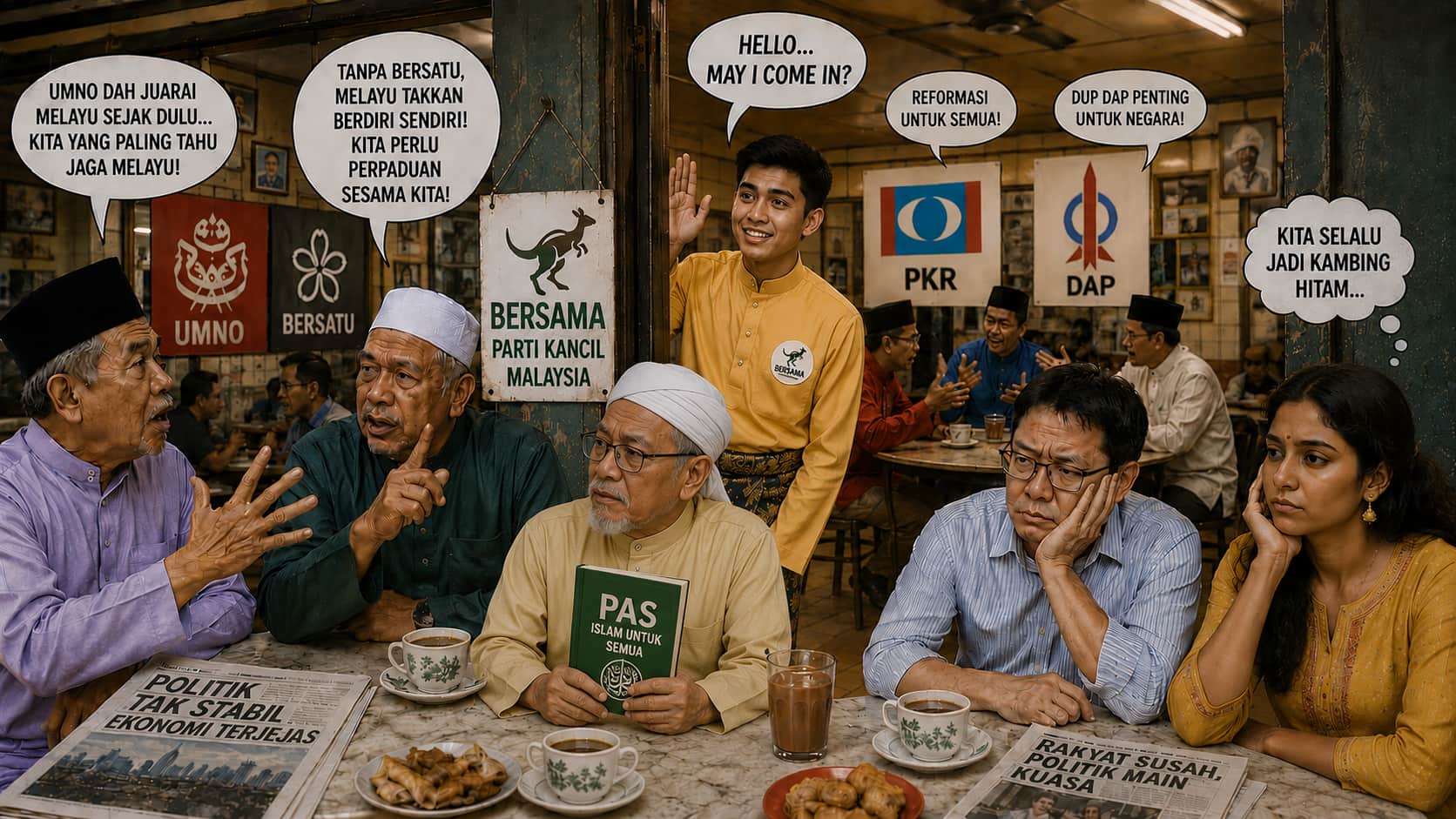
For more than half a century, Malaysian politics has revolved around a recurring promise. Every election cycle, every coalition realignment, and every leadership struggle has ultimately been framed around the same central claim: that a particular political party, leader, or coalition is the indispensable protector of a community. Sometimes the promise is wrapped in the language of Malay rights. Sometimes it is framed as the defense of Islam. Sometimes it appears as a broader commitment to national unity, reform, or social justice. Yet beneath the changing slogans lies a remarkably consistent narrative that without a particular political force in power, the interests of ordinary Malaysians would somehow be endangered.
The irony is that while politicians continue competing to prove who is the most effective protector, many ordinary citizens are increasingly asking a different question altogether. They are less concerned about who is protecting them and more concerned about why life remains so difficult despite decades of promises. Rising living costs, stagnant wage growth, housing affordability, education quality, healthcare accessibility, and economic insecurity have become the dominant concerns of households across the country. These concerns do not distinguish between Indian, Chinese, Malay, Kadazan, Iban, Orang Asli, or any other community. They are shared anxieties that cut across ethnic, religious, and political boundaries.
This growing disconnect between political rhetoric and economic reality should concern every Malaysian. While political leaders continue to engage in endless battles over identity and coalition arithmetic, neighbouring countries are increasingly positioning themselves to capture the opportunities that Malaysia once seemed destined to dominate. The result is a troubling paradox: the louder politicians speak about protecting the people, the less attention appears to be devoted to strengthening the foundations that genuinely improve people's lives.
To understand how Malaysia arrived at this point, it is necessary to examine the historical evolution of the country's major political forces. For decades, UMNO presented itself as the principal guardian of Malay political power and socioeconomic advancement. Supporters point to policies such as the New Economic Policy, the expansion of educational opportunities through institutions like MARA and UiTM, and the development of a substantial Malay middle class as evidence that political intervention successfully addressed historical inequalities. There is truth in this argument. Many Malays benefited from expanded educational access, public sector opportunities, housing programs, and economic initiatives that would have been difficult to achieve without state intervention.
However, the story does not end there. Critics have long argued that while many ordinary Malays benefited from these policies, a disproportionate share of the rewards flowed toward politically connected elites. Over time, concerns about patronage, cronyism, and corruption began to undermine public confidence in the very institutions that were supposed to uplift the wider community. The emergence of major financial scandals further damaged the credibility of leaders who had positioned themselves as protectors of the people. As a result, many Malaysians began questioning whether the system was serving the broader community or primarily preserving the interests of those at the top.
PAS offered a different promise. Rather than emphasizing ethnic nationalism, it framed its political mission around Islamic governance and moral leadership. Supporters believed that a stronger commitment to Islamic values would produce a more just and ethical society. Yet PAS itself became entangled in the realities of coalition politics. Over the years, the party worked with DAP, PKR, UMNO, and later BERSATU. Each alliance was presented as necessary for advancing broader goals, yet many eventually collapsed under the weight of ideological disagreements, leadership rivalries, or competing ambitions. The repeated cycle of cooperation and conflict left many voters wondering whether principles were genuinely driving political decisions or whether power itself had become the overriding objective.
The rise of BERSATU was initially seen as an attempt to offer Malays an alternative to UMNO. Led by former UMNO leaders, the party promised cleaner governance while maintaining a commitment to Malay interests. However, BERSATU soon found itself confronting many of the same contradictions that had plagued its predecessors. Its alliance with PAS was frequently described as a strategic necessity, yet tensions emerged almost immediately over leadership, policy direction, and electoral positioning. What began as a project to reform Malay politics increasingly appeared to many observers as another chapter in the same struggle for power.
PKR, meanwhile, emerged from the Reformasi movement with a promise to transcend old political divisions and build a more inclusive, merit-based political culture. Yet governing has proven far more complicated than opposition. As PKR entered federal power and later formed the backbone of the Unity Government, it encountered the difficult reality of coalition management. Compromises became unavoidable. Reform agendas slowed. Internal tensions surfaced. Critics accused the party of abandoning its principles, while supporters argued that incremental progress was preferable to instability. Whatever one's view, it became clear that no political party was immune from the pressures of survival.
What is striking about these developments is not merely that alliances have shifted. Political alliances shift in every democracy. The deeper issue is that despite their different ideologies, many parties have increasingly relied on similar tactics whenever they face political pressure. When governance becomes difficult, when economic performance disappoints, or when public confidence declines, identity politics often returns to center stage.
This is where the role of scapegoating becomes particularly important. Throughout Malaysia's political history, various parties have found it convenient to blame rivals for problems that are often far more complex. DAP has frequently served as a political lightning rod in this regard. Whenever conservative parties face declining support, internal divisions, or governance challenges, DAP often re-emerges as a convenient symbol around which fears can be mobilized. Yet this pattern reveals something important. If the same scapegoat continues to be blamed regardless of which coalition is in power, perhaps the problem lies elsewhere.
The truth is that fear remains one of the most powerful tools in politics. Fear can unite supporters. Fear can distract from policy failures. Fear can transform difficult economic questions into emotionally charged cultural debates. Most importantly, fear can discourage voters from asking uncomfortable questions about performance. It is easier to tell citizens that their identity is under threat than to explain why wages remain stagnant, why talented graduates continue leaving the country, or why public services struggle to keep pace with growing expectations.
Yet fear cannot solve economic problems.
A family struggling to pay rent cannot improve its finances through political slogans. A young graduate burdened by uncertainty cannot build a career through rhetoric. A small business facing rising costs cannot remain competitive because politicians win arguments on social media. Economic dignity requires something more substantial than emotional mobilisation. It requires sound policy, competent governance, institutional integrity, and long-term planning.
This reality becomes even more apparent when Malaysia is compared with its regional neighbours. Vietnam has successfully positioned itself as one of Asia's most attractive manufacturing destinations, drawing substantial foreign investment from global technology and industrial firms. Indonesia has pursued ambitious infrastructure projects and industrial development strategies designed to strengthen its long-term competitiveness. These countries are not perfect. They face their own political, economic, and social challenges. However, they have demonstrated a degree of policy continuity that investors find reassuring.
The modern global economy rewards stability. Multinational corporations making billion-dollar investment decisions seek predictable environments. They want confidence that major policies will not change dramatically every few years due to political crises, coalition collapses, or leadership struggles. When governments appear perpetually consumed by internal conflicts, investors naturally become more cautious. Capital flows toward certainty, and certainty becomes difficult to project when political survival dominates public discourse.
Malaysia therefore faces an opportunity cost that is rarely discussed honestly. Every hour spent manufacturing fear is an hour not spent strengthening education. Every political crisis consumes attention that could be devoted to innovation, productivity, infrastructure, and competitiveness. Every coalition dispute sends a signal to international observers about the country's ability to maintain policy consistency. While politicians fight over narratives, other countries continue building the future.
The encouraging development is that many younger Malaysians appear increasingly aware of this reality. Growing up in an era of digital connectivity, they are exposed to global benchmarks and international comparisons. They have witnessed multiple coalition changes, leadership transitions, and political realignments. As a result, many are becoming less interested in historical grievances and more interested in practical outcomes. They want quality education, meaningful employment, affordable housing, environmental sustainability, and transparent governance. They are not abandoning their cultural or religious identities. Rather, they are refusing to allow those identities to become substitutes for performance.
This shift may ultimately represent Malaysia's greatest hope. The future will not be secured through perpetual arguments about who best protects the people. It will be secured by leaders capable of empowering them. True protection is not measured by the intensity of political rhetoric. It is measured by whether citizens can build prosperous, dignified, and secure lives.
The ultimate protection of a community lies in its empowerment, not its engineered fear. Strong schools protect communities. Competitive industries protect communities. Effective institutions protect communities. Clean governance protects communities. A dynamic economy protects communities. Everything else is secondary.
Malaysia stands at a crossroads. One path leads toward another generation of political theater, manufactured outrage, and recurring cycles of blame. The other leads toward a politics centered on performance, accountability, and competitiveness. The choice will determine whether Malaysia remains trapped in familiar arguments or emerges as a nation capable of realizing its enormous potential in an increasingly competitive world.
Annan Vaithegi writer and commentator on Malaysian politics, society, and public policy.
Annan Vaithegi (annanvaithegi@icloud.com) is a content creator under the Newswav Creator programme, where you get to express yourself, be a citizen journalist, and at the same time monetize your content & reach millions of users on Newswav. Log in to creator.newswav.com and become a Newswav Creator now!
The User Content (as defined on Newswav Terms of Use) above including the views expressed and media (pictures, videos, citations etc) were submitted & posted by the author. Newswav is solely an aggregation platform that hosts the User Content. If you have any questions about the content, copyright or other issues of the work, please contact creator@newswav.com.