
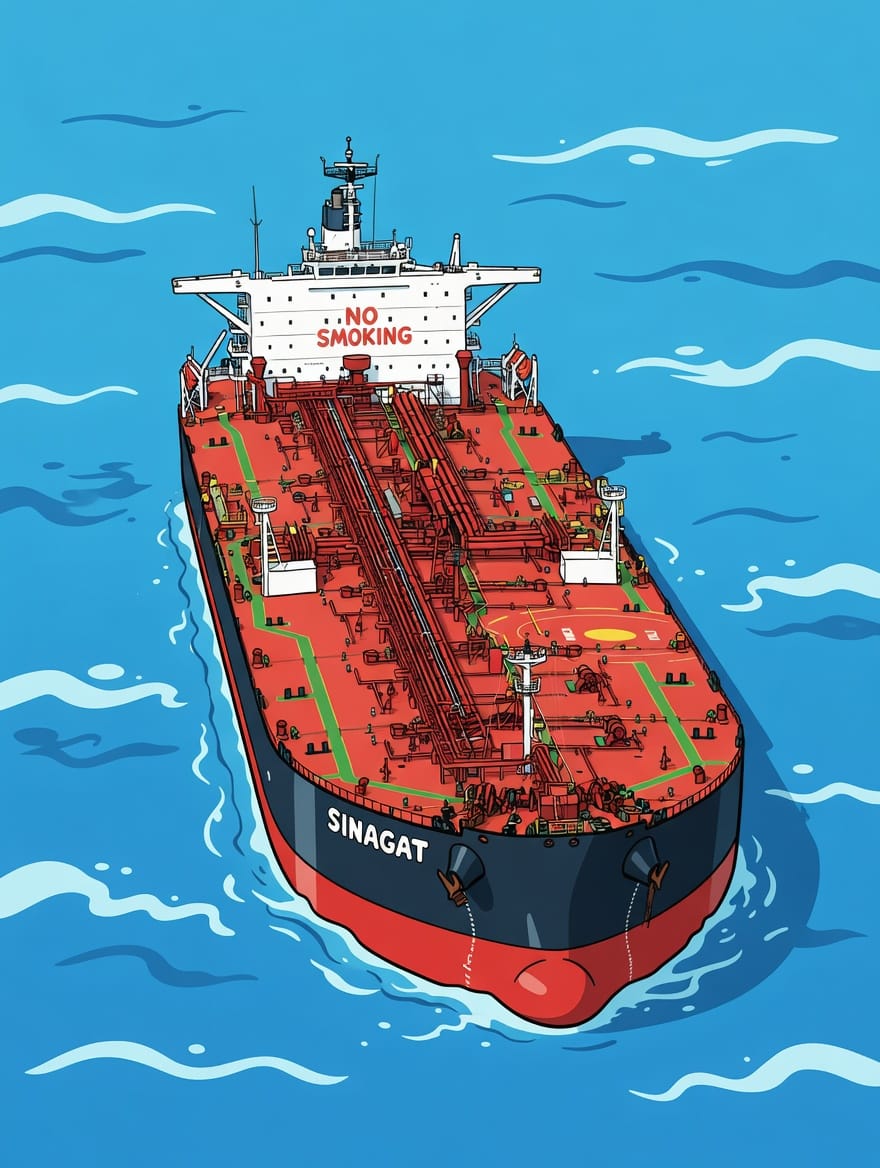
The Strait of Hormuz is widely regarded as the most critical energy chokepoint in the world—a narrow maritime corridor that functions like the beating heart of the global economy. Through this slender passage flows a vast share of the oil and gas that powers industries, fuels transportation, and sustains modern life. It is not merely a route on the map, but a golden artery carrying liquid fire from the deserts to the engines of the world. Its importance has become even more pronounced during the 2026 Iran War, where its effective closure has sent tremors across global markets like a sudden storm cracking the calm surface of the ocean.
First and foremost, the strait serves as a global energy lifeline, a narrow funnel at the mouth of a vast reservoir. Oil exports from Saudi Arabia, Iraq, Kuwait, Qatar, and the United Arab Emirates must all squeeze through this single gate before reaching the wider ocean. Each day, around 20–21 million barrels of oil pass through—roughly one-fifth of global consumption. This makes the strait a giant hourglass, where grains of black sand—each barrel of oil—fall steadily to keep the world’s clock ticking. Alongside oil, about 20% of global liquefied natural gas, mainly from Qatar, travels this route. These energy flows are drawn largely toward Asia, especially China, India, Japan, and South Korea—making the strait a lifeline stretched like a glowing thread between continents, binding producers and consumers together.
Beyond oil and gas, the strait is also a hidden marketplace of essential materials, a quiet caravan route of the modern age. Nearly 45% of the world’s sulfur passes through here, feeding the production of fertilizers that nourish crops across the globe. Helium, aluminum, and urea also transit these waters, like invisible cargoes of breath, metal, and growth. These commodities are the silent nutrients of the global economy, rarely seen but deeply felt. When disruption strikes, the effects ripple outward like stones cast into a still pond. During the 2026 blockade, oil prices leapt from around $65–$70 to over $100 per barrel, a fever rising in the bloodstream of global markets. Shipping costs surged as insurance premiums climbed, and vessels were forced to wait, turning the strait into a crowded bottleneck where ships gather like anxious travelers at a closed gate.
Geopolitically, the Strait of Hormuz is a pressure valve of global power, narrow in size but immense in influence. At just 33 kilometers wide at its tightest point, it is like a thin neck holding back a vast ocean of consequence. Iran, positioned along its northern edge, holds the ability to influence this passage through asymmetric means such as naval mines, drones, and fast attack craft. This gives Iran the role of a gatekeeper standing beside the world’s most important doorway, capable of slowing or stopping the flow at will. In response, global powers, including the United States Navy Fifth Fleet, maintain a presence to safeguard navigation. Yet in times of conflict, even these forces move like tightrope walkers above a sea of uncertainty, where a single misstep could spark wider confrontation. Although international law, particularly the United Nations Convention on the Law of the Sea (UNCLOS), guarantees the right of transit passage, such legal frameworks can feel like paper shields against iron storms when tensions escalate.
Perhaps the most critical vulnerability of the strait lies in the lack of viable alternatives. While pipelines such as Saudi Arabia’s East-West route offer some relief, they can only carry about 4–5 million barrels per day—far short of the total volume that normally flows through the strait. This creates a massive gap, like a narrow stream trying to replace a mighty river that has suddenly run dry. For liquefied natural gas, especially from Qatar, there are no alternative routes at all. If the strait is closed, exports halt entirely, like a tap abruptly turned off at the source of a vast reservoir.
In conclusion, the Strait of Hormuz is far more than a geographic feature—it is a living artery, a fragile bridge, and a strategic lever all at once. It connects continents, fuels economies, and shapes global politics, all within a narrow strip of water. The events of the 2026 Iran War have shown that this vital passage is also a fault line beneath the world’s energy system, where pressure can build and rupture with far-reaching consequences. When the strait flows freely, it is like a calm river sustaining life; when it is blocked, it becomes a dammed force, building tension that threatens to overflow into crisis.
moykokming@gmail.com
Moy Kok Ming (moykokming@gmail.com) is a content creator under the Newswav Creator programme, where you get to express yourself, be a citizen journalist, and at the same time monetize your content & reach millions of users on Newswav. Log in to creator.newswav.com and become a Newswav Creator now!
The User Content (as defined on Newswav Terms of Use) above including the views expressed and media (pictures, videos, citations etc) were submitted & posted by the author. Newswav is solely an aggregation platform that hosts the User Content. If you have any questions about the content, copyright or other issues of the work, please contact creator@newswav.com.
