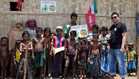
Not too long ago, I remember seeing an interview with Jackie Chan in which he recalled speaking to a Palestinian child.
Jackie asked the child, "What do you want to be when you are older?"
According to Jackie, the child cheerfully replied, "Kids like us don't become older."
Jackie said it broke his heart.
At some point, we are going to have to realise that war refugees are built differently from regular people.
I even wonder whether a refugee child cries in the same way that other children do.
I know a Malaysian child will cry.
A Malaysian child will cry because they are conditioned to cry. Most, if not all, Malaysian children — from any race — are conditioned from a young age to believe that if they are in trouble, all they have to do is cry and display their vulnerability, and those causing them distress will relent, or help might come their way.
I have doubts as to whether a Rohingya child is conditioned in the same way.
For all we know, a Rohingya child might be conditioned to not cry, to never display vulnerability, because displaying tears and vulnerability is like dripping blood in a world filled with predators — it will only compound your problems.
When you hear Malaysians complain about the Rohingyas, many of the complaints are centred around the notion that the Rohingyas are dirty, lazy, or "too much". When I hear such complaints, I wonder what exactly we expect from people who come from a violent, conflict-ridden environment.
Do we expect them to wake up before sunrise, sweep the floor, make their bed, iron their uniform, and head to work, where they greet everyone cheerfully with a "good morning" and "have a nice day"?
Can we really expect a highly traumatised people to be well-adjusted?
If you cannot even expect someone who comes from a broken home to be well-adjusted, you certainly cannot expect a community who might have lived for generation in a war-torn region to be well-adjusted either.
Instead, you should expect a lot of difficulties. They might be depressed, have volatile personalities, or possess troubling behavioural traits.
Recently, hate campaigns involving the Rohingyas have once again made headlines in our country.
A petition calling for Rohingyas to be removed from Malaysia on Change.org received widespread support. It reportedly garnered more than 424,000 signatures as of June 8 before it was taken down following criticism from civil society groups.
The discovery of an unauthorised flat allegedly built by refugees on private land in Sungai Tekali, Hulu Langat, also did not improve the situation.
Local representatives alleged that landowners had allowed the settlement and the construction of the building, which reportedly housed hundreds of Rohingya refugees. Following renewed public attention, authorities announced that the illegal structure would be demolished in accordance with existing laws.
Now, some people are too quick to label Malaysians' refusal to accept the Rohingyas in our midst as a hate campaign, but this is not the case either.
It is genuinely difficult dealing with a broken people. If you have ever dealt with someone who comes from an abusive household, for example, you would know.
To cope with their traumatic circumstances, their personalities and psychological states may be wired differently, and this can make them very difficult people to deal with.
I would not be surprised if some Muslim refugees, such as Palestinians or Rohingyas, have even convinced themselves that they are fighting for Islam itself, and therefore expect a hero's welcome in a country like ours because of the sacrifices they believe they have made for their faith.
When you are already broken psychologically and emotionally traumatised, and then you discover that the people you thought you were fighting for and long assumed would support you, are actually apathetic to your struggle or plight, of course you are going to be difficult to deal with.
I think a major reason why our relationship with the refugee community is becoming strained is because we are not being realistic about ourselves or about them.
We think we are more compassionate and understanding than we actually are.
We might expect refugees to be grateful to us for offering them shelter, while the refugees might expect us to celebrate them for their sacrifices in fighting for our cause.
We might think refugees will quickly adapt to our norms and lifestyle once they arrive here, but we forget that they are refugees in the first place because they refused to give up on their identity. If you suffered for years, and perhaps nearly died in your home country because you wanted to remain who you are, can anyone really expect you to suddenly become somebody else in a different country?
At some point, we must accept that if we wish to be compassionate and understanding, we will have to carry a great burden, and not expect a pleasant experience where we will be regularly cheered and celebrated for our compassion and kindness.
Being compassionate is difficult — that is why you need a noble spirit and a great soul to possess it.
If you do not have a noble spirit and a great soul, but assume that you are highly compassionate and kind, all that will happen is that you will be crushed by the weight of the compassion and kindness you have rushed to carry.
We might be a compassionate and kind people, but at this stage, I think it should be clear that we are not so compassionate and kind that we can comfortably deal with hundreds of thousands of refugees, many of whom are likely traumatised and deeply disturbed.
We can deal with thousands or tens of thousands perhaps, but not hundreds of thousands.
Other than accepting that our compassion and kindness has limits, we also need to open our hearts a little more and realise that traumatised and broken people cannot be expected to be just like us.
When you have seen loved ones murdered, you cannot be expected to prioritise keeping your house spotless.
When you have been subjected to systematic violence and abuse for an extended period of time, you cannot be expected to find meaning and joy in a regular nine-to-five job.
It will take a long time — perhaps generations — for a traumatised people to heal from their trauma.
If we truly wish to be a compassionate people, then we must resolve to bear with these difficulties for the long haul.
TheRealNehruism (nehru.sathiamoorthy@gmail.com) is a content creator under the Newswav Creator programme, where you get to express yourself, be a citizen journalist, and at the same time monetize your content & reach millions of users on Newswav. Log in to creator.newswav.com and become a Newswav Creator now!
The User Content (as defined on Newswav Terms of Use) above including the views expressed and media (pictures, videos, citations etc) were submitted & posted by the author. Newswav is solely an aggregation platform that hosts the User Content. If you have any questions about the content, copyright or other issues of the work, please contact creator@newswav.com.