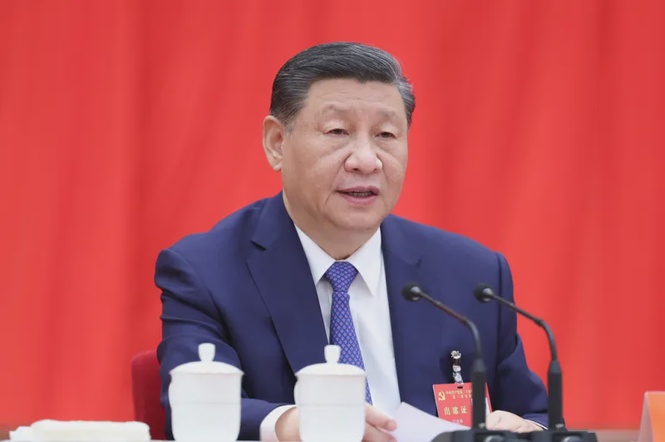
China's Communist Party closed its Fifth Plenum on October 29 without adding a single new member to the Central Military Commission (CMC), leaving the body that commands the People's Liberation Army (PLA) with just two men: Xi Jinping and Zhang Shengmin. Behind that vacuum lies a purge that is still widening and now reaches combat commanders, leaving Beijing with a high command that is more loyal than experienced. Taiwan should take that combination seriously in any future crisis.
The scale of the purge shows in the attendance. According to the plenum communique released by Xinhua, only 162 full members and 117 alternate members of the Central Committee took part, 279 in total. The 20th Party Congress in October 2022 had elected 205 full members and 171 alternates, or 376. Of the 97 missing, one, former customs chief Yu Jianhua, died of illness. The other 96 were kept away because they had been punished or remain under investigation, about 26% of the original roster.
Skipped Promotions Show The Military Purge Is Not Over
The plenum expelled 24 full members of the Central Committee but promoted only 10 alternates, including Lu Dongliang, to replace them. With roughly a year left in the current term, Beijing may not see a need to fill every seat. A likelier explanation is that discipline inspections are still under way, and the party would rather leave seats empty than promote someone who falls later.
Notably, none of the 10 came from the PLA or the People's Armed Police (PAP), China's paramilitary force. Among the five alternates who were next in line but passed over were Lt. Gen. Fu Wenhua, a former commander of the Beijing Garrison who later became a deputy PAP commander, and Lt. Gen. Zhu Wenxiang, also a deputy PAP commander.
Fu, who took over the Beijing Garrison in April 2020, had served under Zhang Youxia, the purged former CMC vice chairman, in the old Shenyang Military Region. After Miao Hua, then director of the CMC Political Work Department, was suspended in late November 2024, Fu was moved to the PAP in March 2025 and promoted to lieutenant general. The garrison command then sat vacant for nearly a year until Chen Yuan, former commander of the PAP's Shanghai contingent, took over in February 2026.
In hindsight, Fu's promotion may have been Xi's opening move against Zhang Youxia, made once the networks of Miao Hua, who vanished from public view in November 2024, and former CMC Vice Chairman He Weidong, unseen since March 11, 2025, had been largely cleared. Moving Fu out let the garrison's political commissar, Maj. Gen. Zhu Jun, an air force officer with no ties to Zhang Youxia, run the capital's garrison day to day.
Zhu Wenxiang may have been passed over because he began his career in the PAP's Fujian contingent and was promoted to lieutenant general as early as July 2020, which tied him in many eyes to the Miao Hua and He Weidong factions.
Other signals point the same way. Vice Adm. Zhang Like, promoted in September 2025 and named head of the CMC National Defense Mobilization Department after Miao's and He's networks were purged, has missed several major events in a row, including the plenum, and has likely fallen. On February 26, 2026, Maj. Gen. Ding Laifu, former commander of the 73rd Group Army in Xiamen, Fujian, and Maj. Gen. Yang Guang, former commander of the Rocket Force's Base 64 in Lanzhou, Gansu, were publicly removed as deputies to the National People's Congress. It was the first time in this wave of purges that commanders of corps-level combat units had been publicly punished, a sign that the campaign is reaching down into operational forces.
That spread could hurt morale in combat units. It may also mean that Xi, while firmly in control of the military, no longer trusts it as he did before the purges began. Since January 1, public reports have recorded no Xi inspection tours of military units, compared with seven in 2023, nine in 2024, and five in 2025.
Xi Is Keeping Zhang Shengmin's Influence In Check
The plenum took the unusual mid-term step of adding Zhang Shengmin to the Politburo, but it added no one to the CMC, which now consists of Xi and Zhang alone.
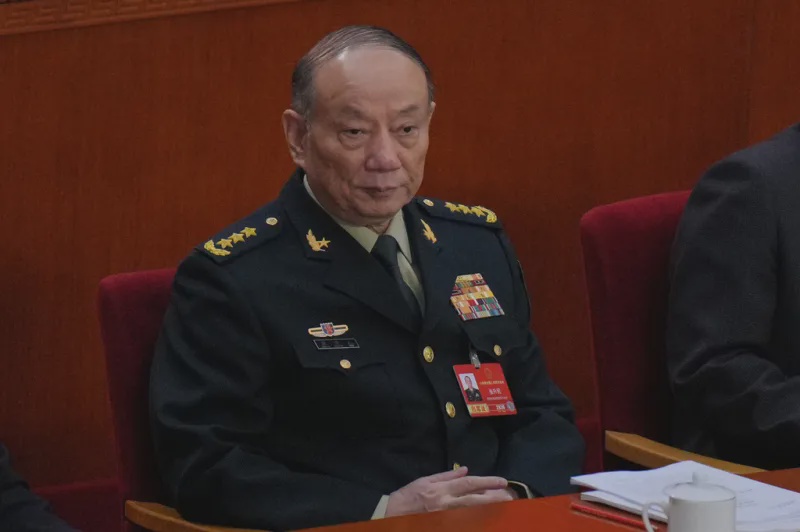
On paper, Gen. Zhang Shuguang was the obvious candidate. Promoted to army general in July 2026, he succeeded Zhang Shengmin as secretary of the CMC Discipline Inspection Commission. But he previously headed the commission's supervision bureau and is Zhang Shengmin's closest protege. Keeping him off the CMC may be Xi's way of stopping Zhang Shengmin's influence in the military from growing too fast. As top leader, Xi is often occupied elsewhere, and a commission run day to day by Zhang Shengmin and his own former deputy would only give Zhang more room to expand his network.
The alternatives were no better for Xi. Defense Minister Adm. Dong Jun is not in Xi's favor. Gen. Han Shengyan and Gen. Yang Zhibin, both more senior than Zhang Shuguang and qualified for CMC seats, lead the Central Theater Command, which guards the capital region, and the Eastern Theater Command, which faces Taiwan and the most complex situation of any theater. With no suitable successors for either post, neither can yet be moved up to balance the two Zhangs.
Keeping the commission at two members until the 21st Party Congress in October 2027 also buys Xi time. By then, at least 20 more lieutenant generals will have two years in rank, giving him a wider pool for the next leadership lineup.
The Political Work Department Is Xi's Key 2027 Appointment
Zhang Shengmin is expected to remain vice chairman after the 21st Party Congress and become the first-ranked executive vice chairman, while Zhang Shuguang is expected to join the new CMC as discipline secretary. That makes the most consequential remaining choice the director of the CMC Political Work Department, a post that also qualifies for a CMC seat.
The reason is procedural. Appointments at the level of full-time theater deputy commander and above are vetted by the Political Work Department, which sends a shortlist to the CMC executive meeting for a decision. After 2027, whenever Xi cannot attend that meeting, Zhang Shengmin would chair it as executive vice chairman.
For checks and balances, the department should go to a career political work officer who is not close to Zhang Shengmin, so that he does not gain outsized sway over senior appointments. Ideally, Xi would recreate the competition over promotions that existed when Zhang Youxia was executive vice chairman and Miao Hua ran the department.
By that logic, one candidate is Air Force Lt. Gen. Chen Demin, promoted in September 2025, who spent most of his career in the air force's political work system and has run the department's daily affairs as deputy director since December 2025. If the other vice chairman is also an air force general, however, Xi may want to avoid putting too many air force officers on the commission. That could open the way for Vice Adm. Li Dongyou, promoted in September 2025, who has served in the navy's political work system since 2016, was deputy political commissar and then political commissar of the carrier Liaoning, and is now deputy political commissar of the Northern Theater Command and director of its political work department.
The second vice chairman will likely be either Han Shengyan or Yang Zhibin, the air force's two most senior generals. Han looks more likely: he became a lieutenant general in 2017, four years before Yang, and has served in the Central Theater Command since July 2018.
If convention holds and the chief of the Joint Staff Department is again an army general from a combat branch, the thin ranks left after the purge point to Lt. Gen. Zhu Chuansheng, promoted in March 2025, who has served as acting chief since January 2026 while holding the deputy chief post. And if both the second vice chairmanship and the Political Work Department go to the air force, Xi may want a navy line officer to reach full admiral and a CMC seat. Vice Adm. Zhang Zheng, promoted in December 2024, studied in the United Kingdom, commanded both the Liaoning and the Shandong, and now runs navy headquarters as navy chief of staff. He could become a CMC member and defense minister after the 21st Party Congress.
A Hollowed High Command Will Struggle To Improvise
The removal of so many generals and senior lieutenant generals means their successors generally have less experience. The gaps run across nearly the entire high command: CMC departments and directly affiliated bodies, the CMC Joint Operations Command Center, the five theater commands, service headquarters, and the PAP. That will almost certainly degrade the quality of PLA decision-making, force building, and management over the next three to four years. It will also weaken the PLA's ability to handle unplanned events, from major disasters to sustained, large-scale force projection abroad and joint operations.
The military reforms Xi launched in 2015 make the problem sharper. To remove the danger posed by the seven old military regions, which had enough independence to act on their own, the reforms made the new theater commands depend on many other bodies to deploy sizable forces. Logistics come from the Joint Logistic Support Force, mobilization runs through the National Defense Mobilization Department via provincial military districts, satellite navigation relies on the Aerospace Force, and communications depend on the Information Support Force. If the leaders of these bodies lack expertise and experience, the quality of their cooperation is easy to imagine.
More important, if the purge's reach into combat units has made Xi less trusting of his military, he may be reluctant to launch large-scale military operations abroad, so as not to give combat forces too much freedom of action.
Routine Pressure On Taiwan Is Unlikely To Ease
PLA activity around Taiwan, by contrast, should be little affected. Routine drills, battlefield preparation, and gray zone operations near Taiwan have long been delegated to the Eastern Theater Command for planning and execution. Its staff have a settled way of working, and leadership turnover at the top barely touches it. The proof is that, amid the upheaval, the command planned and carried out Justice Mission 2025, a large exercise aimed squarely at Taiwan, in just 12 days.
Loyal But Inexperienced Commanders Could Escalate A Crisis
What Taiwan should watch closely is how a purged leadership would handle a crisis sparked by a major political dispute, a military accident, or an accidental exchange of fire. Beijing's party, government, and military leaders may now be "more loyal than professional." They may tell superiors what they want to hear rather than the truth. And PLA leaders and field commanders may follow the old maxim of erring to the left rather than the right, acting more aggressively to match nationalist sentiment instead of recommending restraint.
Together, those tendencies raise the risk that Beijing misreads a situation, or that deliberately aggressive PLA moves drive tensions up quickly. Either way, a cross-Strait crisis would become far harder to manage.
*Chieh Chung is an associate research fellow in the Division of Defense Strategy and Resources at the Institute for National Defense and Security Research (INDSR). The views expressed are the author's own.
You've read it. Now join the conversation — follow us on X, Facebook and IG. Editor: Penny Wang