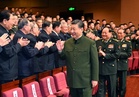
Chinese leader Xi Jinping's drive to tighten his grip on the Communist Party is likely to bring heavier pressure on Taiwan, the island's top China policy agency warned on November 2, days after a party conclave in Beijing vowed to keep "red" rule alive for generations.
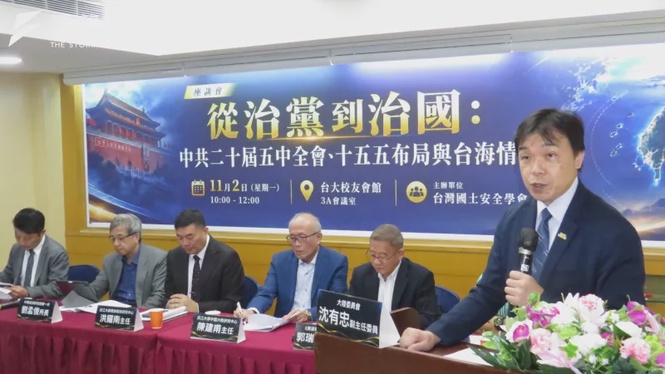
Shen Yu-chung (沈有忠), deputy minister of the Mainland Affairs Council (MAC), the Taiwanese cabinet body that handles relations with Beijing, laid out three readings of the Chinese Communist Party's (CCP) Fifth Plenum: power in Beijing is becoming even more concentrated, security and ideology are distorting China's economy, and the party's internal strains could be turned outward against Taiwan. He spoke at a forum on the plenum, China's next five-year plan and the outlook for the Taiwan Strait, hosted by the Taiwan Homeland Security Association.
The 20th CCP Central Committee met behind closed doors in Beijing from October 26 to 29 and adopted a decision on persevering with full and rigorous Party self-governance, the party's term for its discipline and anti-corruption campaign. In an explanation of the decision that was later made public, Xi told the plenum: "Only by persistently advancing full and rigorous Party self-governance and constantly clearing out the viruses that erode the Party's healthy body can we ensure that the Party never degenerates, never changes color and never loses its flavor, and ensure that red rule is passed down from generation to generation."
MAC Sees Plenum Paving Xi's Path To Another Term
Shen argued that the discipline decision goes well beyond housekeeping. "This is not simply about handling the party's internal affairs," he said. "It can also be seen as the CCP paving the way in advance for Xi Jinping to win another term at next year's 21st Party Congress and to keep all power in his own hands."
He said Beijing would enforce stricter political discipline and higher political standards to guarantee the absolute loyalty of party members and officials to Xi, and that provincial party chiefs were likely to face tougher scrutiny. The plenum also promoted military discipline chief Zhang Shengmin into the Politburo, as Storm Media reported, underscoring how purges have come to define Xi's third term.
"Going forward, we expect Xi Jinping's power to become even more 'totalitarian' and 'dominant,'" Shen said. "This kind of power structure, with no checks and balances, will also shape the security order in the Indo-Pacific and the situation across the Taiwan Strait."
Purges Leave Xi Unchecked And Without A Successor
According to the MAC, Xi has turned party leadership into rule by a single, unchallengeable authority since taking power, pushing China's authoritarian system toward extremes and leaving no one able to correct the leader's mistakes. The party's remedy, a campaign it calls "self-revolution," relies on harsher purges, ideological tightening and top-down control that treat the "Xi core" and "Xi Thought" as edicts no one may defy. Shen described this as a vicious cycle that only concentrates power further.
The risks multiply as power narrows, he said. Major decisions hinge on one man with little room for error, officials compete to prove their loyalty and second-guess what the top wants, erring on the side of being "better too far left than right," and the concerns of ordinary people struggle to reach the leadership.
"A dictatorial power structure like this looks unbreakable, but internally it lacks the resilience to adapt, and it keeps piling up risks that are hard to predict," Shen said. He added that the CCP "still has not established a succession mechanism," leaving China's political future "full of even greater uncertainty."
Beijing's Security-First Economy Threatens Global Trade
Shen's second point concerned the economy. China's property slump, mounting local government debt and weak consumer demand have shown no sign of improving, he said, yet Beijing is pouring national resources into technological self-reliance and mass production to sustain jobs, while stockpiling energy and grain as a strategic reserve.
In his view, this shows the leadership will keep putting regime security ahead of economic well-being, deepening an already severe imbalance between supply and demand at home. That strain is spilling abroad, he warned: China is dumping surplus industrial capacity at low prices, distorting fair trade and drawing strong pushback from the United States and Europe, while expanding economic coercion and trade barriers in the name of security, including controls on rare earths and other critical materials and interference with technology exports.
Taiwan Fears Beijing Will Export Its Domestic Strains
The third and most direct concern for Taipei is that Beijing's internal anxieties will land on Taiwan. "We are worried that, to divert pressure, the CCP may not rule out speeding up its so-called 'governance before unification' measures against Taiwan," Shen said, referring to Beijing's push to act as though it already administers the island.
History shows, he said, that when growth slows in an authoritarian state and its legitimacy is questioned, leaders find it easier to externalize domestic tensions by taking a harder line abroad and stirring up nationalism. "Beijing is trying, before it ever actually attacks Taiwan, to use multiple means to create the illusion that it holds normal jurisdiction over the Taiwan Strait and Taiwan," he said.
Shen identified two fronts. The first is routine gray zone harassment, coercion that stops short of open war. Despite sweeping shake-ups and purges among the People's Liberation Army's top brass, he noted, Beijing's defense spending keeps rising, and it continues to send military aircraft, warships, coast guard vessels, research ships and maritime militia boats into the sea and air space around Taiwan in an effort to turn the strait into Chinese inland waters. "This is why we believe the CCP is, without question, the troublemaker in the Indo-Pacific region today," he said.
The second front is the ballot box. With voters heading to the polls in the 2026 Taiwan local elections on November 28, Shen said the campaign has become a target for Beijing's united front infiltration, its effort to win over or co-opt groups in Taiwan, and for cognitive warfare. Beijing is using legal intimidation and pressure to force public figures, entertainers among them, to declare their positions and "draw a clear line," he said, creating a chilling effect meant to divide Taiwanese society and cloud voters' independent judgment. The council has recently warned China against meddling in the races.
Taiwan Vows Deterrence, Not Provocation
Shen said the government would respond in three ways. First, it will keep building up its self-defense to deter, not provoke. "History has fully proven that peace must rest on solid strength, not be bought by compromising with authoritarianism. Only by preparing for war can we avoid war," he said. Taiwan will strengthen its asymmetric warfare capabilities, whole-of-society defense resilience and protection of critical infrastructure, he added, sending the message that "any reckless attempt to change the status quo by force will come at an unbearable cost." It will also shore up legal defenses against foreign infiltration and cognitive warfare.
Second, Taipei will insist on parity and dignity in cross-strait relations. "Taiwan's mainstream public opinion is already very clear: it rejects the 'one country, two systems' political framework set unilaterally by the CCP, and it rejects the CCP's authoritarian rule," Shen said, referring to the formula Beijing applied to Hong Kong and proposes for Taiwan. The government supports healthy and orderly exchanges, he said, but will never trade away sovereignty or negotiate on terms that belittle Taiwan's status. "It has always been the CCP that is unwilling to hold dialogue and unwilling to communicate."
Third, Taiwan will keep working with like-minded democracies in the Indo-Pacific and beyond. Shen said peace in the Taiwan Strait is not only a cross-strait matter but a cornerstone of global supply chain security, freedom of navigation and regional prosperity, and he urged Beijing to drop its ambition of changing the status quo by force.
Shen Says Democracy, Not Ethnicity, Divides The Two Sides
Shen framed the dispute as a clash of political systems. "The difference between the two sides does not lie in what surnames people have, what food they eat or what festivals they celebrate, nor in how similar they are ethnically and culturally," he said. "What truly matters is that Taiwan is already a prosperous democracy where sovereignty genuinely rests with the people, while the CCP is still thinking about passing red rule down from generation to generation, governing society in an authoritarian, even totalitarian, way and trying to force its political arrangements on us."
He pointed to roughly 30 years of democratic development in Taiwan, three peaceful transfers of power between parties and multiple presidential elections as the island's strongest defense. He called on Beijing to respect mainstream opinion in Taiwan and to talk with its elected government "rather than trying to divide our democracy by engaging with specific political parties."
Whatever happens in Chinese politics, Shen said, Taiwan's government will keep strengthening its defenses and its economic and social resilience, and will continue to defend national sovereignty and its constitutional democracy.
You've read it. Now join the conversation — follow us on X, Facebook and IG. Editor: Penny Wang