
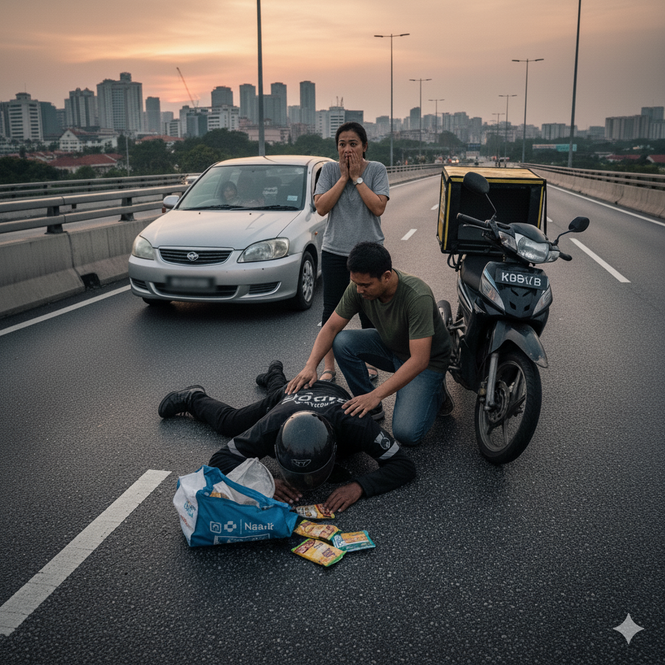
Every accident has two stories — but one choice could prevent it.
Last Saturday evening, as I crossed the overhead bridge from The Gardens to KL Eco City, I saw a small crowd gathered below. Curiosity made me stop and look.
A motorcyclist lay face down on the road, motionless. A packet of food was scattered nearby. His motorbike carrier was open. Most likely delivery rider. A couple stood next to him — the husband bent down to check on the rider, while his wife stood frozen, visibly shaken. In the car, a child peered out the back window.
For minutes, nothing happened until a passing driver stopped, a woman came out and started making calls for help. Another driver stopped, and a man joined in to help. Eventually, the rider stirred slightly, but the image stayed with me long after I left — the food orders wasted, the evening ruined, and the lives of all involved suddenly altered.
For the delivery rider, this accident may mean lost wages for days, maybe weeks. If his family depends on daily earnings, what happens to them tonight, or tomorrow? For the couple, what began as a happy outing with their child now turns into hours at the police station and hospital, their joy replaced by trauma and uncertainty.
In moments like this, the question is not just whose fault it was. The deeper question is - could either of them have done something to prevent it?
The Law vs. Us
Whenever a serious road accident occurs, the debate quickly turns to enforcement. Should the police impose stricter speed limits? Should motorcyclists be regulated differently? Should road design be improved?
These are all valid points. Some roads do invite accidents, and the police regularly run operations to catch speeding or reckless drivers, especially during festive rush periods. The laws exist — and they are enforced.
Yet the question remains, do we, as road users, actually respect these laws? Some argue that offering a 50% discount on summonses is counterproductive. Others see it as a reflection of our own indifference — that we treat road laws and summonses lightly. This attitude is reflected in the fact that in November 2024 there was a staggering 43.5 million outstanding traffic summonses issued by PDRM between 1990 and September 2023. These summonses were worth RM6.5 billion.
Which brings me back to the question: is road safety about the law, or is it really about us — the drivers and riders behind the wheel?
The Real Danger: Inattentional Blindness
Most of us like to think we are careful drivers. But accidents often happen not because we lack knowledge of the law, but because we are mentally absent. Psychologists call this inattentional blindness — the failure to notice what is right in front of us because our mind is elsewhere.
- Driving on autopilot. We arrive at our destination with no memory of the journey. Our hands and feet are moving, but our minds are elsewhere, chit-chatting or worse, meddling with phones.
- Driving against time. Always rushing, we weave through traffic, cut queues, speed, or beat the light to “recover” lost time or save time. We are no longer present, just desperate to get there quicker.
- Driving under emotion. Anger, stress, or frustration turn us into aggressive drivers who forget safety altogether. Mind focused on our emotion instead.
- Driving with ego. Another car overtakes us or the car in front slows us down, and we feel challenged. Suddenly, it becomes a race. Caution disappears as our mind focus on the perceived being one up from the other driver.
We have all driven under these conditions at some point. The danger comes when this becomes our habit. In these moments, no law, no police, no dashcam can save us. The only safeguard is our own awareness.
The Choice is Ours
Road safety doesn’t start with laws. Laws only punish after the fact. Safety starts long before that. It starts every time we choose to focus, to control our emotions, to let go of our ego, and to be fully present behind the wheel.
Yes, enforcement matters. The recalcitrant few must be dealt with. But for the vast majority of us, safety lies not in summonses or roadblocks, but in our daily choices.
Every time we drive or ride, the question is simple: will we be present, or will we endanger ourselves and others?
Because by the time law enforcement steps in, it is already too late.
Coco Nut (anitadharam@yahoo.com) is a content creator under the Newswav Creator programme, where you get to express yourself, be a citizen journalist, and at the same time monetize your content & reach millions of users on Newswav. Log in to creator.newswav.com and become a Newswav Creator now!
The User Content (as defined on Newswav Terms of Use) above including the views expressed and media (pictures, videos, citations etc) were submitted & posted by the author. Newswav is solely an aggregation platform that hosts the User Content. If you have any questions about the content, copyright or other issues of the work, please contact creator@newswav.com.


