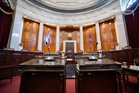
WHEN the Supreme Court declares major budget provisions unconstitutional, the question is no longer simply who inserted the billions, but who approved them, who controlled their release and who must answer to the Filipino people.
The Supreme Court has delivered a constitutional bombshell that should reverberate through Malacañang, Congress and the entire government bureaucracy. In a landmark decision promulgated on Oct. 7, 2026, and publicly announced on Oct. 20, the high court declared major appropriations and provisions in the national budgets of 2024, 2025 and 2026 unconstitutional — all enacted under President Ferdinand Marcos Jr.
The figures are staggering: P449.5 billion in unconstitutional congressional increases to unprogrammed appropriations in 2024; another P17.99 billion added to the Department of Public Works and Highways (DPWH) Special Road Fund in 2025; and unconstitutional provisions governing unprogrammed appropriations in the 2026 budget.
That is approximately P467.49 billion in unconstitutional congressional increases across the 2024 and 2025 budgets alone. Supreme Court findings expose something profoundly troubling: serious constitutional defects in the management of public appropriations involving hundreds of billions of pesos.
And here lies the politically uncomfortable question: How did such massive unconstitutional budgetary arrangements pass through Congress, receive presidential approval and become part of the government’s spending framework? More importantly, where does President Marcos’ accountability begin?
A constitutional violation
The Supreme Court’s ruling, penned by Senior Associate Justice Marvic M.V.F. Leonen, rests on a fundamental constitutional principle: Congress cannot increase the total appropriations recommended by the president.
Article VI, Section 25(1) of the 1987 Constitution establishes that limitation. Yet the court found that the bicameral conference committee (BCC) increased unprogrammed appropriations in the 2024 budget by P449.5 billion, effectively exceeding the president’s recommended spending ceiling.
Even more revealing was the court’s description of how allocations were manipulated. According to the ruling, transferring certain projects from programmed to unprogrammed appropriations created artificial fiscal space, enabling additional allocations for infrastructure and social assistance programs. The court also identified deficiencies in the transparency of BCC proceedings, including the absence of records explaining significant budgetary changes. Imagine hundreds of billions of pesos in budgetary adjustments, yet inadequate documentation explaining how certain decisions were reached.
But the constitutional concerns extend beyond congressional increases. The Supreme Court also identified the Strengthening Assistance for Government Infrastructure and Social Programs (Sagip) mechanism as an unconstitutional lump-sum arrangement that gave the executive authority to identify and allocate projects after enactment. The court described Sagip as a covert repository for lump-sum allocations involving DPWH infrastructure, including flood control projects. This finding is particularly significant given allegations and investigations concerning irregularities in public infrastructure spending.
Marcos’ accountability
Here is where presidential accountability becomes unavoidable. The national budget does not become law through congressional action alone. It passes through the president, who possesses constitutional review and veto powers.
Marcos signed the 2024 and 2025 national budgets. Indeed, when he signed the 2025 General Appropriations Act on Dec. 30, 2024, Malacañang proudly announced that the budget had undergone extensive scrutiny. The president vetoed approximately P194 billion in appropriations, including allocations under DPWH and unprogrammed appropriations. He publicly emphasized his administration’s responsibility as steward of taxpayers’ money. The Department of Budget and Management (DBM) even defended the constitutionality of the enacted budget.
Now comes the uncomfortable contradiction. If the executive conducted such an exhaustive examination, how did unconstitutional appropriations survive that process? Did presidential advisers overlook the constitutional problems? Did the DBM fail to recognize them? Were the disputed provisions considered legally defensible? Or did political and legislative compromises prevail over constitutional caution? These questions require documentary answers, not political speculation.
Presidential approval does not automatically establish criminal liability. However, neither does congressional authorship absolve the executive of responsibility for its own review and implementation.
A president cannot claim credit for signing a national budget while treating every subsequent constitutional defect as exclusively somebody else’s problem. That would be a remarkably convenient interpretation of accountability.
The bicameral committee
Congressional responsibility is equally substantial. The constitutional power of the purse belongs to Congress, but that power is neither unlimited nor exempt from transparency requirements. The Supreme Court’s findings concerning the BCC demand particular scrutiny.
Who proposed the questionable increases? Who negotiated them? Who approved the realignments? What explanations were provided? And why were significant adjustments inadequately documented?
The House leadership under then-speaker Martin Romualdez, Senate leaders, participating legislators and officials involved in budget deliberations all face legitimate questions about their respective roles.
This is especially important because the budget is more than an accounting document. It determines the distribution of national resources, creates opportunities for public procurement and establishes priorities affecting millions of Filipinos.
When appropriations become opaque, public accountability weakens. And when opaque appropriations involve substantial infrastructure funding, the risks become particularly consequential. The court’s findings therefore demand an examination of the entire budgetary chain: from legislative insertion and approval to presidential review, fund release, project implementation and final disbursement.
Conclusion
The larger significance of the Supreme Court ruling extends beyond Marcos, Romualdez, Congress or any single department. It concerns the credibility of Philippine public financial governance. Every peso appropriated represents public resources, taxpayers’ money, that could otherwise support hospitals, schools, agricultural development, disaster preparedness or essential infrastructure.
When hundreds of billions of pesos get entangled in unconstitutional budgetary arrangements, public trust suffers whether later investigations establish criminal wrongdoing. And Filipinos deserve more than another round of congressional hearings featuring familiar speeches, carefully rehearsed expressions of outrage and predictable promises of investigation. They deserve a comprehensive public accounting of public funds/taxpayers’ money.
The Supreme Court has established constitutional violations; relevant investigative agencies must determine whether specific transactions also involved corruption, fraud or abuse of authority. One finding cannot simply be substituted for the other.
Marcos has repeatedly invoked good governance, transparency and accountability as principles of his administration. Now, the Supreme Court ruling creates an opportunity, a serious obligation to demonstrate those principles in practice.
A credible response would include full disclosure of relevant budget records, a comprehensive accounting of affected appropriations, cooperation with independent investigations and reforms preventing similar constitutional violations. Anything less invites further questions about whether accountability is being applied consistently.
The central issue is not whether Marcos personally drafted every disputed allocation. Nevertheless, he signed the budgets. His administration implemented the spending framework. The executive exercised powers that the Supreme Court has now subjected to important constitutional limitations. Those facts demand explanation and scrutiny.
The Supreme Court has spoken on the constitutional defects. The government must now account for the public funds, explain the decisions and determine individual responsibility through proper legal processes. This is now an opportunity to open the books.
After all, good governance is not measured by how frequently politicians pronounce the word ”accountability.” It is measured by whether they accept scrutiny when accountability finally reaches their own doorstep. This time, Mr. President, constitutional questions are knocking at Malacañang’s door.