.jpg)
By Mihar Dias April 2025
As the final days before Hari Raya approach, Alor Setar welcomes home its returning sons and daughters.
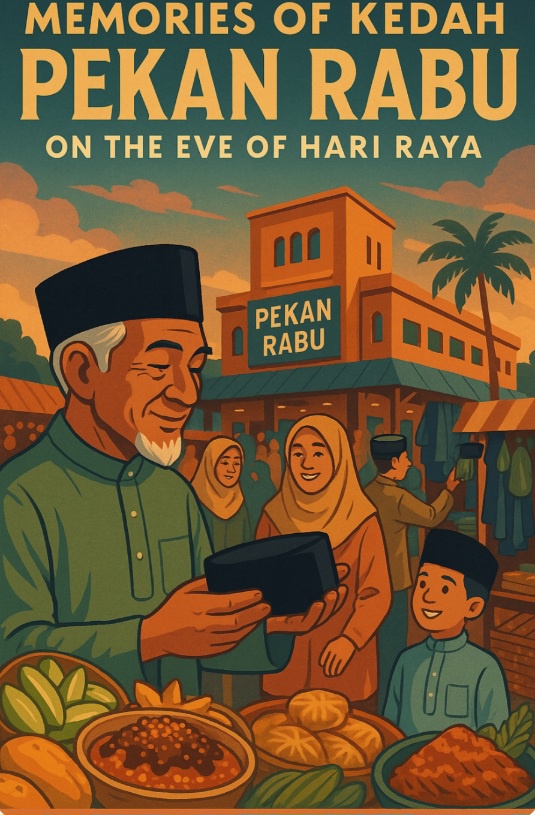
The town takes on a festive air, and no pre-Raya ritual is complete without a visit to Pekan Rabu.
Every Kedahan knows this iconic market is the place to find everything needed for the celebration. The roads leading there become a sea of honking cars, packed bumper to bumper, as people navigate the jam with unwavering determination.
Inside, the market bustles with life. Traditional kuih, songkok, and beautifully tailored baju Melayu are all within reach.
Speaking of baju Melayu, no tailor was more revered than Pak Man, famously patronized by Tun Mahathir himself. Pak Man’s work was legendary, but don’t bother seeking his services at the last minute—his name, "Man Man," means "slowly, slowly" in Hokkien. He believed in taking his time, even for the former Prime Minister. "Be patient," he would say, “slow and steady, it will be ready—no worries.”
The songkok man was no different. My father, knowing my ever-growing head, would take me to get measured for a new songkok at the start of the month.
Shoes, however, were a different struggle. My large feet meant endless shop-hopping, often ending in disappointment. Sometimes, we had to cross state lines to Penang, hunting for sizes meant for European or Australian soldiers stationed there.
For years, the search for shoes and a well-fitted songkok haunted my childhood Hari Raya preparations.
Back at Pekan Rabu, returning Kedahans stocked up on local delights. Among the prized purchases was kuah rojak—thick, rich, and distinctly Kedahan, much like how a kimchi connoisseur treasures the nuances of their craft.
The perfect pairing? A medley of sour green mangoes, jambu batu, carambola, papaya, and other crunchy fruits, all sliced and drenched in that heavenly sauce before being sprinkled with ground peanuts. The burst of flavors was simply unmatched.
Another delicacy that held a special place on our tables was fermented freshwater fish—usually sepat—caught straight from the padi fields. Deep-fried to a golden crisp, it paired exquisitely with steaming glutinous rice and freshly grated coconut.
Once a high-energy staple for farmers, this dish has become a beloved culinary tradition for generations of Kedahans.
Sweet treats were equally abundant. Karas, a crisp, golden snack resembling the Turkish kunafa—minus the cheese and honey—was a must-have. Kuih loyang, peneram, putu kacang, and an array of other traditional sweets, many exclusive to Kedah and Pekan Rabu, filled the air with nostalgic aromas.
The pungent scent of preserved fruits, fish, and meats transported me back to simpler days when my biggest worry was whether my oversized songkok would attract curious glances at Masjid Zahir during prayers.
For me, no trip home is complete without Pekan Rabu. It is more than just a market; it is a pilgrimage of taste, scent, and memory.
No matter how far Kedahans travel, they return, year after year, to relive the magic of this bustling haven of flavours. And yet, despite its name—"Wednesday Market"—few of us ever questioned why it was called that. In Alor Setar, tradition is taken as it is—no explanations needed.
Mihar Dias is a content creator under the Newswav Creator programme, where you get to express yourself, be a citizen journalist, and at the same time monetize your content & reach millions of users on Newswav. Log in to creator.newswav.com and become a Newswav Creator now!
The User Content (as defined on Newswav Terms of Use) above including the views expressed and media (pictures, videos, citations etc) were submitted & posted by the author. Newswav is solely an aggregation platform that hosts the User Content. If you have any questions about the content, copyright or other issues of the work, please contact Newswav.





