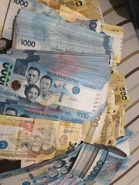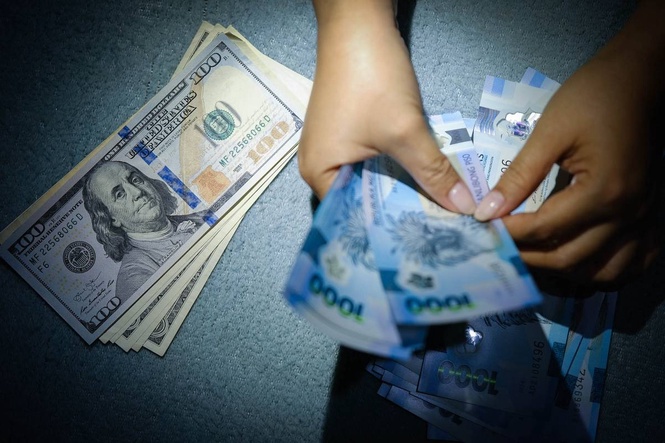
THE Philippine peso sank to a new record low of P62.86 against the greenback on Monday, weakening by another 18 centavos from Friday’s record low of P62.28:$1, while local stocks staged a modest recovery.
Analysts said continued demand for the US dollar contributed to the peso’s persistent weakness.
The local currency opened at P62.75:$1 and ranged from P62.75 to P62.875. Trading volume dropped to $969.22 million from $1.138 billion in the previous session.
One trader said the peso remained under pressure amid a “strong dollar, elevated oil prices and continued local demand for dollars.”
“P63 is clearly within striking distance,” the trader, who asked not to be named, said. “But touching P63 is different from staying there.”
“At these levels, the [Bangko Sentral ng Pilipinas] is likely to be increasingly watchful of any disorderly move, so the bigger question is whether P63 becomes a new trading range or simply another level the market tests,” the trader added.
Meanwhile, local stocks recovered on Monday as investors returned to select stocks after two consecutive sessions of losses, taking encouragement from the Bangko Sentral ng Pilipinas’ indication that it could ease monetary policy if the pace of inflation slows earlier than expected.
The benchmark Philippine Stock Exchange index (PSEi) rose 13.26 points, or 0.22 percent, to 6,075.07, with bargain hunting helping lift the market from its recent lows.
Luis Limlingan, head of sales at Regina Capital Development Corp., said investors took advantage of lower prices after the market’s two-day decline.
“The local bourse edged higher after two consecutive sessions in the red, as investors engaged in bargain hunting following the BSP’s indication that it could begin easing monetary policy if inflation declines faster than expected,” Limlingan said.
The recovery, however, remained modest as the continuing US-Iran conflict kept investors cautious and limited risk appetite.
“However, gains remained limited as the ongoing US-Iran conflict weighed on investor sentiment and encouraged more cautious positioning,” Limlingan said.
Michael Ricafort, chief economist at Rizal Commercial Banking Corp., said the PSEi also benefited from expectations of stronger domestic economic activity, citing the planned P60 daily minimum wage increase for Metro Manila workers effective Sept. 26 and the resumption of bidding for infrastructure projects.
He also pointed to market interest ahead of the planned initial public offering of Mynt, parent of e-wallet GCash, in October.
Foreign investors turned net buyers, with the market recording net foreign buying of about $0.6 million on Monday, compared with $15.9 million in net foreign selling in the previous session, Ricafort said.
US equities also provided some support after major US stock indexes recovered by around 0.9 percent to 1 percent, although investors continued to price in possible Federal Reserve rate hikes ahead.
Trading remained selective, with 96 gainers, 95 decliners and 66 stocks unchanged at the end of the session, while total turnover reached P4.90 billion, net of extraordinary block sales.
All sectoral indices gained except industrials, which fell 0.31 percent.
Mining and oil led the advance, rising 0.38 percent, followed by services, up by 0.36 percent. Financials and holding firms both gained 0.26 percent, while property stocks edged up 0.11 percent.
Ricafort said the PSEi was also supported by the end of the traditional ghost month on Sept. 10 and recent affirmations of the Philippines’ credit ratings by Japan Credit Rating Agency, Moody’s Ratings and Rating and Investment Information.
“Overall, market participants remained selective amid lingering geopolitical uncertainty and concerns over economic growth,” Limlingan said.