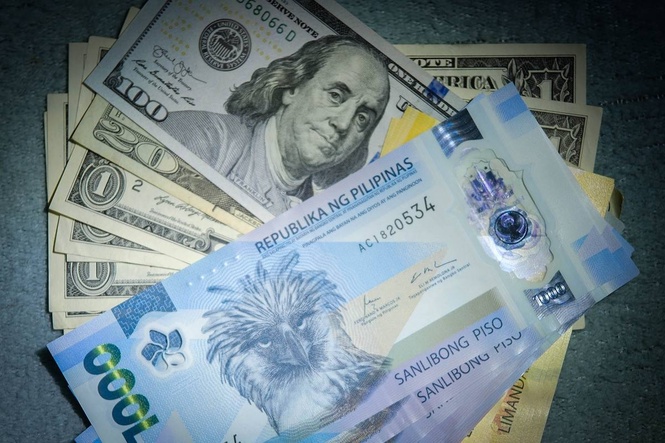
THE peso breached the P64:$1 level on Tuesday amid market’s adverse reaction to the central bank’s aggressive surprise rate hike last week.
The peso weakened by 22 centavos to close at P64.17 from the previous record low of P63.95:$1. This marks the sixth consecutive trading day that the peso has hit a record low.
The peso’s depreciation stoked concerns that power and fuel would cost more, triggering more increases in commodity prices.
The Palace acknowledged this on Tuesday, saying the government has instituted several interventions to lower the prices of commodities.
Presidential Communications Office (PCO) Undersecretary Claire Castro said the ongoing geopolitical conflict in the Middle East "keeps crude oil prices high and the dollar-to-peso exchange rate volatile." "This is not what the president wanted. This is not what the government wanted. Who would ever want a crisis, war, or conflict in the Middle East?" Castro said.
"Since we import our crude oil from there, it has a massive impact on our products because it creates a domino effect," she said.
Downward trend
The peso opened at P63.95 and traded between P63.9 and P64.2:$1. The volume reached P1.726 billion, higher than the previous P1.648 billion.
Chinabank economist Domini Velasquez said the peso has been depreciating further despite the jumbo rate hike announced by the Bangko Sentral ng Pilipinas (BSP) last week.
Velasquez said a similar episode occurred two months earlier, when the peso also weakened to a record low following a rate increase.
“This reinforces our view that rate hikes alone may not be enough to reverse the peso’s depreciation,” Velasquez said.
“Ultimately, the key question is how quickly the Philippine economy can recover amid heightened uncertainty,” she added.
The BSP policymaking body Monetary Board raised key policy rates by 50 basis points last week, bringing rates to a higher 5.5 percent.
The central bank told The Manila Times in a Viber message that they continue to monitor the foreign exchange market.
“We intervene to smooth extreme volatility, especially when these can accelerate inflation, in line with our primary mandate of price stability,” the BSP said, adding they also intervene to address disorderly market conditions.
“The BSP has ample reserves to support these actions,” it added.
Data from the central bank showed that gross international reserves (GIR) dropped to $99.99 billion as of end-September amid efforts to smooth out peso volatility. This was markedly lower than the $104.85 billion and $109.06 billion recorded a month and year earlier.
This is the lowest reserves recorded since September 2023’s $98.12 billion.
The peso has been depreciating since the Middle East war began in March, breaching the P60-per-dollar level during the period.
Compared to Oct. 27 of last year, the currency had weakened by P5.27, or 8.9 percent, from its P58.90:$1 level.
To date, the peso has depreciated by P5.38 or 9.15 percent, from its P58.79:$1 close on Dec. 29, 2025.
Metrobank economist Nicholas Antonio Mapa said the pass through of forex depreciation to inflation was measured by the central bank at 0.04 percentage point for every peso depreciation.
“So the sharp move in reaction to the surprise overly aggressive tightening may be viewed as inflationary given how quickly spot increased in reaction to the meeting,” Mapa said.
“Market is aware that aggressive tightening cannot stop inflation and now remains focused on likely weaker growth prospects,” he added.
Velasquez also said pressure on the currency is likely to persist, with October and November inflation potentially approaching 8 percent and the third quarter growth possibly falling below 3 percent.
Consumer price growth accelerated to 7.2 percent in September and the central bank has already said this could go higher amid local and global uncertainties.
“Financial markets could also remain volatile in early November as investors assess incoming economic data and the outlook for economic recovery,” she said.
Velasquez also argued that seasonal dollar inflows, particularly remittances in November and December, could provide some support for the peso.
However, she said that uncertainty over the pace of economic recovery appears to be offsetting the seasonal support from remittances.
“If the peso remains near P64.00 per dollar, it could recover modestly to around P63.00 by year-end, although downside risks remain,” Velasquez said.
Power rates to rise
Energy Secretary Sharon Garin on Tuesday said the peso’s depreciation could cause electricity rates to go higher as most fuels being used by major distribution utilities are bought using dollars.
"Indirectly, this development will affect electricity rates and make them go up because we buy coal, diesel, and LNG with dollars, and P64 is really one of the highest we have right now. So it will impact the rate of electricity because it is a pass-through charge," Garin said in a media interview at the Singapore International Energy Week event.
She said that the DOE intends to have a meeting with the Energy Regulatory Commission (ERC) on how they can ease the impact of the development.
She said all stakeholders must work together as the country is beset by global, economic, and climate pressures.
"We have the oil crisis, we have this currency devaluation, we also have the El Niño and coming summer as well. We have to try to work it out like as much as possible and minimize the overall impact," Garin said.
Supply is priority
Castro said President Ferdinand Marcos Jr. has ordered concerned agencies that "no matter what happens, even if the price of fuel rises, we must always have a supply." That is the primary directive to the Energy secretary "because even if the price of fuel or crude oil is low, it means nothing if you have no supply," Castro said in Filipino.
"It is harder to live and harder for the economy to move if we do not have crude oil," Castro said.
"There is also the fuel subsidy for our drivers and operators. So, a lot of assistance is currently being implemented," the PCO official said.