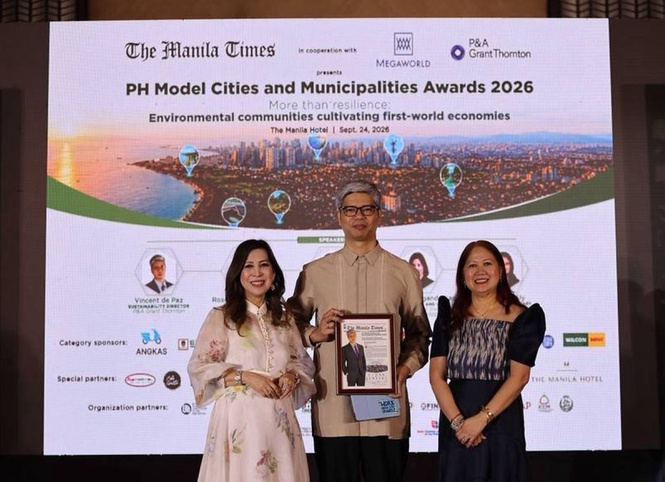
WHAT began in 2017 as a pioneering initiative to champion livable urban design reached new heights at the 2026 Philippine Model Cities and Municipalities Awards bestowed by The Manila Times last Sept. 24. Centered on the theme of “More than Resilience: Environmental Communities Cultivating First World Economies,” this year’s awards program saw a record number of entries from 65 local government units (LGUs) competing in 15 categories.
Showcasing how sustainable planning, digital innovation and inclusive social initiatives drive regional growth, the TMT awards continue to demonstrate that green urban development is the blueprint for economic progress and not merely an alternative. A city or municipality does not become a model because of its size or growing economy, but because of how effectively it turns limited resources, investments and good policies into better jobs, services and living conditions for its constituents.
The awards cover infrastructure, business, education, disaster management, food security, information technology, tourism and sustainability. Taken together, the results show that effective local governance is about excelling in various areas, delivering better services and making communities better places for work-life balance.
In the overall cities division, the TMT Top Model City Award went to Calamba City in Laguna for the third time following its previous wins in 2023 and 2025. This may be attributed to its seamless integration of green urban development, economic vitality and stable governance. It also took top honors in the Sustainability Champion category for its integrated green city plan.
For the overall municipalities division, the town of Bacnotan in La Union achieved the TMT Top Municipality Award again. Winning for the second time since 2024, it posted high scores across the board, particularly for its eco-friendly governance and long-term environmental protection initiatives, including coastal management, community sanitation and urban greening.
A new award was introduced this year: the Mega City Special Award, which was created to address a distinct gap in evaluating rapidly urbanizing component cities against traditional sustainability metrics. It was conferred on the City of General Trias in Cavite as a major industrial hub with extensive residential townships.
From recognizing early trailblazers such as Bacolod City in Negros Occidental and Liloan municipality in Cebu to the current powerhouses of San Fernando City in Pampanga, the Island Garden City of Samal in Davao del Norte and the town of Guiuan in Eastern Samar, the TMT awards show how governance translates into tangible benefits for communities. The winners’ experiences offer valuable lessons on how LGUs can shape economic growth and community development.
Navigating energy and climate shocks
Every quarter, the Asian Development Bank (ADB) publishes its flagship economic publication called the Asian Development Outlook (ADO), providing assessments of growth, inflation and development prospects across Asia and the Pacific. Its September 2026 report titled “Navigating Prolonged Energy Shocks and El Niño” was released last week during a briefing at the ADB headquarters in Ortigas Center, Mandaluyong City.
Highlighting the resilience of Asian economies despite global geopolitical tensions and disruptions in energy markets, the report also assesses the potential effects of a strong El Niño phenomenon this year — especially on agricultural production, food prices and vulnerable communities. The outlook underscores the importance of prudent macroeconomic management and stronger policies that can sustain inclusive growth amid persistent uncertainty.
ADB lowered its 2026 growth forecast for the Philippines to 3.7 percent from its projection of 3.8 percent last July, while at the same time retaining the projected 5.3-percent growth for 2027. The downgrade for this year reflects weaker domestic demand, delayed investments, higher energy and commodity costs, as well as climate-related risks.
Another concern is inflation, as the country faces stronger price pressures from elevated energy prices that feed into food and transport costs — compounded by climate disruptions associated with El Niño. According to the latest ADO, these pressures could constrain household consumption and complicate monetary policy decisions.
Nevertheless, ADB sees underlying resilience in the Philippine economy due to support from the manufacturing and services sectors. Government spending and investment remain important growth drivers over the next two years.
Meanwhile, the broader Southeast Asian economy is projected to perform better — with regional growth upgraded to 4.7 percent in 2026 and 4.9 percent in 2027. Therefore, the challenge for the country’s economic managers is to restore stronger domestic demand while managing inflation, climate risks, delayed investment and energy vulnerability.
The author is The Manila Times Sustainability Magazine’s executive editor. He is a member of the Finex Foundation’s Environment Committee and its Sustainability Handbook’s Editorial Board.