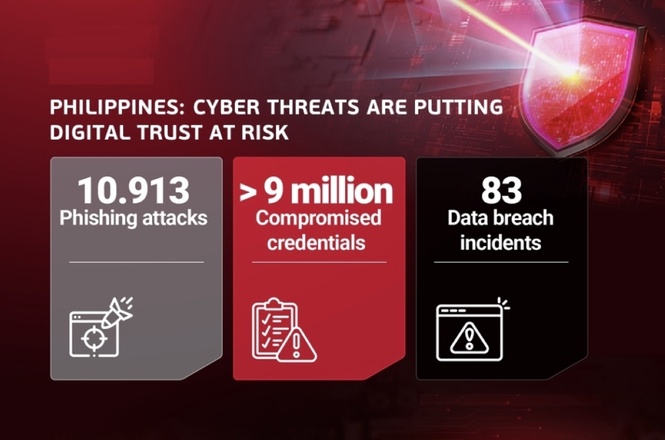
MORE than 9 million credentials linked to Philippine users were compromised in the third quarter of 2026, as phishing attacks, data breaches and ransomware incidents increased, exposing government agencies, financial institutions and private businesses to growing cybersecurity risks.
The Cyber Threat Landscape in the Philippines Q3 2026 report by Viettel Threat Intelligence recorded 9,032,508 compromised credentials from July to September, more than double the 4.32 million recorded in the same period last year. The figure was also slightly higher than the 8.86 million compromised credentials reported in the second quarter.
The report counted 10,913 phishing attacks and 83 data breach incidents during the quarter, with more than 85.9 million records exposed. Ransomware attacks rose to 19 from five in the third quarter of 2025, indicating a sharp increase in threats against organizations across several industries.
The findings point to the growing commercialization of stolen credentials and the increasing ability of cybercriminals to use compromised accounts as entry points into corporate and government networks.
“Attackers today don’t need to break in when they can simply log in. With more than 9 million Philippine credentials compromised in a single quarter, a stolen password has become one of the cheapest ways into a company’s network,” said Thomas Luu, country manager of Viettel Cyber Security.
“The real question for business leaders is no longer whether their accounts have been exposed, but whether they would notice when someone else starts using them,” he said.
Government, financial institutions among top targetsGovernment entities accounted for 41 percent, or 34, of the 83 data breach incidents recorded in the Philippines during the quarter. This was higher than the 30 percent share recorded in the first half of 2026.
The banking, financial services and insurance sector followed with 19 percent, or 16 incidents, while consumer services accounted for 16 percent, or 13 incidents. The remaining incidents affected education, healthcare, technology, retail, services and logistics, among other sectors.
The report said government breaches were driven by credential leaks from agency portals and intrusions involving national agencies and local government units.
Several incidents exposed large volumes of sensitive information. Six online lending platforms suffered breaches involving approximately 32 million records, including names, contact details, addresses, identification information and account data.
An incident affecting the transportation sector exposed 16 million records, including franchise and operator information and personal data from multiple systems and databases.
Separate attacks against public institutions and healthcare facilities exposed identity documents and internal information. One public-sector incident involved 103.2 gigabytes of breached data, including more than 140,000 scanned passports and identification documents. A hospital-related attack compromised 2.44 gigabytes of internal data covering more than 3.5 million files.
The report said the consequences of such intrusions extend beyond the exposure of personal information. Stolen credentials and access to internal systems can enable account takeovers, business email compromise, further data theft and ransomware attacks.
Phishing, ransomware incidents increasePhishing attacks reached 10,913 in the third quarter, a 43 percent increase from the 7,656 recorded in the same period last year.
The financial sector accounted for 29 percent of recorded phishing attacks, followed by government impersonation at 24 percent and social media-related threats at 16 percent. Online services and e-commerce each represented 10 percent.
Cybercriminals increasingly used artificial intelligence-generated images and videos to impersonate public figures, government officials and cybersecurity authorities. The report also identified romance scams, fraudulent fund-recovery services, cross-border card fraud and phishing distributed through social media, SMS and messaging platforms.
It warned that attackers were adopting coordinated, multichannel approaches, including fake government social media accounts and SMS campaigns using devices designed to impersonate mobile network infrastructure.
Ransomware incidents nearly quadrupled year on year, increasing from five in the third quarter of 2025 to 19 in the latest reporting period.
Manufacturing and transportation each recorded three incidents, while hospitality and tourism, business services, healthcare and financial services were also affected. Other incidents involved logistics, real estate, professional services, government and defense.
The report said ransomware groups continued to use double extortion, stealing data before encrypting systems and threatening to disclose the information to pressure victims into paying.
Stolen credentials fuel further attacksThe report identified the growing commercialization of credential theft as a major factor behind the increase in cyber risks.
Through the Stealer-as-a-Service model, criminals can rent information-stealing tools without developing their own malware. Compromised credentials are then traded through underground markets and messaging channels, making them available for subsequent attacks.
The volume of compromised credentials linked to Philippine users exceeded 28.3 million in the first nine months of 2026, nearly three times the 9.74 million recorded throughout 2025.
Viettel Threat Intelligence also documented a case in which a hacktivist group claimed to have maintained access to a government agency’s Active Directory environment for more than a month before compromising a domain controller.
The report warned that privileged accounts, particularly internal administrator, virtual private network and single sign-on accounts, pose significant risks. Access to one central account can allow attackers to move across connected systems and potentially reach sensitive information and critical infrastructure.
Vulnerabilities and AI-assisted attacksThe report recorded 34,223 newly disclosed vulnerabilities in the third quarter, approximately 195 percent more than the 9,277 recorded in the same period in 2025. Critical- and high-severity vulnerabilities accounted for nearly 60 percent of the total.
Viettel Threat Intelligence said the increase may partly reflect the wider use of artificial intelligence-assisted tools for source code review and vulnerability discovery, which can reduce detection time and improve research productivity.
However, actual attacks continued to exploit older vulnerabilities in widely used enterprise software and infrastructure. These included Log4Shell in Apache Log4j, vulnerabilities affecting Fortinet FortiNAC, SolarWinds Orion, Atlassian Confluence and F5 BIG-IP devices.
The report also identified growing AI use among advanced persistent threat groups, which employ the technology for reconnaissance, infrastructure development, phishing, malware modification and data collection.
Organizations urged to strengthen defensesViettel Threat Intelligence recommended stronger account protection, continuous monitoring, timely software updates, regular data backups and improved incident response capabilities.
It also urged organizations to apply zero-trust security principles, restrict privileged access, monitor unusual account activity and adopt phishing-resistant multifactor authentication.
“Going into 2027, the businesses that stay ahead will be those that treat cybersecurity as a leadership priority reviewed regularly, not an IT problem fixed after an incident,” Luu said.
“Knowing where you are exposed before attackers do is now a basic business requirement,” he added.
The report also recommended regular cybersecurity awareness training, third-party risk assessments and stronger controls over internal data access. Organizations using artificial intelligence systems were advised to implement safeguards against prompt injection and restrict access to sensitive information in retrieval-augmented generation systems.