The European Union and the Philippines said Tuesday that the two sides made a “breakthrough” in their talks on a long-awaited free trade deal.
Brussels and the Philippines “reached substantial agreement on a Free Trade Agreement (FTA), marking a significant milestone for both sides,” EU trade chief Maros Sefcovic and Philippine Trade Secretary Cristina Roque said in a statement.
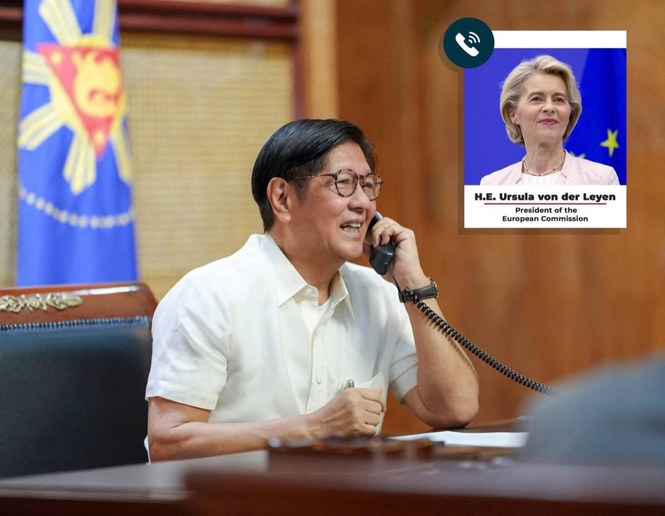
They made the announcement after a video call, “setting the deal on a clear path towards its formal conclusion in the coming months.”
The EU and the Philippines began the negotiations for a free trade agreement in 2016 but they stalled just a year later, before resuming again in March 2024.
The arrival of US President Donald Trump in 2025 and his tariff blitz jolted the 27-country bloc into cultivating trade ties around the world.
Brussels has since signed deals from South America to Australia, and is seeking more agreements.
The EU remains among the Philippines’ most important trading partners, with annual bilateral trade exceeding €17 billion.
The historic accomplishment makes the Philippines the fourth Asean country after Singapore, Vietnam, Indonesia to reach a bilateral free trade agreement with the EU.
The FTA is expected to formally conclude in the following months.
The agreement is expected to bring in investments, generate new opportunities, and create jobs. It is also anticipated to promote shared sustainable development and digital and clean transition goals.
European Chamber of Commerce of the Philippines (ECCP) and the Philippine Chamber of Commerce and Industry (PCCI) welcomed the development.
In a statement, the ECCP said the agreement marks a significant turning point in the economic partnership between the Philippines and the EU.
“For the Philippines, securing this agreement as a pioneer in ASEAN demonstrates our economic resilience and readiness to compete globally,” ECCP President Diana Edralin said.
Aside from tariff reduction, the agreement provides long-term clarity for global supply chains and cross-border expansion, added ECCP Executive Director Florian Gottein.
PCCI President Perry Ferrer noted that the FTA would be especially beneficial for small and medium enterprises looking to expand their presence in the international market.
“The ball is now in the hands of our policymakers. We hope that both the government and the private sector will continue working together to sustain this momentum,” said Ferrer.
“The timely ratification of the agreement will be crucial in unlocking its full benefits and ensuring that Philippine businesses can compete more effectively in the European market,” he added.
Meanwhile, the EU-Asean Business Council urged the Asean and EU to pursue a region-to-region economic framework to commemorate the 50th anniversary of their partnership next year.
EU-ABC Chairman Jens Ruebbert made the appeal during a consultation with Asean Economic Ministers and EU trade officials as part of the 58th Asean Economic Ministers’ Meeting in Manila.
“Making such rapid progress on several bilateral agreements is no doubt an incredible achievement,” said Ruebbert. “It sends a strong signal on the growing strategic importance of Asean to the EU, and the shared political commitment to deepening that economic partnership.”
“We strongly believe a regional deal would provide a competitive edge for European and Southeast Asian companies alike, bringing trade and investment to a level that reflects the scale and strategic importance of the Asean-EU relationship,” he said. With AFP