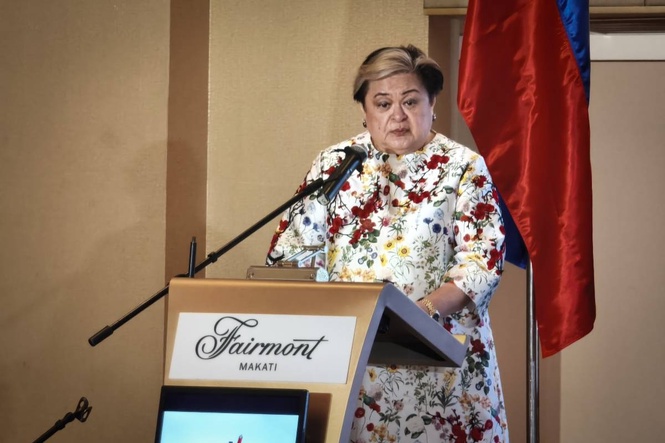
FOREIGN Affairs Secretary Ma. Theresa Lazaro has called for stronger international cooperation to protect critical maritime infrastructure, warning that the security and resilience of such facilities are essential to global commerce, connectivity and economic stability.
Lazaro made the call as she reaffirmed the Philippines’ commitment to multilateral cooperation and to advancing the United Nations Convention on the Law of the Sea (Unclos) and the UN Charter during the Foreign Ministerial Meeting on “Reinforcing Cooperation to Achieve a Secure and Stable Maritime Domain” on Sept. 23, held on the sidelines of the 81st UN General Assembly in New York.
The Philippines co-hosted the meeting with Estonia, the Netherlands, Bahrain, Canada, Japan and the European Union, building on a maritime security meeting convened by Manila during the 80th UN General Assembly last year.
Lazaro emphasized the need to further develop and strengthen international law, particularly in protecting critical maritime infrastructure located beyond national jurisdiction.
She cited the Philippines’ experience in hosting the Experts’ Forum on Critical Maritime Infrastructure in Manila on Sept. 8, saying greater international collaboration was needed to protect maritime infrastructure and ensure freedom of navigation and commerce, global connectivity and resilience.
The Philippines has consistently underscored the importance of Unclos as the legal framework governing the use of the oceans and as a basis for the peaceful settlement of maritime disputes.
Lazaro outlined five pathways proposed by Manila to address emerging maritime security challenges: adopting a comprehensive whole-of-nation approach to resilience; translating high-level diplomatic dialogue into day-to-day operational cooperation; institutionalizing the protection of critical maritime infrastructure within Asean; modernizing multilateral ocean governance anchored on Unclos; and shifting from reactive security measures toward proactive resilience.
“At its core, protecting critical maritime infrastructure is about safeguarding the vital lifelines that sustain our economies, protect our communities, and connect our human family,” Lazaro said.
“As an archipelagic nation situated at the crossroads of the Indo-Pacific, the Philippines lives the maritime reality every single day. We remain profoundly committed to advancing this indispensable agenda shoulder-to-shoulder with all of you,” she added.
The initiative comes as the Philippines continues to promote a rules-based maritime order and greater cooperation in the Indo-Pacific, including efforts to strengthen maritime security, ocean governance and the peaceful resolution of disputes under international law.